Product Design, Manufacturing & Innovation Resources
» トリプルモジュラー冗長性(TMR)

トリプルモジュラー冗長性(TMR)

1950
  • John von Neumann
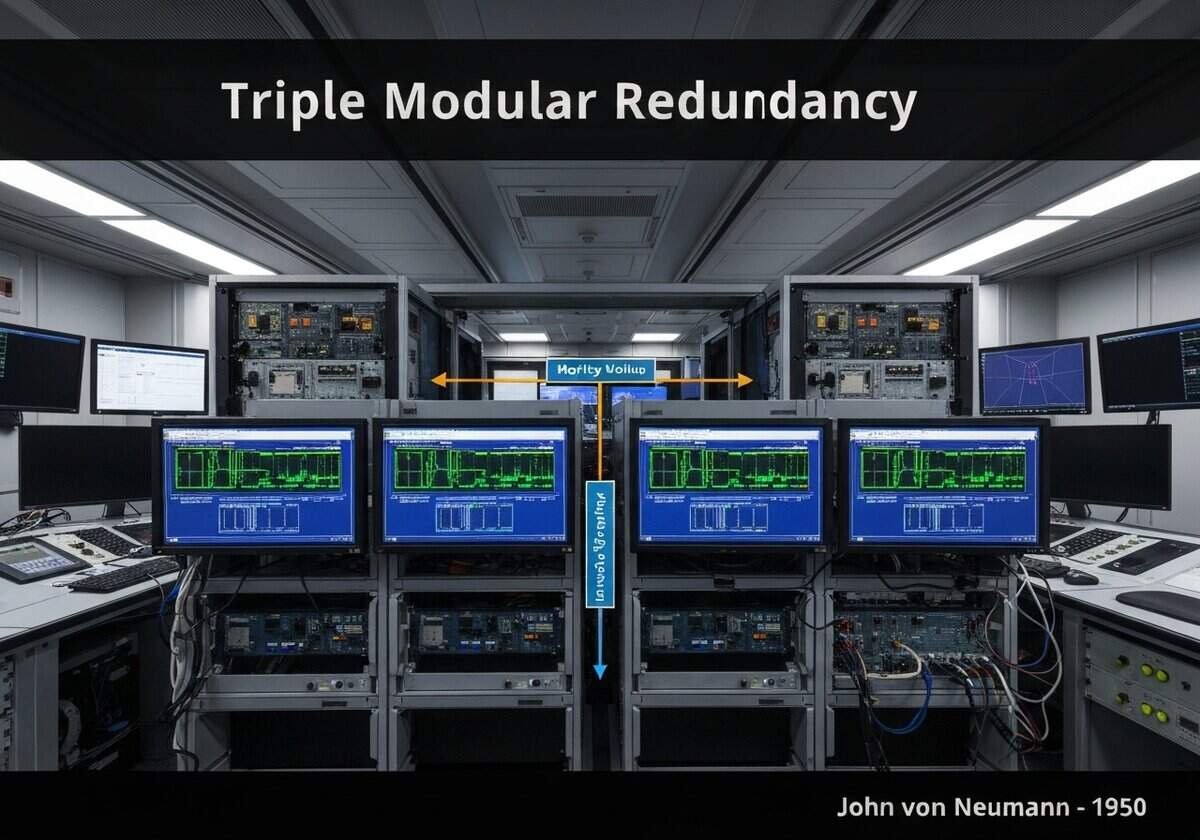
フォールト・トレランスのために3つの並列コンピュータ・モジュールを備えた航空宇宙管制室。.

(画像はイメージです)

TMR(トリプルモジュラー冗長)は、同一のモジュール3つを並列に動作させることで、ハードウェアの耐障害性を実現する技術です。これらのモジュールの出力は多数決回路に入力されます。1つのモジュールが故障して誤った出力を生成した場合でも、他の2つのモジュールに基づいて正しい出力を判定できるため、故障を隠蔽し、継続的な動作を保証します。
トリプルモジュラー冗長(TMR)は、N=3のNモジュラー冗長の典型的な例です。その核心となる考え方は、重要なコンポーネントを3つ複製し、それらすべてが同じ入力を同時に処理することです。これら3つのモジュールからの結果が投票器に渡されます。投票器は多数決関数を実行します。3つの入力のうち少なくとも2つが同じであれば、その値が最終出力として選択されます。このメカニズムにより、いずれかのモジュールに単一の障害が発生した場合でも、効果的にその障害を隠蔽できます。たとえば、モジュールA、B、Cがそれぞれ1、1、0の出力を生成する場合、多数決投票器は1を出力します。

The reliability of the TMR system depends not only on the modules but also on the voter itself. If the voter fails, the entire system fails. Therefore, the voter must be significantly more reliable than the individual modules it is monitoring. In practice, voters are often simpler circuits than the modules they manage, which helps in achieving this higher reliability. The overall system reliability can be modeled mathematically. If the reliability of a single module is [latex]R_m[/latex], the reliability of the TMR system (assuming a perfect voter) is given by the probability that at least two modules work correctly: [latex]R_{TMR} = R_m^3 + 3R_m^2(1-R_m) = 3R_m^2 – 2R_m^3[/latex]. This formula shows that TMR improves reliability only if the individual module reliability [latex]R_m[/latex] is greater than 0.5.

Historically, John von Neumann’s work in the 1950s laid the theoretical groundwork for building reliable systems from unreliable components, which directly led to concepts like TMR. It was first implemented in practice in systems where failure was not an option, such as the Saturn V launch vehicle’s digital computer and early fly-by-wire flight control systems. While TMR increases hardware cost, power consumption, and weight by a factor of more than three (due to the voter), its simplicity and effectiveness in handling single random hardware faults make it a cornerstone of high-availability and safety-critical system design.

UNESCO Nomenclature: 1203
コンピュータサイエンス

タイプ

抽象システム

混乱

実質的な

使用法

広く普及している

前駆物質

  • クロード・シャノンの情報理論とリレー回路に関する研究
  • ジョン・フォン・ノイマンによる、信頼性の低い部品を用いた信頼性の高い計算に関する講義
  • 生物システムにおける冗長性の初期概念
  • 投票の基本原則と多数決の論理

アプリケーション

  • 航空宇宙システム(例:飛行制御コンピュータ)
  • 衛星
  • 原子力発電所の安全システム
  • 耐障害性コンピュータアーキテクチャ

特許:

NA

潜在的なイノベーションのアイデア

ボットによるトラフィック(現在1日あたり4万件以上)を排除するため、このコンテンツはコミュニティメンバー限定となっています。
> ログイン < または > 登録 < (100%無料)でこれにアクセスできます。他のすべての制限付きコンテンツとツールも同様です。

関連キーワード:トリプルモジュラー冗長、TMR、フォールトマスキング、ハードウェア冗長、Nモジュラー冗長、多数決、安全性が重要なシステム、航空宇宙、フォン・ノイマン、信頼性工学。

歴史的背景

トリプルモジュラー冗長性(TMR)

1940
1943
1950
1950
1953
1960
1960
1939
1940
1950
1950
1952
1956
1960
1967

(日付が不明または関連性がない場合、例えば「流体力学」などでは、その注目すべき出現時期の概算値が提示されます。)
関連する発明、革新、および技術原理

フルサイズの画像とダウンロードは、登録会員のみが100%無料で利用できます。