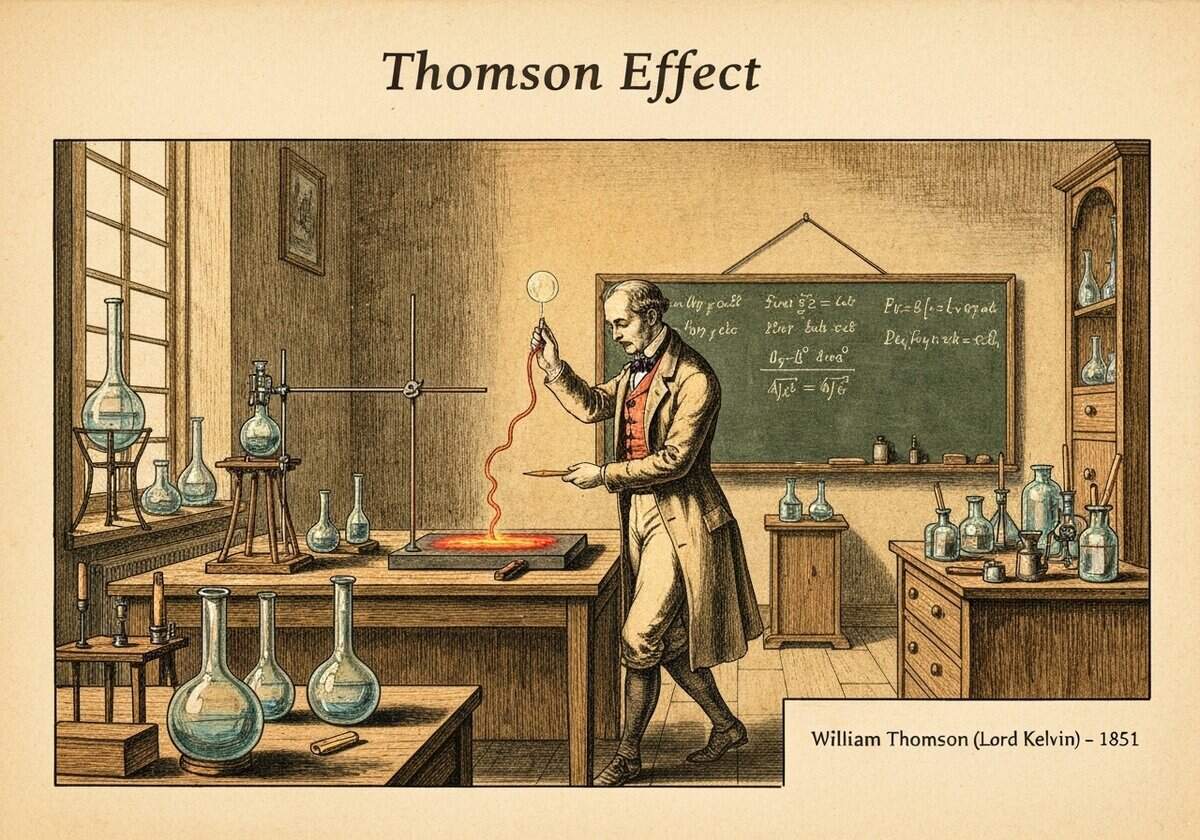
トムソン効果は、電流が流れる導体の長さに沿って温度勾配が存在する場合に、その導体が加熱または冷却される現象を説明するものです。電流が温度勾配のある物質を流れると、熱が発生または吸収されます。単位長さあたりの熱発生率は、[latex]frac{dQ}{dx} = -mathcal{K} J frac{dT}{dx}[/latex]で与えられます。ここで、[latex]mathcal{K}[/latex]はトムソン係数です。


(画像はイメージです)
トムソン効果は、電流が流れる導体の長さに沿って温度勾配が存在する場合に、その導体が加熱または冷却される現象を説明するものです。電流が温度勾配のある物質を流れると、熱が発生または吸収されます。単位長さあたりの熱発生率は、[latex]frac{dQ}{dx} = -mathcal{K} J frac{dT}{dx}[/latex]で与えられます。ここで、[latex]mathcal{K}[/latex]はトムソン係数です。

The Thomson effect arises because the Seebeck coefficient of a material is generally dependent on temperature. As charge carriers move along a conductor from a hot region to a cold region (or vice versa), their average energy changes not only due to the temperature but also due to the changing Seebeck coefficient. When an electric current (J) flows through a conductor with a temperature gradient ([latex]frac{dT}{dx}[/latex]), this effect becomes apparent.
If the current flows in the same direction as the heat flow (from hot to cold), heat may be absorbed or released depending on the sign of the Thomson coefficient ([latex]mathcal{K}[/latex]) for that material. This heating or cooling is distinct from and superimposed upon the irreversible Joule heating ([latex]I^2R[/latex]) that always occurs. The Thomson effect is crucial for a complete thermodynamic description of thermoelectric phenomena and is linked to the Seebeck and Peltier effects through the Kelvin relations, which are foundational to the field.
ボットによるトラフィック(現在1日あたり4万件以上)を排除するため、このコンテンツはコミュニティメンバー限定となっています。
> ログイン < または > 登録 < (100%無料)でこれにアクセスできます。他のすべての制限付きコンテンツとツールも同様です。
トムソン効果
(日付が不明または関連性がない場合、例えば「流体力学」などでは、その注目すべき出現時期の概算値が提示されます。)

フルサイズの画像とダウンロードは、登録会員のみが100%無料で利用できます。
> ログイン <