Product Design, Manufacturing & Innovation Resources
Lar » Efeito Thomson

Efeito Thomson

1851
  • William Thomson (Lord Kelvin)
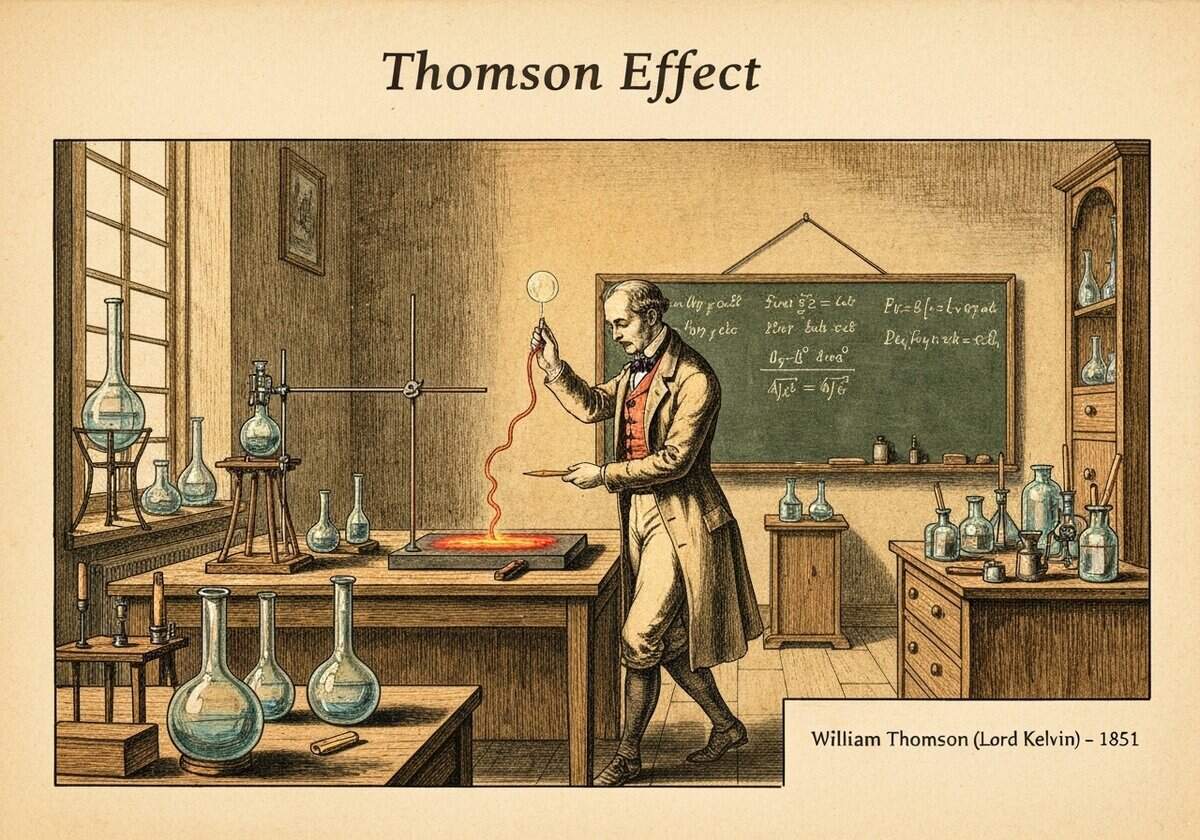
Current-carrying conductor experiment demonstrating Thomson Effect in thermoelectricity.

(Imagem gerada apenas para fins ilustrativos)

O efeito Thomson descreve o aquecimento ou resfriamento de um condutor percorrido por corrente elétrica quando existe um gradiente de temperatura ao longo de seu comprimento. O calor é produzido ou absorvido quando a corrente flui através de um material com um gradiente de temperatura. A taxa de produção de calor por unidade de comprimento é dada por [latex]frac{dQ}{dx} = -mathcal{K} J frac{dT}{dx}[/latex], onde [latex]mathcal{K}[/latex] é o coeficiente de Thomson.

The Thomson effect arises because the Seebeck coefficient of a material is generally dependent on temperature. As charge carriers move along a conductor from a hot region to a cold region (or vice versa), their average energy changes not only due to the temperature but also due to the changing Seebeck coefficient. When an electric current (J) flows through a conductor with a temperature gradient ([latex]frac{dT}{dx}[/latex]), this effect becomes apparent.

If the current flows in the same direction as the heat flow (from hot to cold), heat may be absorbed or released depending on the sign of the Thomson coefficient ([latex]mathcal{K}[/latex]) for that material. This heating or cooling is distinct from and superimposed upon the irreversible Joule heating ([latex]I^2R[/latex]) that always occurs. The Thomson effect is crucial for a complete thermodynamic description of thermoelectric phenomena and is linked to the Seebeck and Peltier effects through the Kelvin relations, which are foundational to the field.

UNESCO Nomenclature: 2211
Física do estado sólido

Tipo

Efeito físico

Interrupção

Incremental

Uso

Nicho/Especializado

Precursores

  • discovery of the seebeck effect (1821)
  • discovery of the peltier effect (1834)
  • O trabalho de Sadi Carnot sobre termodinâmica e máquinas térmicas.
  • O trabalho de James Prescott Joule sobre o efeito de aquecimento da corrente elétrica.

Aplicações

  • fornece uma estrutura teórica completa para a termoeletricidade
  • Utilizado na modelagem precisa de geradores e refrigeradores termoelétricos.
  • ajuda a caracterizar materiais relacionando os três coeficientes termoelétricos.

Patentes:

NA

Ideias de Inovação Potencial

Devido ao tráfego de bots de coleta de dados, atualmente superior a 40 mil por dia, este conteúdo é reservado aos membros da comunidade.
> Login < ou > Registrar < (100% gratuito) para acessar isso, assim como todo o restante do conteúdo e das ferramentas restritas.

Relacionado a: efeito Thomson, Lord Kelvin, termoeletricidade, coeficiente de Seebeck, gradiente de temperatura, aquecimento Joule, transporte de calor, relações de Kelvin, relações termodinâmicas, fenômenos de transporte.

Contexto histórico

Efeito Thomson

1850
1850
1850
1851
1852
1859
1860
1850
1850
1850
1850
1851
1854
1859
1861

(Caso a data seja desconhecida ou irrelevante, por exemplo, "mecânica dos fluidos", é fornecida uma estimativa aproximada de seu surgimento notável)

Princípios relacionados à invenção, inovação e tecnologia

Imagens em tamanho real e downloads estão disponíveis apenas, 100% gratuitos, para membros registrados.