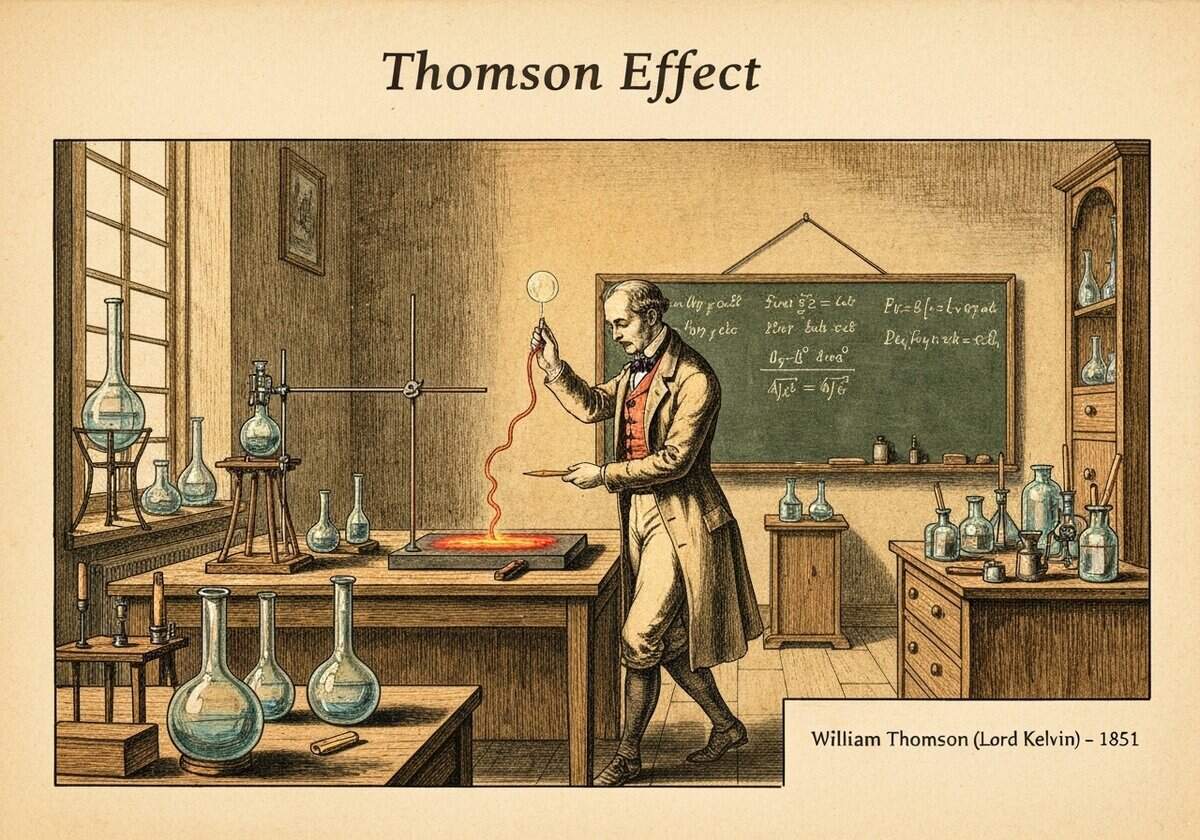
The Thomson effect describes the heating or cooling of a current-carrying conductor when a temperature gradient exists along its length. Heat is produced or absorbed when current flows through a material with a temperature gradient. The rate of heat production per unit length is given by [latex]frac{dQ}{dx} = -mathcal{K} J frac{dT}{dx}[/latex], where [latex]mathcal{K}[/latex] is the Thomson coefficient.