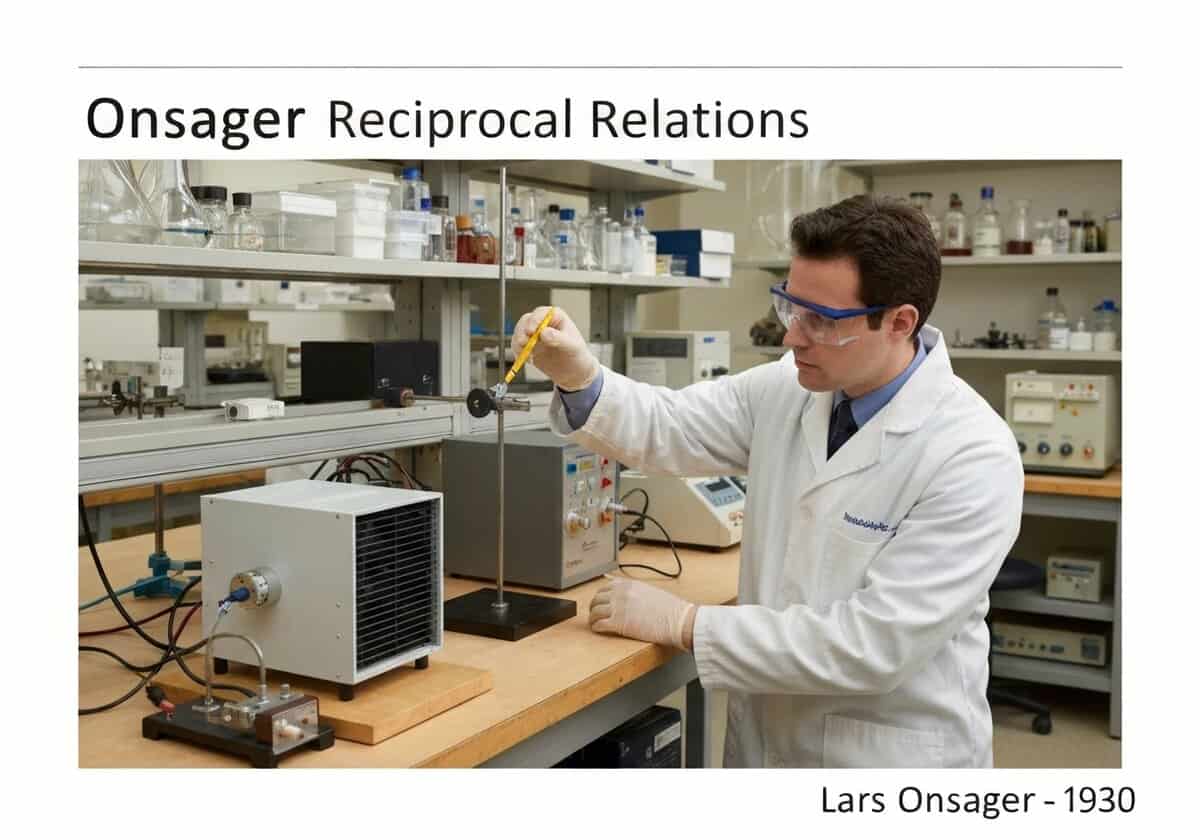
非平衡熱力学の重要な定理であるこれらの関係式は、エネルギーと物質の結合した流れの間の特定の相互係数の等価性を表しています。磁場がない場合、輸送係数の行列は対称であることを示しています。[latex]L_{alphabeta} = L_{betaalpha}[/latex]。これは、一見無関係な輸送現象を結びつけます。 ゼーベック そして ペルティエ 熱電効果における影響。


(画像はイメージです)
非平衡熱力学の重要な定理であるこれらの関係式は、エネルギーと物質の結合した流れの間の特定の相互係数の等価性を表しています。磁場がない場合、輸送係数の行列は対称であることを示しています。[latex]L_{alphabeta} = L_{betaalpha}[/latex]。これは、一見無関係な輸送現象を結びつけます。 ゼーベック そして ペルティエ 熱電効果における影響。

The Onsager reciprocal relations extend classical thermodynamics, which primarily deals with systems in equilibrium, to systems that are near equilibrium but experiencing irreversible processes. These processes are described by a set of linear equations relating thermodynamic ‘fluxes’ (like heat flow, electric current, or mass diffusion) to thermodynamic ‘forces’ (like temperature gradient, electric potential gradient, or chemical potential gradient). For example, a heat flux ([latex]J_q[/latex]) can be caused by a temperature gradient ([latex]X_q[/latex]) and an electric potential gradient ([latex]X_e[/latex]), so [latex]J_q = L_{qq}X_q + L_{qe}X_e[/latex].
The novelty of Onsager’s work, for which he won the 1968 Nobel Prize in Chemistry, was to prove that the cross-coefficient linking the electrical force to heat flow ([latex]L_{qe}[/latex]) is equal to the coefficient linking the thermal force to electric current ([latex]L_{eq}[/latex]). This symmetry is not obvious from macroscopic observation but arises from the principle of microscopic reversibility—the idea that the equations of motion for individual particles are symmetric with respect to time reversal. These relations dramatically simplified the study of complex transport phenomena by reducing the number of independent coefficients that need to be measured experimentally.
ボットによるトラフィック(現在1日あたり4万件以上)を排除するため、このコンテンツはコミュニティメンバー限定となっています。
> ログイン < または > 登録 < (100%無料)でこれにアクセスできます。他のすべての制限付きコンテンツとツールも同様です。
オンサーガーの相互関係
(日付が不明または関連性がない場合、例えば「流体力学」などでは、その注目すべき出現時期の概算値が提示されます。)

フルサイズの画像とダウンロードは、登録会員のみが100%無料で利用できます。
> ログイン <