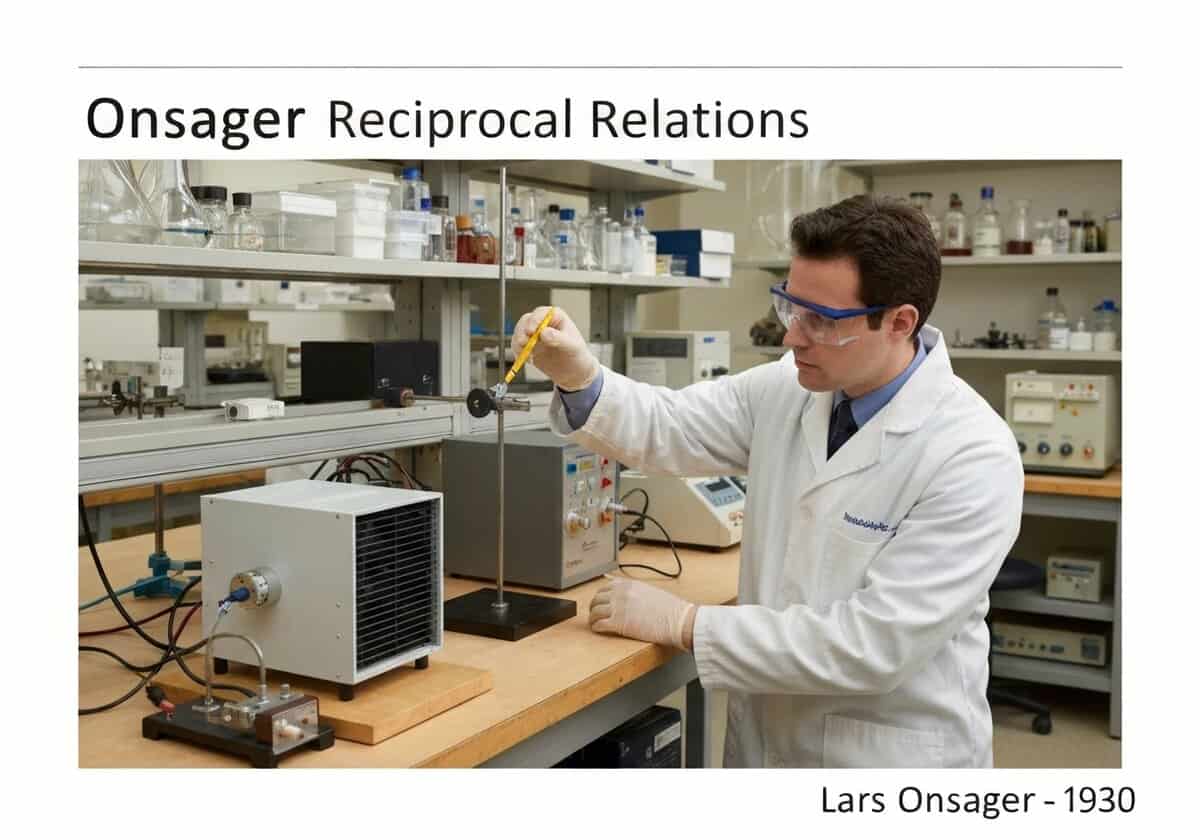
The Onsager reciprocal relations extend classical thermodynamics, which primarily deals with systems in equilibrium, to systems that are near equilibrium but experiencing irreversible processes. These processes are described by a set of linear equations relating thermodynamic ‘fluxes’ (like heat flow, electric current, or mass diffusion) to thermodynamic ‘forces’ (like temperature gradient, electric potential gradient, or chemical potential gradient). For example, a heat flux ([latex]J_q[/latex]) can be caused by a temperature gradient ([latex]X_q[/latex]) and an electric potential gradient ([latex]X_e[/latex]), so [latex]J_q = L_{qq}X_q + L_{qe}X_e[/latex].
The novelty of Onsager’s work, for which he won the 1968 Nobel Prize in Chemistry, was to prove that the cross-coefficient linking the electrical force to heat flow ([latex]L_{qe}[/latex]) is equal to the coefficient linking the thermal force to electric current ([latex]L_{eq}[/latex]). This symmetry is not obvious from macroscopic observation but arises from the principle of microscopic reversibility—the idea that the equations of motion for individual particles are symmetric with respect to time reversal. These relations dramatically simplified the study of complex transport phenomena by reducing the number of independent coefficients that need to be measured experimentally.