Product Design, Manufacturing & Innovation Resources
» ファラデーの電磁誘導の法則(積分形式)

ファラデーの電磁誘導の法則(積分形式)

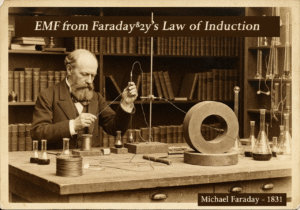
1831
  • Michael Faraday
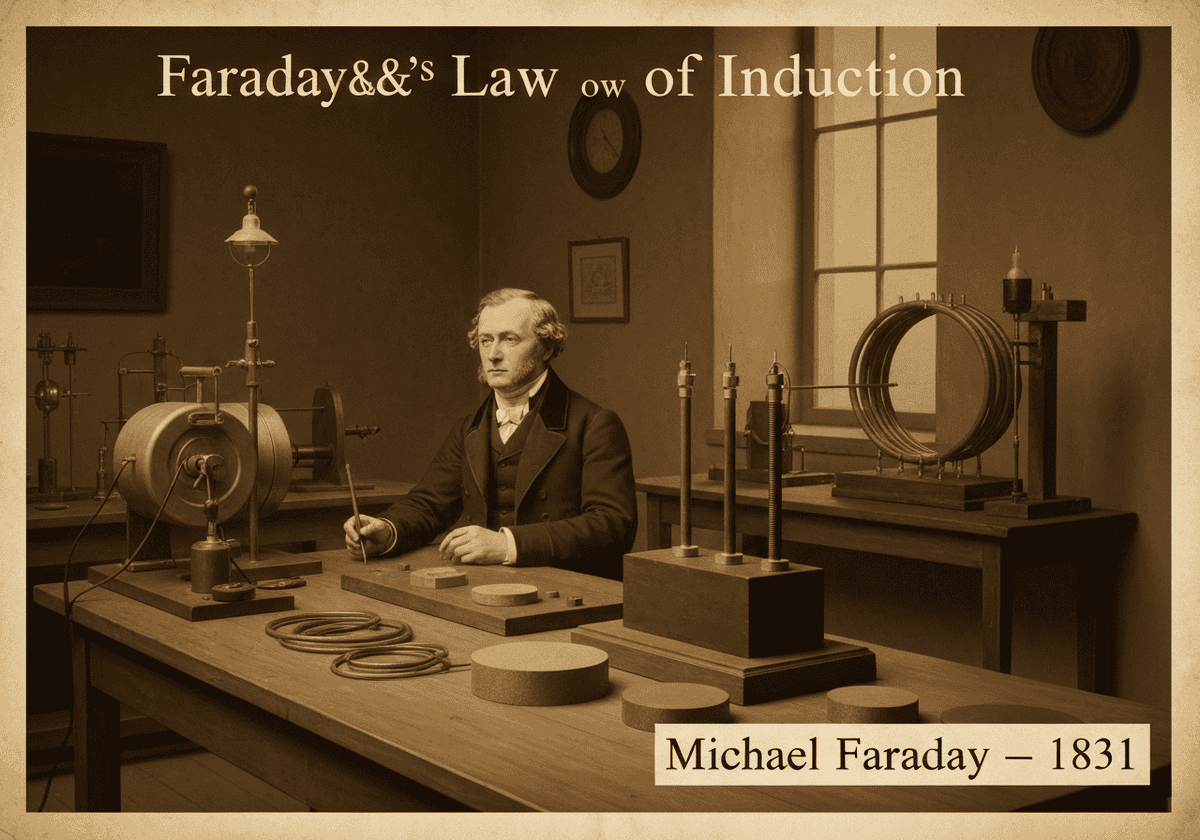
年代物の実験室で電磁気学の原理を実演するマイケル・ファラデー。.

(画像はイメージです)

この法律は、 起電力 (EMF任意の閉回路に誘導される磁束密度 [latex]mathcal{E}[/latex] は、回路を通過する磁束 ([latex]Phi_B[/latex]) の時間変化率の負の値に等しくなります。数式は [latex]mathcal{E} = -frac{dPhi_B}{dt}[/latex] です。この原理は、発電機、変圧器、インダクタの基礎となっており、誘導の巨視的な効果を説明しています。

The integral form of Faraday’s law of induction provides a macroscopic view of the relationship between a changing magnetic environment and an electrical circuit. It defines the electromotive force, or EMF ([latex]\mathcal{E}[/latex]), as the line integral of the electric field [latex]\mathbf{E}[/latex] around a closed loop [latex]\partial\Sigma[/latex]: [latex]\mathcal{E} = \oint_{\partial\Sigma} \mathbf{E} \cdot d\mathbf{l}[/latex]. This EMF represents the total voltage that would be measured by a voltmeter placed in the loop if it were cut open. The law equates this EMF to the rate of change of magnetic flux, [latex]\Phi_B[/latex], passing through the surface [latex]\Sigma[/latex] bounded by the loop.

Magnetic flux is defined as the surface integral of the magnetic field [latex]\mathbf{B}[/latex] over the surface [latex]\Sigma[/latex]: [latex]\Phi_B = \iint_\Sigma \mathbf{B} \cdot d\mathbf{A}[/latex]. Therefore, the full law is written as [latex]\oint_{\partial\Sigma} \mathbf{E} \cdot d\mathbf{l} = -\frac{d}{dt} \iint_\Sigma \mathbf{B} \cdot d\mathbf{A}[/latex]. The negative sign, formalized by Lenz’s law, indicates that the induced EMF creates a current that generates a magnetic field opposing the original change in flux. This opposition is a manifestation of the conservation of energy.

This law is remarkably general. The change in flux can be caused by several factors: the magnetic field itself can change in strength, the loop can change its area, the orientation of the loop relative to the field can change, or any combination of these. This versatility explains its application in a vast range of devices. For instance, in an AC generator, a coil of wire (the loop) is rotated in a constant magnetic field, continuously changing the orientation and thus the flux, inducing a sinusoidal EMF. In a transformer, a changing current in a primary coil creates a changing magnetic field, which in turn induces an EMF in a secondary coil.

UNESCO Nomenclature: 2205
電磁気学

タイプ

物理法則

混乱

革命的

使用法

広く普及している

前駆物質

  • 磁鉄鉱の磁気特性の発見
  • ウィリアム・ギルバートの磁気に関する研究(『磁気論』、1600年)
  • ハンス・クリスチャン・エルステッドによる、電流が磁場を生成するという観察(1820年)
  • アンドレ=マリー・アンペールによる電磁気学の数学的記述

アプリケーション

  • 変圧器
  • 交流発電機
  • 誘導電動機
  • 電子回路におけるインダクタ
  • クレジットカード磁気ストライプリーダー
  • エレキギター用ピックアップ
  • 地絡遮断器(GFCI)

特許:

NA

潜在的なイノベーションのアイデア

ボットによるトラフィック(現在1日あたり4万件以上)を排除するため、このコンテンツはコミュニティメンバー限定となっています。
> ログイン < または > 登録 < (100%無料)でこれにアクセスできます。他のすべての制限付きコンテンツとツールも同様です。

Related to: faraday’s law, integral form, electromotive force, magnetic flux, induction, lenz’s law, electric generator, transformer.

歴史的背景

ファラデーの電磁誘導の法則(積分形式)

1822
1824
1827
1831
1831
1833
1834
1821
1822
1827
1831
1831
1832
1834
1835

(日付が不明または関連性がない場合、例えば「流体力学」などでは、その注目すべき出現時期の概算値が提示されます。)
関連する発明、革新、および技術原理

フルサイズの画像とダウンロードは、登録会員のみが100%無料で利用できます。