Product Design, Manufacturing & Innovation Resources
» オームの法則

オームの法則

1827
  • Georg Ohm
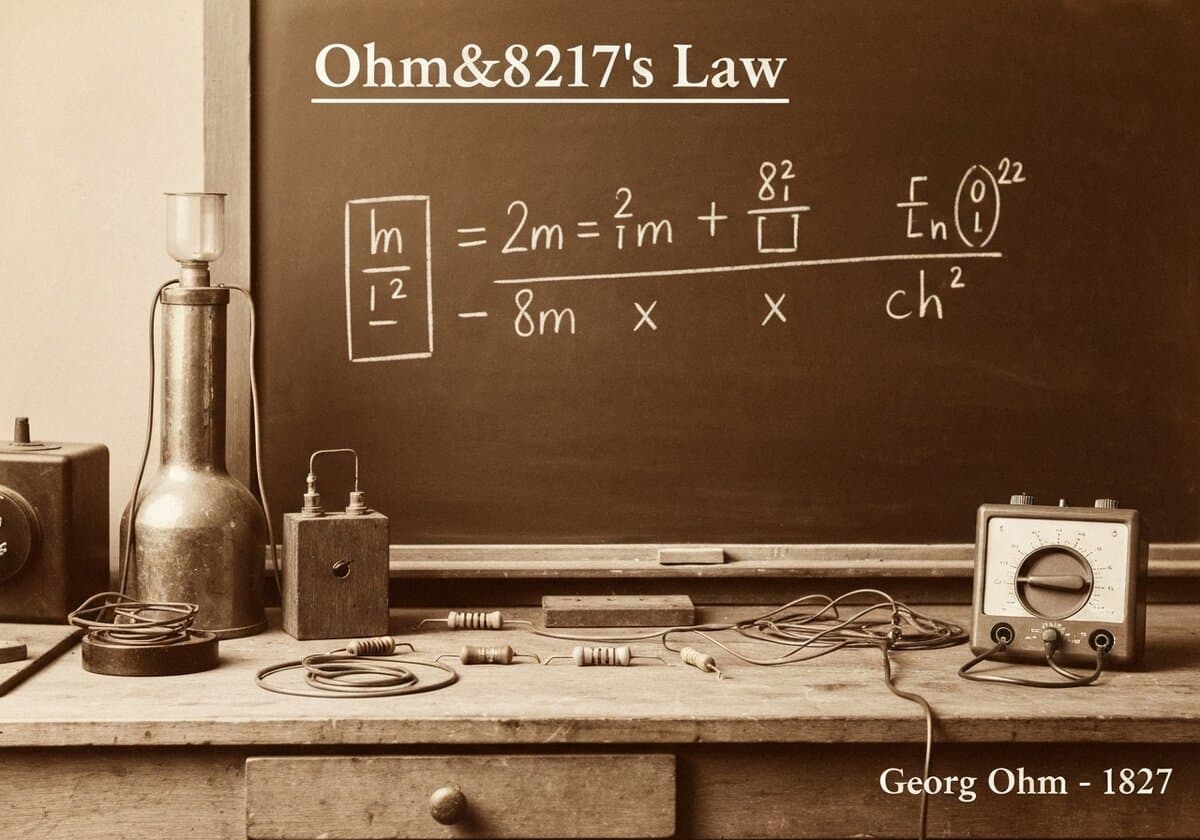
Laboratory setup illustrating Ohm's Law with electrical components and a chalkboard.

(画像はイメージです)

Ohm’s law states that the electric current flowing through a conductor is directly proportional to the voltage across it and inversely proportional to its resistance. This fundamental relationship in DC circuits is expressed by the equation [latex]I = frac{V}{R}[/latex], where I is the current in amperes, V is the potential difference in volts, and R is the resistance in ohms.


Georg Ohm’s discovery was initially met with skepticism but became a cornerstone of electrical circuit theory. The law describes the behavior of materials known as ‘ohmic’ conductors, where the resistance ‘R’ remains constant regardless of the applied voltage ‘V’ or the resulting current ‘I’, provided that physical conditions like temperature are unchanged. The relationship is linear, meaning if you double the voltage, you double the current.

This simple formula is incredibly powerful for analyzing direct current (DC) circuits. For instance, if a 12-volt battery is connected across a resistor with a resistance of 4 ohms, the current flowing through the resistor can be calculated as [latex]I = 12V / 4Omega = 3A[/latex]. This principle allows engineers to control and predict the behavior of electricity in a vast range of applications, from simple flashlights to complex electronic systems. It’s important to note that Ohm’s law in this scalar form is an empirical law and an idealization; it does not hold true for all materials and conditions, particularly for semiconductor devices or at extreme temperatures.

UNESCO Nomenclature: 2205
電磁気学

タイプ

抽象システム

混乱

基礎

使用法

広く普及している

前駆物質

  • Alessandro Volta’s invention of the voltaic pile (a reliable dc voltage source)
  • André-Marie Ampère’s formulation of laws governing the relationship between electric currents
  • Joseph Fourier’s mathematical analysis of heat conduction, which provided a theoretical model for Ohm’s work

アプリケーション

  • basic electrical circuit design and analysis
  • calculating voltage drops in wiring
  • resistor selection for current limiting (e.g., for leds)
  • sizing of fuses and circuit breakers
  • potentiometer and voltage divider design

特許:

NA

潜在的なイノベーションのアイデア

ボットによるトラフィック(現在1日あたり4万件以上)を排除するため、このコンテンツはコミュニティメンバー限定となっています。
> ログイン < または > 登録 < (100%無料)でこれにアクセスできます。他のすべての制限付きコンテンツとツールも同様です。

Related to: Ohm’s law, voltage, current, resistance, electricity, circuit analysis, Georg Ohm, direct current, V=IR, electrical engineering.

歴史的背景

オームの法則

1820
1821
1822
1827
1831
1831
1832
1820
1820
1822
1824
1827
1831
1831
1833

(日付が不明または関連性がない場合、例えば「流体力学」などでは、その注目すべき出現時期の概算値が提示されます。)

関連する発明、革新、および技術原理

フルサイズの画像とダウンロードは、登録会員のみが100%無料で利用できます。