Lei da Indução de Faraday (forma integral)
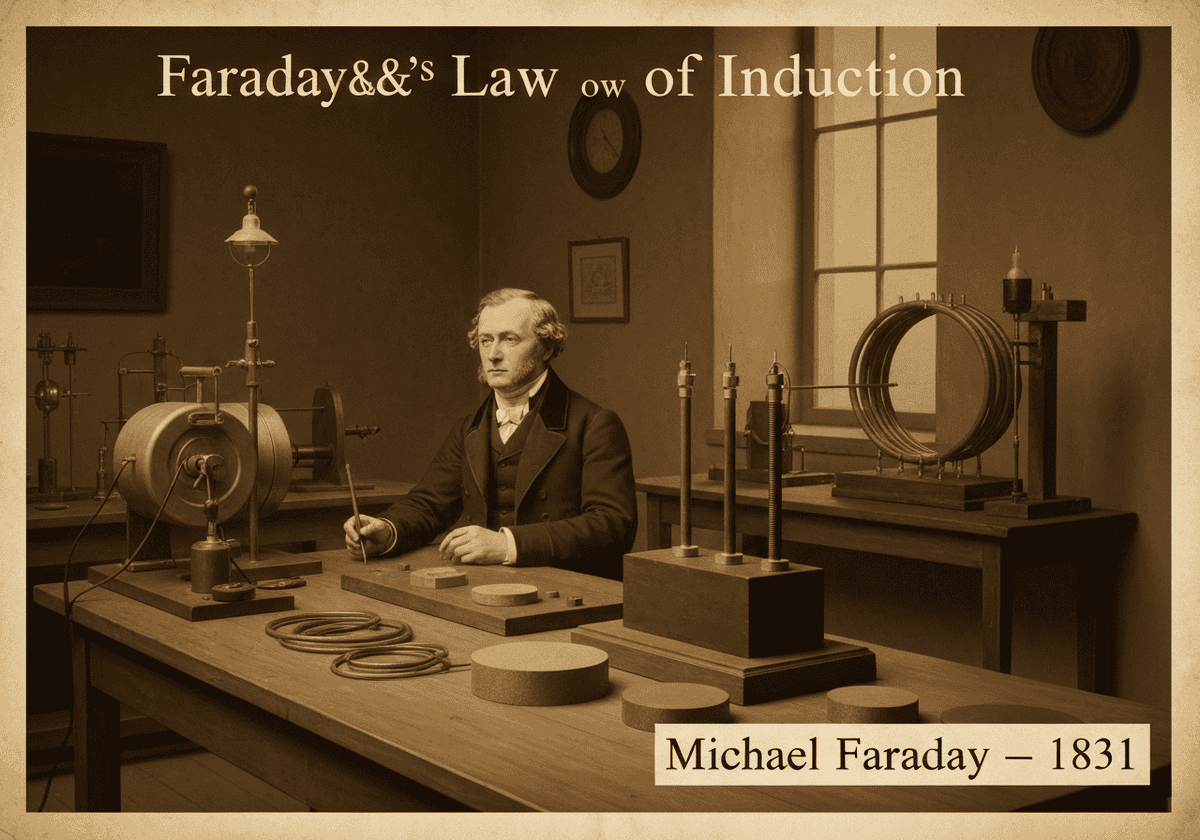
Esta lei afirma que força eletromotriz (EMFA força eletromotriz induzida em qualquer circuito fechado ([latex]mathcal{E}[/latex]) é igual ao negativo da taxa de variação temporal do fluxo magnético ([latex]Phi_B[/latex]) através do circuito. A expressão matemática é [latex]mathcal{E} = -frac{dPhi_B}{dt}[/latex]. Este princípio é a base para geradores elétricos, transformadores e indutores, descrevendo o efeito macroscópico da indução.
The integral form of Faraday’s law of induction provides a macroscopic view of the relationship between a changing magnetic environment and an electrical circuit. It defines the electromotive force, or EMF ([latex]\mathcal{E}[/latex]), as the line integral of the electric field [latex]\mathbf{E}[/latex] around a closed loop [latex]\partial\Sigma[/latex]: [latex]\mathcal{E} = \oint_{\partial\Sigma} \mathbf{E} \cdot d\mathbf{l}[/latex]. This EMF represents the total voltage that would be measured by a voltmeter placed in the loop if it were cut open. The law equates this EMF to the rate of change of magnetic flux, [latex]\Phi_B[/latex], passing through the surface [latex]\Sigma[/latex] bounded by the loop.
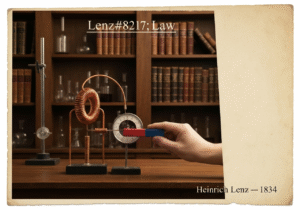
Magnetic flux is defined as the surface integral of the magnetic field [latex]\mathbf{B}[/latex] over the surface [latex]\Sigma[/latex]: [latex]\Phi_B = \iint_\Sigma \mathbf{B} \cdot d\mathbf{A}[/latex]. Therefore, the full law is written as [latex]\oint_{\partial\Sigma} \mathbf{E} \cdot d\mathbf{l} = -\frac{d}{dt} \iint_\Sigma \mathbf{B} \cdot d\mathbf{A}[/latex]. The negative sign, formalized by Lenz’s law, indicates that the induced EMF creates a current that generates a magnetic field opposing the original change in flux. This opposition is a manifestation of the conservation of energy.
This law is remarkably general. The change in flux can be caused by several factors: the magnetic field itself can change in strength, the loop can change its area, the orientation of the loop relative to the field can change, or any combination of these. This versatility explains its application in a vast range of devices. For instance, in an AC generator, a coil of wire (the loop) is rotated in a constant magnetic field, continuously changing the orientation and thus the flux, inducing a sinusoidal EMF. In a transformer, a changing current in a primary coil creates a changing magnetic field, which in turn induces an EMF in a secondary coil.
UNESCO Nomenclature: 2205
Eletromagnetismo
Interrupção
Revolucionário
Precursores
- Descoberta das propriedades magnéticas da magnetita
- Obra de William Gilbert sobre magnetismo (De Magnete, 1600)
- Observação de Hans Christian Ørsted de que as correntes elétricas criam campos magnéticos (1820)
- Descrição matemática do eletromagnetismo por André-Marie Ampère
Aplicações
- transformadores elétricos
- geradores de corrente alternada (CA)
- motores de indução
- indutores em circuitos eletrônicos
- leitores de tarja magnética de cartão de crédito
- captadores de guitarra elétrica
- interruptores de circuito de falha de aterramento (GFCIs)
Ideias de Inovação Potencial
Devido ao tráfego de bots de coleta de dados, atualmente superior a 40 mil por dia, este conteúdo é reservado aos membros da comunidade.
> Login < ou > Registrar < (100% gratuito) para acessar isso, assim como todo o restante do conteúdo e das ferramentas restritas.
Related to: faraday’s law, integral form, electromotive force, magnetic flux, induction, lenz’s law, electric generator, transformer.