数論における重要な結果の一つに、素数 p が 2 つの整数 a と b の積を割り切るならば、p は少なくともどちらか一方の整数を割り切るというものがあります。つまり、p が ab を割り切るならば、p は a または b を割り切るということです。この性質は、基本法則の一意性部分を証明する上で不可欠です。 算術の定理.
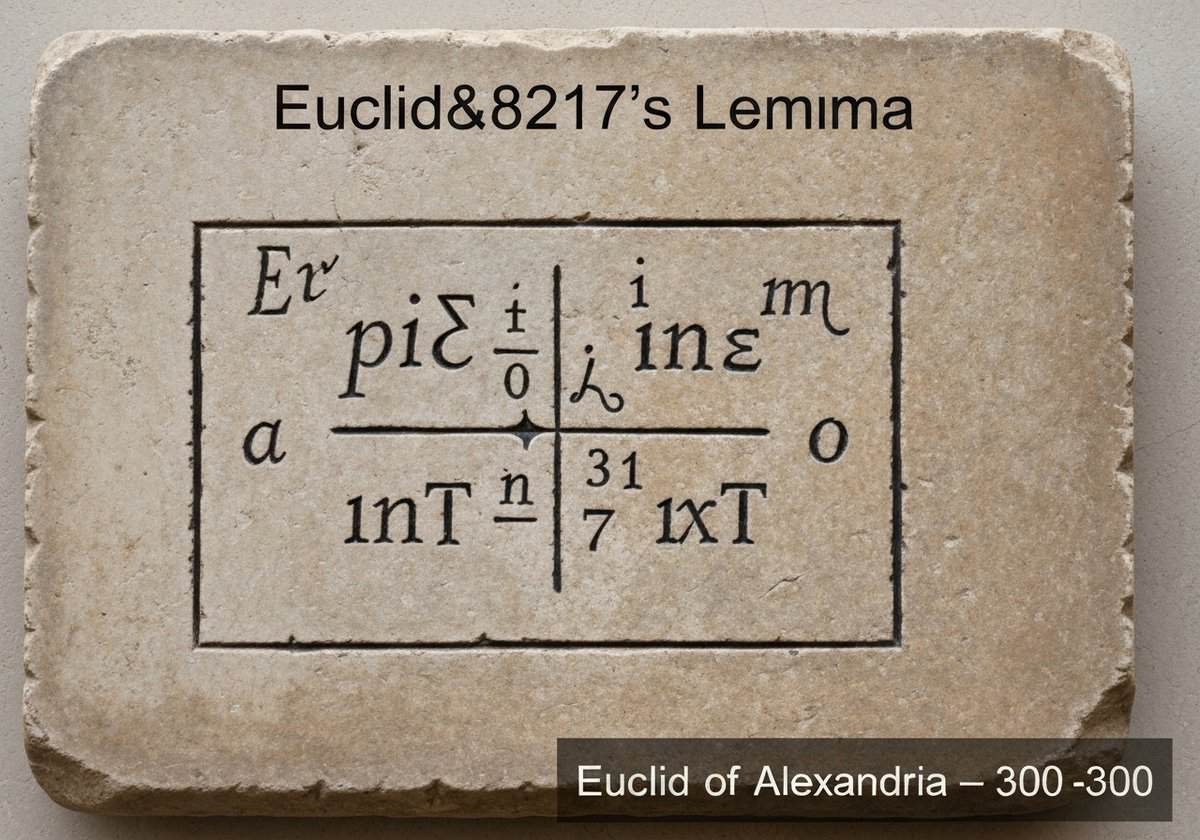
Euclid’s Lemma is Proposition 30 in Book VII of his *Elements*. Its proof typically relies on another fundamental result, Bézout’s identity, which states that the greatest common divisor (GCD) of two integers `a` and `b` can be expressed as a linear combination `ax + by` for some integers `x` and `y`. The proof of the lemma proceeds as follows: Assume a prime `p` divides `ab`. If `p` does not divide `a`, then `p` and `a` are coprime (their GCD is 1), since the only divisors of `p` are 1 and `p`. By Bézout’s identity, there exist integers `x` and `y` such that `px + ay = 1`. Multiplying this entire equation by `b` gives `pbx + aby = b`. We know that `p` divides `pbx` (trivially) and `p` divides `aby` (by our initial assumption that `p` divides `ab`). Therefore, `p` must divide their sum, which is `b`. This completes the proof.
This lemma is the critical step in establishing the uniqueness of prime factorizations. Without it, one could potentially have two different sets of prime factors for the same number. The lemma ensures that if a prime appears in one factorization, it must also appear in any other factorization of the same number. The property described in the lemma is now used to define the more general concept of a ‘prime element’ in abstract algebra and ring theory, distinguishing it from an ‘irreducible element’.