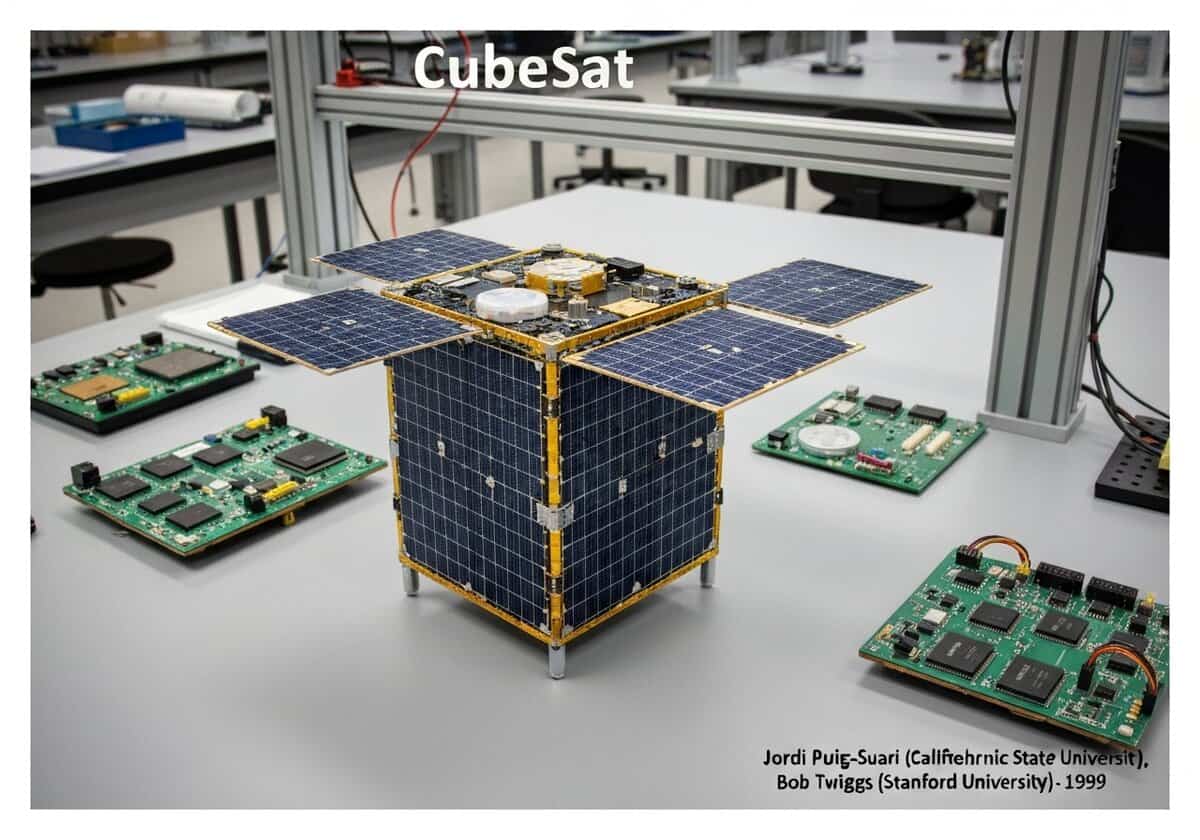
The CubeSat standard was conceived in 1999 as an educational tool to give graduate students hands-on experience in designing, building, testing, and operating a satellite. The core innovation was not just the small size, but the standardization of the form factor and its interface with the launch vehicle. This was achieved through the Poly-Picosatellite Orbital Deployer (P-POD), a box-like mechanism that holds the CubeSats securely during launch and ejects them into orbit using a spring-loaded system.
By standardizing the external dimensions and providing a simple, reliable deployment method, the CubeSat specification decoupled the satellite’s design from the specifics of the launch vehicle. This allowed launch providers to treat CubeSats as a uniform type of secondary payload, simplifying integration and safety reviews. This predictability fueled the creation of a vibrant ecosystem of commercial-off-the-shelf (COTS) components. Companies began mass-producing CubeSat-compatible subsystems like power systems, on-board computers, radios, and attitude control systems. This COTS market drastically reduced the cost and development time for new missions, transforming the CubeSat from a purely educational tool into a viable platform for commercial ventures, government science, and even interplanetary exploration.