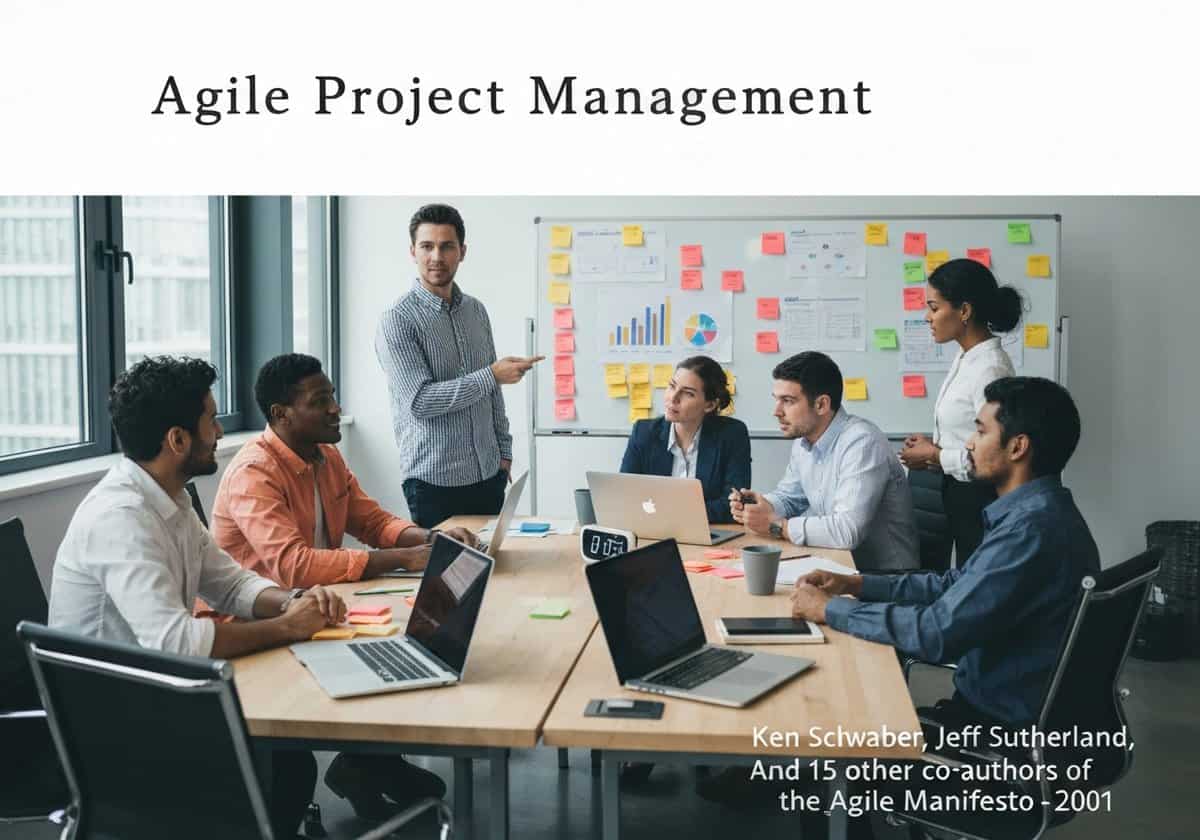
アジャイルプロジェクト管理
2001
- Ken Schwaber
- Jeff Sutherland
- And 15 other co-authors of the Agile Manifesto
Agile project management is an iterative approach to delivering a project throughout its ライフサイクル. It breaks down large projects into smaller, manageable tasks completed in short iterations or ‘sprints.’ This allows for frequent reassessment, adaptation of plans, and flexibility in response to change. It prioritizes customer collaboration, working ソフトウェア, and responding to change over comprehensive documentation and rigid plans.
Agile methodologies evolved as a reaction to the perceived limitations of traditional ‘waterfall’ methods, which are sequential and often rigid. The core principles of Agile are articulated in the 2001 ‘Manifesto for Agile Software Development.’ It values individuals and interactions over processes and tools, working software over comprehensive documentation, customer collaboration over contract negotiation, and responding to change over following a plan. The novelty was this explicit shift in values, prioritizing human-centric collaboration and adaptability over rigid, process-driven control.
Popular Agile frameworks include Scrum, Kanban, and Extreme Programming (XP). Scrum, for instance, organizes work into sprints, typically lasting one to four weeks. Each sprint begins with a planning meeting and ends with a review and retrospective. Daily stand-up meetings (or ‘daily scrums’) keep the team aligned. Key roles in Scrum include the Product Owner (represents stakeholders), the Scrum Master (facilitates the process), and the Development Team. The goal is to deliver a potentially shippable increment of the product at the end of each sprint, allowing for rapid feedback and continuous improvement. This iterative nature makes Agile particularly well-suited for projects where requirements are expected to evolve or are not fully understood at the outset, a common scenario in software and innovative product development.
UNESCO Nomenclature: 1203
– Computer engineering
前駆物質
- Iterative and incremental development models (e.g., Evo model)
- Lean manufacturing principles (e.g., Toyota Production System)
- Rapid Application Development (RAD)
- Dynamic Systems Development Method (DSDM)
アプリケーション
- software development
- new product development
- marketing campaign management
- research and development
- event planning
- business process improvement
潜在的なイノベーションのアイデア
ボットによるトラフィック(現在1日あたり4万件以上)を排除するため、このコンテンツはコミュニティメンバー限定となっています。
> ログイン < または > 登録 < (100%無料)でこれにアクセスできます。他のすべての制限付きコンテンツとツールも同様です。
Related to: Agile, project management, Scrum, Kanban, iterative, Sprint, software development, Agile manifesto, incremental, adaptive planning.