Product Design, Manufacturing & Innovation Resources
Casa » Equazione di sollevamento NIOSH

Equazione di sollevamento NIOSH

1991
  • National Institute for Occupational Safety and Health (NIOSH)
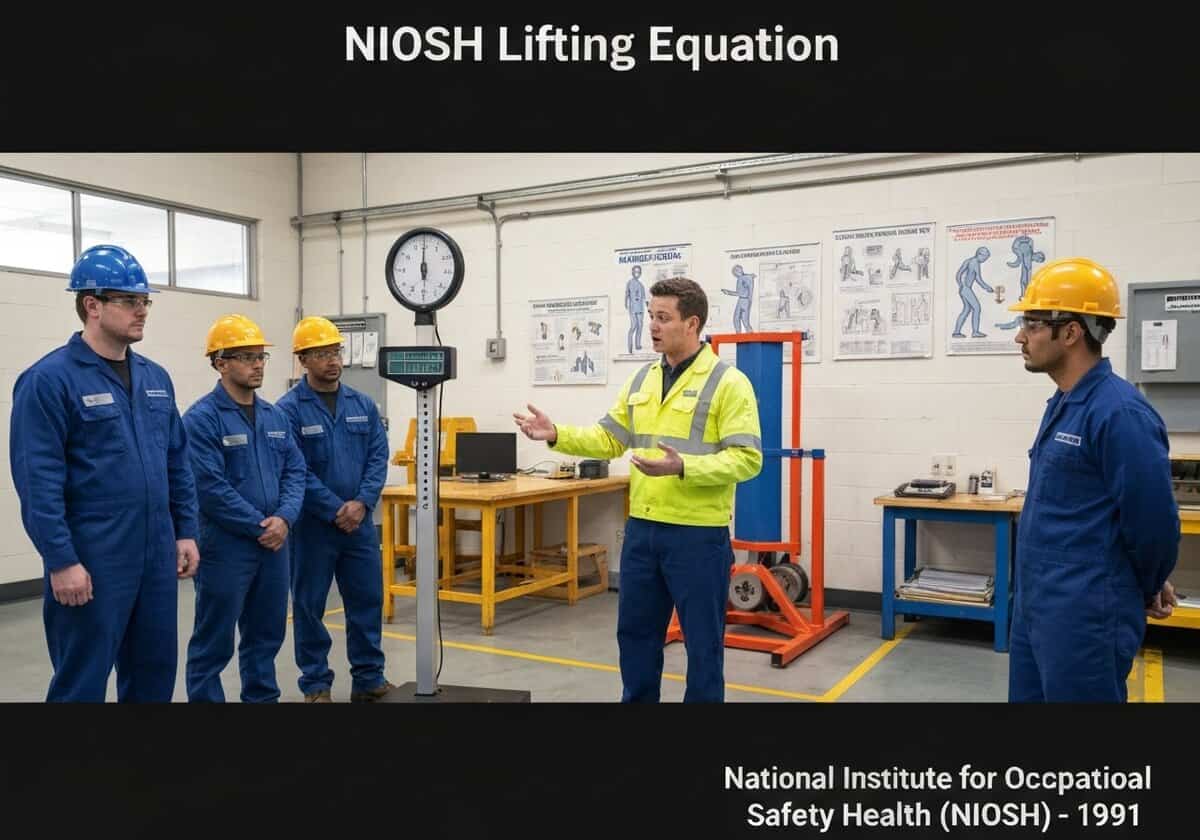
Professionista del settore sanitario che dimostra l'equazione di sollevamento NIOSH in ambito industriale.

(Immagine generata a solo scopo illustrativo)

IL NIOSH equazione di sollevamento È uno strumento utilizzato dai professionisti della salute e sicurezza sul lavoro per valutare il rischio di lesioni muscoloscheletriche associate alle attività di sollevamento manuale. Calcola un limite di peso raccomandato (RWL) per una specifica attività, che rappresenta il peso massimo che un lavoratore sano potrebbe sollevare senza un aumento del rischio di lesioni alla parte bassa della schiena, tenendo conto di fattori come la geometria dell'attività e la frequenza.


The revised NIOSH lifting equation from 1991 provides a more comprehensive valutazione del rischio than its 1981 predecessor. The core of the method is the calculation of the Recommended Weight Limit (RWL) using the formula: [latex]RWL = LC \times HM \times VM \times DM \times AM \times FM \times CM[/latex]. In this formula, LC is the Load Constant (51 lbs or 23 kg), which is the maximum recommended weight under ideal conditions. The other terms are multipliers, each with a value between 0 and 1, which reduce the allowable weight based on deviations from these ideal conditions. These multipliers are: HM (Horizontal Multiplier), VM (Vertical Multiplier), DM (Distance Multiplier), AM (Asymmetric Multiplier), FM (Frequency Multiplier), and CM (Coupling Multiplier). For example, the further an object is held from the body (increasing the horizontal distance), the smaller the HM value becomes, thus lowering the RWL. The equation also allows for the calculation of a Lifting Index (LI), where [latex]LI = \frac{Load Weight}{RWL}[/latex]. An LI greater than 1.0 indicates that the task is high-risk for some fraction of the workforce, and redesign should be prioritized. An LI of 3.0 or more is considered highly hazardous. The equation is a cornerstone of physical ergonomia, providing a quantitative, evidence-based method for evaluating and mitigating one of the most common causes of workplace injury.

UNESCO Nomenclature: 3307
- Ingegneria industriale

Tipo

Sistema astratto

Interruzione

Incrementale

Utilizzo

Uso diffuso

Precursori

  • biomechanical models of the lumbar spine
  • epidemiological studies linking manual lifting to low back pain
  • psychophysical studies on maximum acceptable weights
  • the original 1981 niosh lifting guide
  • static strength prediction models

Applicazioni

  • lavoro hazard analysis in manufacturing and logistics
  • redesign of workstations to reduce lifting risks
  • development of workplace safety standards and regulations
  • training programs for manual material handling
  • rehabilitation and return-to-work planning for injured employees

Brevetti:

NA

Idee e potenziali innovazioni

  • smartphone apps that use computer vision to estimate lifting equation parameters automatically
  • indossabile sensor suits that calculate the lifting index in real-time during a work shift
  • integration of the niosh equation into warehouse management software to flag risky palletizing tasks
  • esoscheletro control systems that provide assistive force based on the calculated rwl
  • virtual reality training modules where users can experience the effects of poor lifting technique on their li score
  • ai-driven job rotation schedulers that minimize cumulative lifting strain for each worker
  • 3d-printed, task-specific lifting aids designed to improve the coupling multiplier (cm)
  • ergonomic dashboards for managers showing real-time lifting risk across a facility
  • robotic systems that automatically take over tasks identified as having a high lifting index
  • crowdsourced databases of lifting tasks and their associated risk factors to refine the equation’s multipliers
Argomenti correlati: NIOSH, equazione di sollevamento, RWL, limite di peso raccomandato, lesioni muscoloscheletriche, sicurezza sul lavoro, biomeccanica, movimentazione manuale dei carichi, valutazione del rischio, ergonomia.

Contesto storico

Equazione di sollevamento NIOSH

1990
1990
1990
1991
1992
1993
1994
1990
1990
1990
1990
1992
1992
1993-07-22
1996

(se la data è sconosciuta o non rilevante, ad esempio "meccanica dei fluidi", viene fornita una stima approssimativa della sua notevole comparsa)

decimo anno anniversario

Le immagini a grandezza naturale e i download sono disponibili, gratuitamente al 100%, solo per gli utenti registrati.

> Login <