Product Design, Manufacturing & Innovation Resources
Maison » Théorème de Bayes

Théorème de Bayes

1763-12-23
  • Thomas Bayes
  • Pierre-Simon Laplace
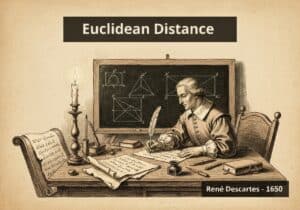
Historical study room with mathematician calculating Bayes' theorem.

(Image générée à titre d'illustration uniquement)

Bayes’ theorem describes the probability of an event based on prior knowledge of conditions that might be related to the event. It is a fundamental concept in probability theory and statistics. Mathematically, it is stated as [latex]P(A|B) = \frac{P(B|A)P(A)}{P(B)}[/latex], where A and B are events and [latex]P(B) \neq 0[/latex]. It relates the conditional and marginal probabilities of two random events.

Bayes’ Theorem provides a mathematical way to update existing beliefs with new evidence. In the formula [latex]P(A|B) = \frac{P(B|A)P(A)}{P(B)}[/latex], [latex]P(A|B)[/latex] is the posterior probability: the probability of hypothesis A given the evidence B. [latex]P(B|A)[/latex] is the likelihood: the probability of observing evidence B if hypothesis A is true. [latex]P(A)[/latex] is the prior probability: the initial belief in hypothesis A before seeing evidence B. Finally, [latex]P(B)[/latex] is the marginal likelihood or evidence: the total probability of observing the evidence B under all possible hypotheses. This term serves as a normalization constant, ensuring the posterior probabilities sum to one.

The theorem was first presented in Thomas Bayes’s essay “An Essay towards solving a Problem in the Doctrine of Chances,” which was read to the Royal Society in 1763 after his death. However, it was Pierre-Simon Laplace who independently developed and popularized the theorem, applying it to problems in celestial mechanics, medical statistics, and jurisprudence. The novelty of the theorem was its formalization of inverse probability—reasoning from effects back to their causes. While classical (frequentist) statistics focuses on the probability of data given a hypothesis, Bayesian statistics focuses on the probability of the hypothesis given the data, which is often a more intuitive and direct answer to scientific questions.

UNESCO Nomenclature: 1208
- Statistiques

Taper

Système abstrait

Perturbation

Révolutionnaire

Usage

Utilisation généralisée

Précurseurs

  • Théorie générale des probabilités (développée par Pascal, Fermat et Bernoulli)
  • Concept de probabilité conditionnelle
  • Travaux sur les problèmes de probabilité inverse par des mathématiciens antérieurs

Applications

  • Filtrage anti-spam dans les clients de messagerie
  • tests de diagnostic médical
  • Algorithmes d'apprentissage automatique (par exemple, classificateurs Naive Bayes)
  • opérations de recherche et de sauvetage
  • Modélisation écologique
  • prédiction des marchés financiers

Brevets:

NA

Idées d'innovations potentielles

En raison du trafic généré par les robots de scraping, actuellement supérieur à 40 000 par jour, ce contenu est réservé aux membres de la communauté.
> Connexion < ou > Registre < (100% gratuit) pour y accéder, ainsi qu'à tous les autres contenus et outils à accès restreint.

Lié à : théorème de Bayes, probabilité conditionnelle, a posteriori, a priori, vraisemblance, statistiques bayésiennes, probabilité inverse, Thomas Bayes, Laplace, évidence.

Contexte historique

Théorème de Bayes

1650
1736
1750
1763-12-23
1780
1805
1822
1640
1650
1747
1758
1777
1799
1812
1822

(si la date est inconnue ou non pertinente, par exemple « mécanique des fluides », une estimation arrondie de son émergence notable est fournie)

Inventions, innovations et principes techniques connexes

Les images en pleine résolution et les téléchargements sont uniquement disponibles, et 100% gratuits, pour les membres inscrits.