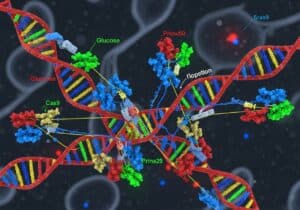
La biología sintética integra principios de ingeniería con la biología molecular para construir nuevos sistemas biológicos y rediseñar los existentes. El diseño de circuitos genéticos y las técnicas de edición genómica, incluyendo los sistemas CRISPR-Cas, permiten la manipulación precisa del material genético. La ingeniería de vías metabólicas optimiza la producción bioquímica, mientras que las redes de genes sintéticos facilitan la programación del comportamiento celular. Los avances en la síntesis de ADN y la ingeniería de proteínas amplían las capacidades funcionales. Las plataformas de biología sintética sin células aceleran el prototipado de constructos genéticos. Los biosensores y los interruptores genéticos proporcionan control dinámico y capacidad de respuesta al entorno. Los ribosomas ortogonales y los promotores sintéticos mejoran la especificidad y la modularidad.
Esta es nuestra última selección de publicaciones y patentes mundiales en inglés sobre Biología Sintética, entre muchas revistas científicas en línea, clasificadas y centradas en biología sintética, diseño de circuitos de genes, edición de genomas, CRISPR-Cas, ingeniería de vías metabólicas, red de genes sintéticos, síntesis de ADN, ingeniería de proteínas, sintético sin células, biosensor, interruptor de palanca genético, ribosoma ortogonal, genoma mínimo, promotores sintéticos, basados en ARN, análisis del flujo metabólico, evolución dirigida, cromosoma sintético, biobrick, expansión del código genético, biología sintética computacional, organismo chasis, operón sintético, modulación de la expresión génica, factor de transcripción sintético, biofundiciones, ingeniería metabólica, automatización de la biología sintética, bibliotecas de partes genéticas, estándar de biología sintética y estrategias de biocontención.
Spot drops biosensor nutrient management
Patent published on the 2026-06-11 in WO under Ref WO2026122877 by SOUTH DAKOTA BOARD OF REGENTS [US] (Khalid Ahmed [us], Mirzaee Salman [us], Mirzakhani Nafchi Ali [us], Kumari Karishma [us])
Abstract: Disclosed herein are methods and systems of detecting nutrient deficiencies in an agricultural field and creating a variable rate fertilizer application map by analyzing a field for standard vegetation markers, creating a management zone map having management zones based on the standard vegetation markers, wherein the management zones are assigned based on commonality in the standard vegetation markers. Applying a standard nutrient fertilizer to the field, assigning a plurality of biosensor rich[...]
Our summary: The system detects nutrient deficiencies in agricultural fields using biosensors. It creates a variable rate fertilizer application map based on vegetation markers and management zones. Fertilizer is applied variably using controlled spray nozzles to optimize yield.
biosensor, nutrient management, variable rate application, agricultural technology
Patent
Smart biosensor sensor based on superposition of biopotential and physical signals
Patent published on the 2026-06-11 in WO under Ref WO2026122483 by SAN DIEGO STATE UNIV RESEARCH FOUNDATION [US] (Moon Kee Suk [us], Lee Sung Q [us])
Abstract: In some embodiments, there may be provided an apparatus including a first sensor element comprising a first electrode and a second sensor element comprising a second electrode and a piezoelectric sensor. The apparatus may include or be coupled to at least one processor coupled to the first element and the second element, the at least one processor configured to separate, based on at least on frequency, the at least one biopotential signal and the at least one acoustic signal obtained from vibrat[...]
Our summary: The apparatus includes two sensor elements for biopotential and acoustic signal detection. A processor separates these signals based on frequency. The system derives indicators related to the wearer from the processed signals.
biosensor, biopotential, piezoelectric, signal processing
Patent
Method for enhancing plant transformation efficiency by using agrobacterium carrying virg mutant gene and nahg gene
Patent published on the 2026-06-11 in US under Ref US20260159848 by NULLA BIO INC [KR] (Jeon Eun-young [kr], Jeong Jin-hee [kr])
Abstract: [0000] A method for enhancing transformation efficiency of a plant includes transforming a plant cell with a bacteria of the genus Agrobacterium carrying virGgene and NahG (salicylate hydroxylase) gene. The method is based on the discovery that introducing both a constitutively active virG mutant gene (virG) and a salicylic acid-degrading gene (NahG) into an Agrobacterium strain synergistically increases its ability to deliver a target gene into a plant cell. The provided strains can be used to [...]
Our summary: The method enhances plant transformation efficiency by using Agrobacterium with a virG mutant and NahG gene. This approach improves gene delivery into plant cells. It is applicable to various plant species, including those that are typically difficult to transform.
Agrobacterium, plant transformation, virG gene, NahG gene
Patent
Cellular iron biosensors
Patent published on the 2026-06-03 in EP under Ref EP4752155 by UNIV GRAZ MEDIZINISCHE [AT] (Akyol Ali [at], Graier Wolfgang [at], Malli Roland [at])
Abstract: The present invention relates to genetically encoded cellular iron biosensors, in particular to nucleic acids encoding the same, vectors and cells comprising the nucleic acid(s), in vitro methods for measuring, and optionally monitoring, cellular Fe2+ and/or cellular iron-sulfur cluster (ISC), in vitro screening methods for a compound that affects cellular Fe2+ and/or cellular ISC, and to in vitro methods for identifying a dosage and/or formulation of a compound that affects cellular Fe2+ and/or[...]
Our summary: This invention describes genetically encoded cellular iron biosensors. It includes nucleic acids, vectors, and cells for measuring cellular Fe2+ and iron-sulfur clusters. Additionally, it outlines methods for screening compounds that affect cellular iron levels and identifying optimal dosages.
iron biosensors, genetically encoded, cellular Fe2+, in vitro methods
Patent
Enhanced resuscitation for emergency care
Patent published on the 2026-06-03 in EP under Ref EP4751767 by KONINKLIJKE PHILIPS NV [NL] (Berman Randall M [nl], Fujito Keiichi [nl], Arbanas Brian [nl], Jorgenson Dawn Blilie [nl], Frosh Karl [nl], Gehman Stacy Earl [nl], Szymanski Joyce Ann [nl], Burns Delaney [nl], Evans Dave [nl], Riemer Adena [nl], De Lat Bente [nl])
Abstract: [0001] A defibrillation system employs one or more of a wearable biosensor configured to monitor a ventilation of the patient, a wearable injector configured to administer a medication to the patient, a digital stethoscope configured to monitor a heart of the patient; and ambient sensor (70, 80)(s) configured to monitor ambient sound and/or ambient light. The defibrillation system further employs a defibrillator including a defibrillation controller configured to implement a resuscitation protoc[...]
Our summary: The defibrillation system integrates multiple wearable sensors to monitor patient ventilation, heart activity, and ambient conditions. It includes a wearable injector for medication administration. The system s controller implements a resuscitation protocol based on real-time data from these devices.
defibrillation, biosensor, resuscitation, monitoring
Patent
Biosensor and module for detecting target substance in body fluid
Patent published on the 2026-05-28 in WO under Ref WO2026111559 by LMK CO LTD [KR] (Kim Sung Il [kr], Myung Hyun Sik [kr], Lee Jong Geun [kr], Lee Kyo Wung [kr])
Abstract: The present invention relates to a biosensor and a biomodule, for detecting a target substance in a body fluid, which are capable of collecting a body fluid such as saliva, urine, or blood from an examinee to detect a target substance (for example, a hormone) in the body fluid, and performing diagnosis based on a level thereof. The biosensor for detecting a target substance in a body fluid, according to the present invention, is for detecting a target substance in a body fluid of an examinee, an[...]
Our summary: The invention describes a biosensor and biomodule for detecting target substances in body fluids like saliva, urine, or blood. It features a substrate with an electrode and a hydrogen-free carbon thin film that includes an immobilized material matching the target substance. The detection process is based on analyzing XPS peak intensities related to carbon bonds in the thin film.
Biosensor, Body fluid, Carbon thin film, Target substance
Patent
Re-evaluating the site-directed nuclease classification as a regulatory trigger for genome-edited plant products
Published on 2026-03-05 by Osman Mewett, John McMurdy, Lieselot Bertho, Ana Atanassova, Naomi Stevens, Scott Huber, Maria Fedorova, Kevin Diehl, Kevin Tianmeng Zhao @NATURE
Abstract: Nature Biotechnology, Published online: 05 March 2026; doi:10.1038/s41587-026-03028-0Site-directed nuclease (SDN) classification into SDN-1, SDN-2 and SDN-3 outcomes is used for regulating genome-edited plant products in some countries. This reductive categorization system fails to cover the breadth of genome editing technologies developed over the past decade and their rapidly approaching commercial use. Here, we argue that, in the context of plant breeding, regulations should focus on the char[...]
Our summary: The current classification of site-directed nucleases (SDNs) is inadequate for regulating genome-edited plants. A shift towards an outcome-focused regulatory approach is proposed to enhance oversight and efficiency. This change aims to address challenges in crop improvement related to climate change and pest resistance.
genome editing, site-directed nucleases, regulatory framework, plant breeding
Publication
Ethical and Clinical Best Practices for Genome Editing Applications
Published on 2026-02-02 by Mara Ortiz-Bueno, Federica Zinghirino, Pilar Puig Serra, Kyriaki Paschoudi, Lluis Montoliu, Erden Atilla, Yonglun Luo, Alessia Cavazza, Carsten W. Lederer, Karim Benabdellah @MDPI
Abstract: Genome editing (GE) has transformed medicine by allowing precise changes to DNA, offering potential treatments for a range of inherited and acquired disorders. Several technologies support these advances, including zinc-finger nucleases (ZFNs), transcription activator-like effector nucleases (TALENs), and clustered regularly interspaced short palindromic repeats (CRISPR)-based systems, of which the latter has emerged as the most accessible, versatile, and popular. While GE holds great promise, i[...]
Our summary: Genome editing technologies enable precise DNA modifications for medical treatments. Ethical and regulatory considerations are crucial for safe clinical applications. Regulatory agencies provide guidance on safety, consent, and compliance in genome editing practices.
Genome Editing, Ethical Standards, Regulatory Compliance, Clinical Applications
Publication