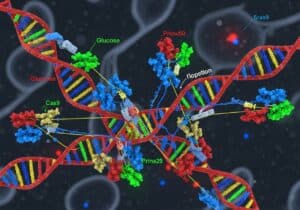
合成生物学は、工学原理と分子生物学を統合し、新たな生物システムを構築したり、既存のシステムを再設計したりする学問です。遺伝子回路設計やゲノム編集技術(CRISPR-Casシステムを含む)により、遺伝物質の精密な操作が可能になります。代謝経路工学は生化学物質の生産を最適化し、合成遺伝子ネットワークはプログラム可能な細胞挙動を促進します。DNA合成とタンパク質工学の進歩は、機能的能力を拡大します。無細胞合成生物学プラットフォームは、遺伝子構築物のプロトタイプ作成を加速します。バイオセンサーと遺伝子トグルスイッチは、動的な制御と環境応答性を提供します。直交リボソームと合成プロモーターは、特異性とモジュール性を向上させます。
これは、合成生物学に関する英語の世界中の出版物と特許の最新のセレクションです。多数の科学オンラインジャーナルの中から、合成生物学、遺伝子回路設計、ゲノム編集、CRISPR-Cas、代謝経路工学、合成遺伝子ネットワーク、DNA合成、タンパク質工学、無細胞合成、バイオセンサー、遺伝子トグルスイッチ、直交リボソーム、最小ゲノム、合成プロモーター、RNAベース、代謝フラックス解析、指向性進化、合成染色体、バイオブリック、遺伝暗号拡張、計算合成生物学、シャーシ生物、合成オペロン、遺伝子発現調節、合成転写因子、バイオファウンドリ、代謝工学、合成生物学自動化、遺伝子部品ライブラリ、合成生物学標準、バイオ封じ込め戦略に分類され、焦点を絞っています。
Electrode, biosensor, and electrode manufacturing method
Patent published on the 2026-07-02 in WO under Ref WO2026140553 by NITTO DENKO CORP [JP] (Fukuda Keita [jp], Yamashita Takayuki [jp], Kamano Yusuke [jp])
Abstract: This electrode comprises a substrate film and a conductive carbon layer in this order toward one side in the thickness direction. The electrode satisfies expression. Expression: 0.30[...]
Our summary: This content discusses an electrode that consists of a substrate film and a conductive carbon layer. It highlights a specific manufacturing method for the electrode. The electrode meets a defined expression value of 0.30.
Electrode, biosensor, conductive carbon, substrate film
Patent
Systems and methods for estrogen biosensing
Patent published on the 2026-06-25 in US under Ref US20260176666 by BIOSENS8 INC [US] (Kuzmanovic Uros [us], Charles Jr Roger J [us], Davis Connor A [us])
Abstract: The present disclosure generally relates to enzyme-based biosensors and, in particular, to biosensors for determining estrogen and other biomolecules. In some cases, the enzymes may be based on dehydrogenases, such as 17-beta hydroxysteroid dehydrogenases. In certain embodiments, the enzyme may include an active site that is able to bind to and oxidize estrogen, or other biomolecules. In some cases, the active site may include certain residues positioned around the active site that are able to s[...]
Our summary: The disclosure describes enzyme-based biosensors for detecting estrogen and other biomolecules. It focuses on dehydrogenases that oxidize estrogen through specific active sites. Methods for creating and utilizing these biosensors and related kits are also discussed.
biosensors, estrogen, dehydrogenases, enzyme-based
Patent
Biosensor device
Patent published on the 2026-06-18 in WO under Ref WO2026127530 by WISOL CO LTD [KR] (Kim Jung Min [kr], Lee Ho Sub [kr])
Abstract: A biosensor device according to the present invention comprises: a printed circuit board in which at least one sample seating hole for seating a test sample is formed to have a hollow structure; a biosensor which is coupled to a position corresponding to the sample seating hole on the lower surface of the printed circuit board, and senses a sample reaction of the test sample; and a case having an inner space for accommodating the printed circuit board.[...]
Our summary: The biosensor device features a printed circuit board with a hollow sample seating hole. It includes a biosensor positioned beneath the hole to detect sample reactions. The device is housed in a case that accommodates the printed circuit board.
biosensor, printed circuit board, sample seating hole, test sample
Patent
Method to generate immuno-free and stress-resistant donor cells
Patent published on the 2026-06-18 in US under Ref US20260167932 by MAHRAT REEM [US] (Mahrat Reem [us])
Abstract: [0000] A method for generating immuno-free and stress-resistant donor cells comprising editing PRDM1 and FOXP3 genes in T-cells and B-cells with CRISPR-Cas9 and modulating immune responses to reduce inflammation and prevent autoimmunity. Particularly, the present invention discloses a method for treating Type 1 Diabetes, comprising genetically modifying pancreatic beta cells with CRISPR-Cas9, and altering HLA expression, and upregulating immune checkpoint molecules such as PD-L1 to obtain immune[...]
Our summary: A method is described to generate immuno-free and stress-resistant donor cells by editing PRDM1 and FOXP3 genes in T-cells and B-cells. The invention focuses on treating Type 1 Diabetes by genetically modifying pancreatic beta cells to enhance immune tolerance. This involves altering HLA expression and upregulating immune checkpoint molecules like PD-L1.
CRISPR-Cas9, immune tolerance, gene editing, Type 1 Diabetes
Patent
Spot drops biosensor nutrient management
Patent published on the 2026-06-11 in WO under Ref WO2026122877 by SOUTH DAKOTA BOARD OF REGENTS [US] (Khalid Ahmed [us], Mirzaee Salman [us], Mirzakhani Nafchi Ali [us], Kumari Karishma [us])
Abstract: Disclosed herein are methods and systems of detecting nutrient deficiencies in an agricultural field and creating a variable rate fertilizer application map by analyzing a field for standard vegetation markers, creating a management zone map having management zones based on the standard vegetation markers, wherein the management zones are assigned based on commonality in the standard vegetation markers. Applying a standard nutrient fertilizer to the field, assigning a plurality of biosensor rich[...]
Our summary: The system detects nutrient deficiencies in agricultural fields using biosensors. It creates a variable rate fertilizer application map based on vegetation markers and management zones. Fertilizer is applied variably using controlled spray nozzles to optimize yield.
biosensor, nutrient management, variable rate application, agricultural technology
Patent
Method for enhancing plant transformation efficiency by using agrobacterium carrying virg mutant gene and nahg gene
Patent published on the 2026-06-11 in US under Ref US20260159848 by NULLA BIO INC [KR] (Jeon Eun-young [kr], Jeong Jin-hee [kr])
Abstract: [0000] A method for enhancing transformation efficiency of a plant includes transforming a plant cell with a bacteria of the genus Agrobacterium carrying virGgene and NahG (salicylate hydroxylase) gene. The method is based on the discovery that introducing both a constitutively active virG mutant gene (virG) and a salicylic acid-degrading gene (NahG) into an Agrobacterium strain synergistically increases its ability to deliver a target gene into a plant cell. The provided strains can be used to [...]
Our summary: The method enhances plant transformation efficiency by using Agrobacterium with a virG mutant and NahG gene. This approach improves gene delivery into plant cells. It is applicable to various plant species, including those that are typically difficult to transform.
Agrobacterium, plant transformation, virG gene, NahG gene
Patent
Ethical and Clinical Best Practices for Genome Editing Applications
Published on 2026-02-02 by Mara Ortiz-Bueno, Federica Zinghirino, Pilar Puig Serra, Kyriaki Paschoudi, Lluis Montoliu, Erden Atilla, Yonglun Luo, Alessia Cavazza, Carsten W. Lederer, Karim Benabdellah @MDPI
Abstract: Genome editing (GE) has transformed medicine by allowing precise changes to DNA, offering potential treatments for a range of inherited and acquired disorders. Several technologies support these advances, including zinc-finger nucleases (ZFNs), transcription activator-like effector nucleases (TALENs), and clustered regularly interspaced short palindromic repeats (CRISPR)-based systems, of which the latter has emerged as the most accessible, versatile, and popular. While GE holds great promise, i[...]
Our summary: Genome editing technologies enable precise DNA modifications for medical treatments. Ethical and regulatory considerations are crucial for safe clinical applications. Regulatory agencies provide guidance on safety, consent, and compliance in genome editing practices.
Genome Editing, Ethical Standards, Regulatory Compliance, Clinical Applications
Publication
Theoretical Framework and NISQ Implementation Strategy
Published on 2026-02-02 by Yong-Hwan Lee, Wan-Bum Lee @MDPI
Abstract: We present a theoretical framework integrating quantum optimization with DNA-based molecular storage for enhanced image compression, validated via classical simulation in IBM Qiskit. The proposed Quantum-DNA Image Compression (Q-DIC) framework formulates DNA codon selection as a quantum search problem, applying Grover’s algorithm to achieve O(N) speedup in exploring the 48 = 65,536-codon solution space. Key contributions include (1) novel multi-objective cost functions[...]
Our summary: This work presents a theoretical framework that integrates quantum optimization with DNA-based molecular storage for image compression. It formulates DNA codon selection as a quantum search problem, achieving significant speedup using Grover s algorithm. The study also validates the framework through simulations, demonstrating practical viability on IBM Quantum systems.
Quantum Optimization, DNA Storage, Image Compression, NISQ Implementation
Publication