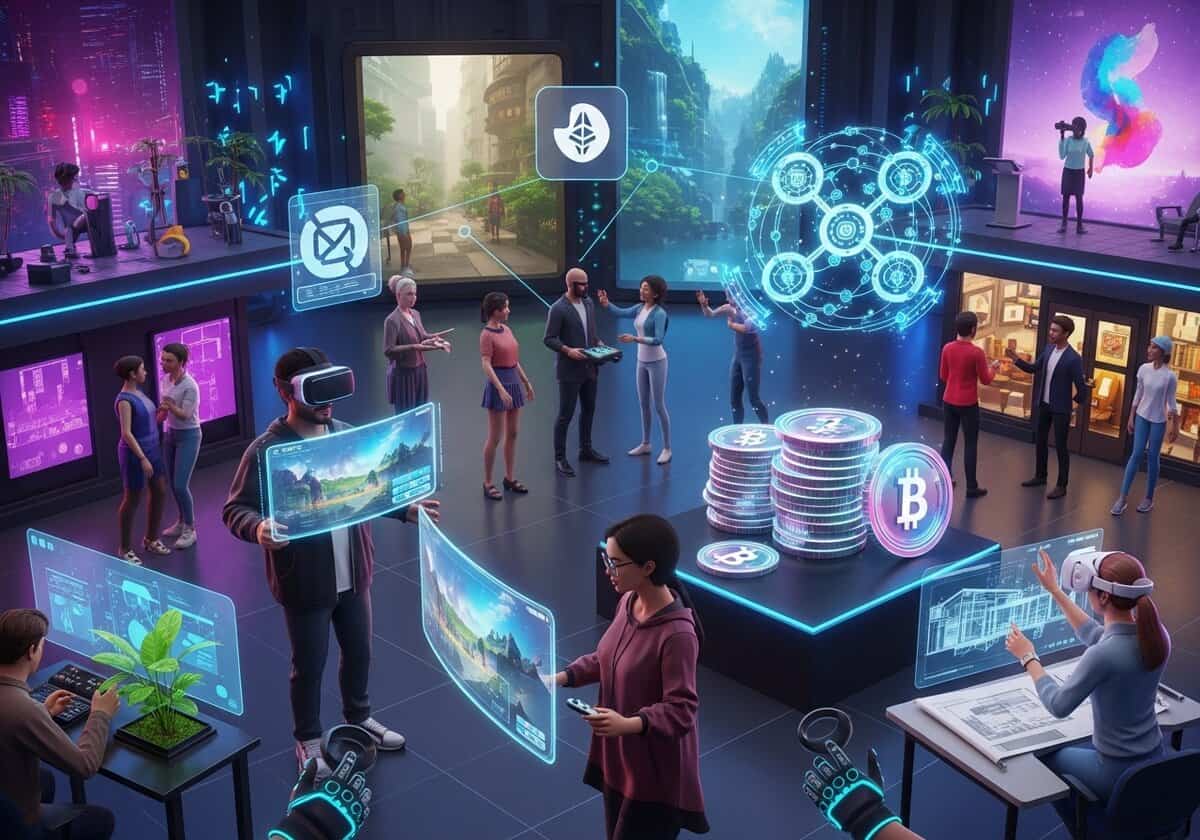

El Metaverso constituye una convergencia de tecnologías de realidad virtual, aumentada y mixta que forman entornos digitales 3D persistentes y compartidos en los que los usuarios interactúan a través de avatares y comprometer en actividades sociales, económicas y creativas. Entre los elementos básicos se incluyen la computación espacial, la renderización en tiempo real, la retroalimentación háptica y las economías virtuales basadas en blockchain que apoyan la propiedad y la gobernanza de los activos. La investigación y la innovación se centran en la interoperabilidad entre plataformas, el desarrollo de hardware inmersivo, los marcos de identidad digital y la infraestructura escalable para experiencias de usuario sin fisuras. Este repositorio, que se actualiza continuamente, recopila las últimas publicaciones y patentes que abordan los avances en arquitecturas metaversales, herramientas de creación de contenidos, protocolos de seguridad y modelos de gobernanza descentralizados que impulsan la evolución de los mundos virtuales interconectados.
Esta es nuestra última selección de publicaciones y patentes mundiales en inglés sobre Metaverso, entre muchas revistas científicas en línea, clasificadas y centradas en Metaverso, realidad virtual, realidad aumentada, realidad mixta, Gemelos digitales, personalización de avatares, computación espacial, entorno 3D, experiencia inmersiva, retroalimentación háptica, economía virtual, RV social, mundo persistente, plataformas Metaverse, contenido generado por el usuario, bienes raíces virtuales, gobernanza Metaverse, avatar AI, identidad digital, realidad cruzada, hardware XR, SDKs Metaverse, mundo descentralizado, evento virtual, seguridad Metaverse, renderizado en tiempo real, analítica Metaverse y RV.
State of health estimation for all-vanadium redox flow batteries based on interaction measurement analysis and genetic algorithm
Published on 2026-10-24 by @OXFORD
Abstract: AbstractAccurate state of health (SOH) estimation of all-vanadium redox flow batteries (VRFBs) is essential for ensuring safe and reliable operation. In this paper, a series of VRFB charge/discharge cycle experiments is conducted to extract the best health feature subset by the interaction measurement analysis, based on which an SOH estimation method combining the extreme learning machine and a genetic algorithm (GA) is proposed. Compared with the sand cat swarm optimization algorithm, GAs are m[...]
Our summary: The study presents a method for estimating the state of health (SOH) of all-vanadium redox flow batteries using interaction measurement analysis and a genetic algorithm. It demonstrates superior accuracy in SOH prediction compared to other optimization methods, achieving a maximum error of 0.53%. The proposed approach is robust against noisy conditions and suitable for various data acquisition levels, enhancing operational reliability in industrial applications.
State of Health, All-Vanadium Redox Flow Batteries, Genetic Algorithm, Extreme Learning Machine
Publication
Virtual reality walking balance assessment system using firm and foam surfaces for sensory contributions to walking balance
Patent published on the 2026-10-15 in US under Ref US20260314991 by CLARKSON UNIV [US] (Appiah-kubi Kwadwo [us])
Abstract: A virtual reality walking balance assessment system includes a head-mounted display configured to present an interactive virtual environment to a participant during over-ground walking and to generate head-tracking data representing motion of the head-mounted display during the over-ground walking. A walking test protocol specifies a plurality of visual scene conditions and specifies a first walking surface condition and a second walking surface condition that is more compliant than the first wa[...]
Our summary: A virtual reality walking balance assessment system uses a head-mounted display to create an interactive environment for participants. It evaluates walking balance by analyzing head-tracking data and computing gait balance metrics. The system incorporates various visual scenes and surface conditions to assess sensory contributions to balance.
virtual reality, balance assessment, gait metrics, sensory contributions
Patent
Controlling virtual content display based on environment
Patent published on the 2026-10-15 in WO under Ref WO2026217097 by MAGIC LEAP INC [US] (Singh Vikramjit [us], Miller Michael Nevin [us], Ong Ryan Jason [us])
Abstract: Techniques are described for controlling the presentation of virtual image content through a wearable display system, such as an augmented reality and/or mixed reality display system, based on the environment in proximity to the display system. In some embodiments, the virtual image content being presented through such a system may be modified to enable the user of the display system to have a better view of the physical world, for example by changing one or more of a position, a depth, a resolu[...]
Our summary: Techniques for controlling virtual content display adapt to the surrounding environment. Modifications to virtual images enhance user interaction with the physical world. Changes can be triggered by the presence of nearby individuals, adjusting visibility accordingly.
augmented reality, mixed reality, wearable display, environmental interaction
Patent
Polyester resin, sheet and molded body using same, and method for producing polyester resin
Patent published on the 2026-10-15 in WO under Ref WO2026216484 by MITSUBISHI GAS CHEMICAL CO INC [JP] (Iwasaki Atsuko [jp], Morishita Takami [jp])
Abstract: The present invention provides, for example, a polyester resin having excellent toughness. Provided is a polyester resin comprising structural units derived from polyfunctional carboxylic acids and structural units derived from polyfunctional alcohols, wherein: when all the structural units derived from the polyfunctional carboxylic acids are regarded as 100 mol%, structural units derived from an aromatic dicarboxylic acid are not less than 70 mol%; when all the structural units derived from t[...]
Our summary: The invention describes a polyester resin with excellent toughness. It consists of specific structural units from polyfunctional carboxylic acids and alcohols. The resin has defined melt flow and crystallization properties.
Polyester resin, structural units, toughness, production method
Patent
Vision-based augmented reality scanning of items
Patent published on the 2026-10-15 in US under Ref US20260320933 by DOORDASH INC [US] (Zhou Weiyu [us], Huang Albert [us], Sung Sihun [us])
Abstract: [0000] A device can display a prompt to capture an image sequence, which can include a plurality of images, of a shelf unit with items and item tags comprising machine readable codes adjacent to the items. The device can generate a first user interface visualization that indicates first scanning instructions for a first image based on a previous image of the image sequence. The device can display the first user interface visualization and the first image. The device can generate a second user in[...]
Our summary: The device captures an image sequence of a shelf unit with items. It generates user interface visualizations to guide scanning instructions. The visualizations help in displaying images and managing the scanning process.
augmented reality, image sequence, user interface, machine readable codes
Patent
Personalized virtual layout for collaborative metaverse sessions
Patent published on the 2026-10-15 in US under Ref US20260320944 by INT BUSINESS MACHINES CORPORATION [US] (Polgrean Heather Nicole [us], Majdabadi Hamid [ca], Rakshit Sarbajit Kumar [in], Garcia Delgado Carolina [mx])
Abstract: [0000] In some implementations, a computer may obtain sensing information indicating real-time information associated with a physical space of a user. The computer may obtain a participant profile of the user, where the participant profile indicates at least one of a role, a responsibility, or a mobility type of the user for a metaverse collaboration session. The computer may generate, using a generative model, a personalized virtual layout within the metaverse collaboration session based on the[...]
Our summary: A computer generates a personalized virtual layout for metaverse collaboration sessions using real-time sensing information and participant profiles. The layout is customized based on user roles, responsibilities, and mobility types. This arrangement includes virtual objects tailored to specific constraints from the user s environment and profile.
virtual layout, metaverse, collaborative sessions, generative model
Patent
Machine-learning framework for generating records from user-generated content
Patent published on the 2026-10-15 in US under Ref US20260320112 by ANCESTRY COM OPERATIONS INC [US] (Reese Jack [us], Archibald Taylor Neil [us], Chen Siteng [us], Subraveti Suraj [us], Fabiano Maria Antonia [us], Murahari Kalyan Chakravarthi [us], Paradkar Vishwajeet Vijay [us])
Abstract: [0000] The present disclosure relates to systems, non-transitory computer-readable media, and methods for processing user-generated genealogical content. In particular, in one or more embodiments, the disclosed systems receive digital images reflecting user-generated genealogical-content items and utilize a content-classification model to generate record classifications and route the digital images to one or more specialized processing pipelines to extract genealogical data from the digital imag[...]
Our summary: The system processes user-generated genealogical content by classifying digital images and extracting genealogical data. It employs an ensemble of models for classification and data extraction. Additionally, layout analysis is performed to optimize the reading order of the digital images.
machine learning, genealogical data, content classification, digital image processing
Patent
Iterative delay correction improves breath-hold cerebrovascular reactivity mapping in clinical populations
Published on 2026-10-01 by @MIT
Abstract: AbstractCerebrovascular reactivity (CVR), the ability of cerebral blood vessels to dilate or constrict in response to a vasoactive stimulus, is an important measure of cerebrovascular health. Accurate CVR estimation requires accounting for the time required for the vasoactive stimulus to reach each brain region and the time it takes for local arterioles to modulate cerebral blood flow. The temporal search range used to calculate this spatially varying offset can substantially impact CVR estimate[...]
Our summary: An iterative approach for determining maximum shift improves cerebrovascular reactivity (CVR) mapping in stroke survivors. This method increases the number of voxels with significant CVR and alters CVR polarity in certain cases. The findings indicate that iterative delay correction enhances CVR assessments in clinical populations.
Cerebrovascular reactivity, Iterative delay correction, Breath-hold fMRI, Stroke survivors
Publication