Product Design, Manufacturing & Innovation Resources
Hogar » Southern Blot

Southern Blot

1975
  • Edwin Southern
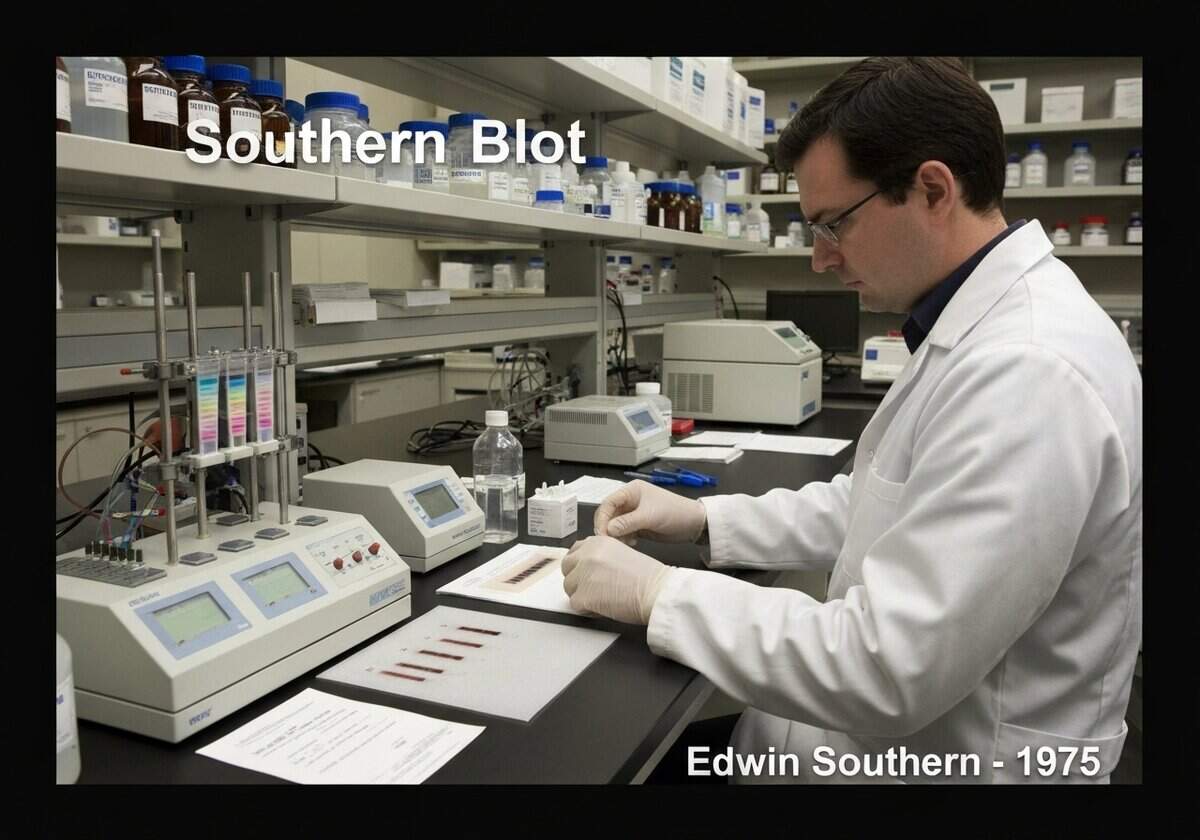
Escena de laboratorio que demuestra la técnica Southern blot para el análisis del ADN en genética molecular.

(Imagen generada únicamente con fines ilustrativos)

La transferencia Southern es un método Se utiliza para la detección de una secuencia de ADN específica en una muestra de ADN. Combina la transferencia de fragmentos de ADN separados por electroforesis a una membrana de filtro con la posterior detección de los fragmentos mediante una sonda de ADN marcada. Esta técnica permite a los investigadores identificar un gen específico dentro de una mezcla compleja de ADN basándose en su tamaño y secuencia.


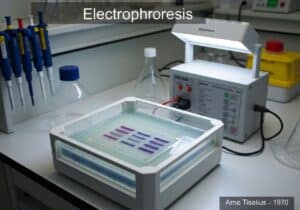
The Southern blot, named after its inventor Edwin Southern, is a powerful and specific method for detecting a target DNA sequence within a complex mixture of DNA. It was a foundational technique in molecular genetics before the widespread adoption of PCR and sequencing. The process is a multi-step procedure that combines size separation with specific molecular recognition. It begins with the digestion of the total genomic DNA sample using one or more restriction enzymes, which cleaves the DNA into fragments of varying sizes. These fragments are then separated according to their size by agarose gel electrophoresis. The gel now contains a smear of countless DNA fragments, sorted by length. The crucial next step is the transfer, or ‘blotting,’ of these separated DNA fragments from the fragile gel onto a more durable membrane, typically made of nitrocellulose or nylon. This is achieved through capillary action, which wicks a buffer solution through the gel and the membrane, carrying the DNA along with it and immobilizing it on the membrane’s surface. The DNA is first denatured into single strands so it can bind to the probe. The membrane now holds a faithful replica of the DNA fragment pattern from the gel. To find the specific gene of interest among the thousands of fragments, a labeled probe is used. This probe is a single-stranded piece of DNA (or RNA) that has a sequence complementary to the target gene and is tagged with a marker, such as a radioactive isotope ([latex]^{32}P[/latex]) or a fluorescent/chemiluminescent molecule. The membrane is incubated with this probe, which hybridizes (forms a double helix) only with its complementary DNA fragment on the membrane. After washing away any unbound probe, the location of the hybridized probe is detected, revealing a band that corresponds to the size of the DNA fragment containing the target gene.

UNESCO Nomenclature: 2406
- Biología molecular

Tipo

Proceso químico

Ruptura

Incremental

Uso

Nicho/Especialización

Precursores

  • gel electrophoresis for DNA separation
  • discovery of restriction enzymes
  • understanding of DNA hybridization principles
  • development of radioactive labeling techniques for probes
  • techniques for creating nitrocellulose membranes

Aplicaciones

  • gene mapping
  • diagnosing genetic diseases (e.g., sickle cell anemia)
  • identifying gene mutations or rearrangements
  • forensic DNA analysis (RFLP)
  • paternity testing
  • detecting transgenes in GMOs

Patentes:

NA

Ideas para posibles innovaciones

Debido al bloqueo del tráfico generado por bots, que actualmente supera los 40.000 al día, este contenido está reservado para los miembros de la comunidad.
> Iniciar sesión < o > Registrarse < (100% gratis) para acceder a esto, al igual que a todo el demás contenido y herramientas restringidos.

Related to: Southern blot, Edwin Southern, DNA detection, hybridization, DNA probe, RFLP, blotting, molecular biology, gene identification, electrophoresis.

Contexto histórico

Southern Blot

1960
1970
1973
1975
1979
1983
1988
1960
1967
1970
1975
1977
1983
1987
1990

(Si la fecha es desconocida o no es relevante, por ejemplo "mecánica de fluidos", se proporciona una estimación redondeada de su aparición notable)

Invención, innovación y principios técnicos relacionados.

Las imágenes a tamaño completo y las descargas sólo están disponibles, 100% gratis, para los miembros registrados.

> Acceso <