Product Design, Manufacturing & Innovation Resources
Hogar » Espectroscopia

Espectroscopia

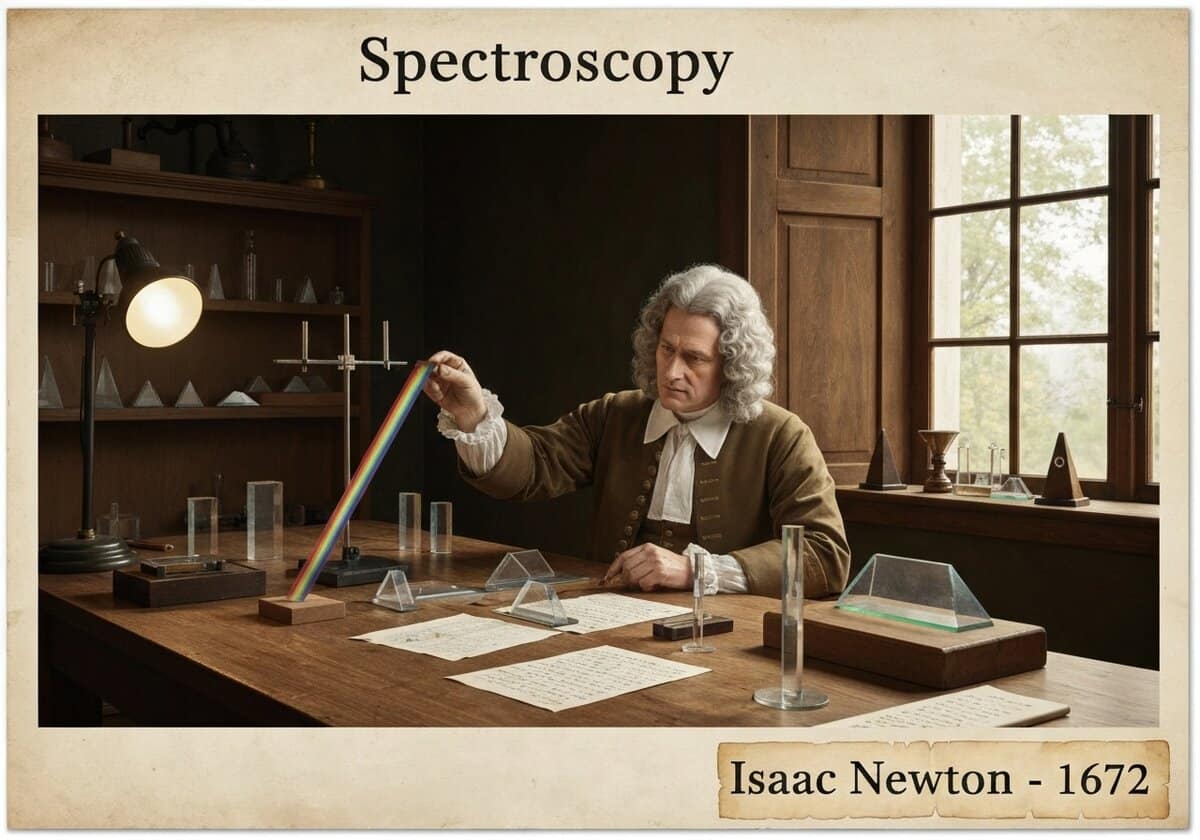
1672
  • Isaac Newton
Isaac Newton conducting spectroscopy experiments with prisms and light in a historical laboratory.

(Imagen generada únicamente con fines ilustrativos)

Espectroscopia is the study of the interaction between matter and electromagnetic radiation as a function of the radiation’s wavelength or frequency. A spectroscopic instrument produces a spectrum by dispersing the radiation according to its wavelength. This spectrum reveals how the matter absorbs, emits, or scatters the radiation, providing information about the matter’s composition, structure, and physical properties.

The core idea of spectroscopy is that different materials interact with light (or any electromagnetic radiation) in unique ways. When radiation passes through a substance or is emitted by it, specific wavelengths are absorbed or emitted, creating a characteristic pattern or “spectrum”. This pattern is like a fingerprint for the atoms, molecules, or ions in the substance. The positions of the spectral lines (dark for absorption, bright for emission) correspond to the energy differences between quantum states of the material. For example, an electron in an atom can jump to a higher energy level by absorbing a photon of a specific energy, or it can fall to a lower level by emitting a photon. The energy of this photon is directly related to its frequency and wavelength. By analyzing the intensity and position of these lines, scientists can deduce the chemical composition, temperature, density, and motion of the object being studied. This principle applies across the entire electromagnetic spectrum, from radio waves to gamma rays, leading to a vast array of spectroscopic techniques tailored for different types of analysis.

UNESCO Nomenclature: 2209
– Optics

Tipo

Sistema abstracto

Ruptura

Revolucionario

Uso

Uso generalizado

Precursores

  • Isaac Newton’s experiments with prisms demonstrating the dispersion of white light (1672)
  • Descubrimiento de la naturaleza ondulatoria de la luz por Christiaan Huygens (1678)
  • Desarrollo del concepto de átomos y elementos

Aplicaciones

  • observación astronómica de cuerpos celestes
  • análisis químico
  • diagnósticos médicos
  • ciencias de los materiales
  • monitoreo ambiental

Patentes:

NA

Ideas para posibles innovaciones

  • Monitorización de glucosa en sangre en tiempo real mediante espectroscopia cutánea no invasiva
  • Escáneres de alimentos portátiles para detectar alérgenos y contenido nutricional
  • Drones de contaminación atmosférica que mapean las concentraciones de contaminantes en 3D
  • automated clasificación systems for plastics recycling based on infrared spectral signatures
  • Detección temprana del cáncer mediante el análisis de biomarcadores espectrales en el aliento
  • Herramientas de prospección de minerales en campo para operaciones mineras
  • Sensores de control de calidad para líneas de fabricación farmacéutica
  • wearable sensors to detect dehydration levels in athletes
  • Autenticación de arte mediante el análisis de la composición de pigmentos sin dañar la obra de arte.
  • Sensores de agricultura inteligente para determinar los niveles de nutrientes del suelo y la salud de los cultivos
Related to: spectroscopy, electromagnetic radiation, spectrum, wavelength, absorption, emission, chemical analysis, matter-light interaction, quantum states, frequency.

Contexto histórico

Espectroscopia

1650
1650
1672
1687
1687
1738
1750
1600
1650
1650
1678
1687
1687
1738
1750

(Si la fecha es desconocida o no es relevante, por ejemplo "mecánica de fluidos", se proporciona una estimación redondeada de su aparición notable)

décimo año aniversario

Las imágenes en tamaño completo y las descargas solo están disponibles, de forma totalmente gratuita, para los miembros registrados.

> Acceso <