Product Design, Manufacturing & Innovation Resources
Lar » Espectroscopia

Espectroscopia

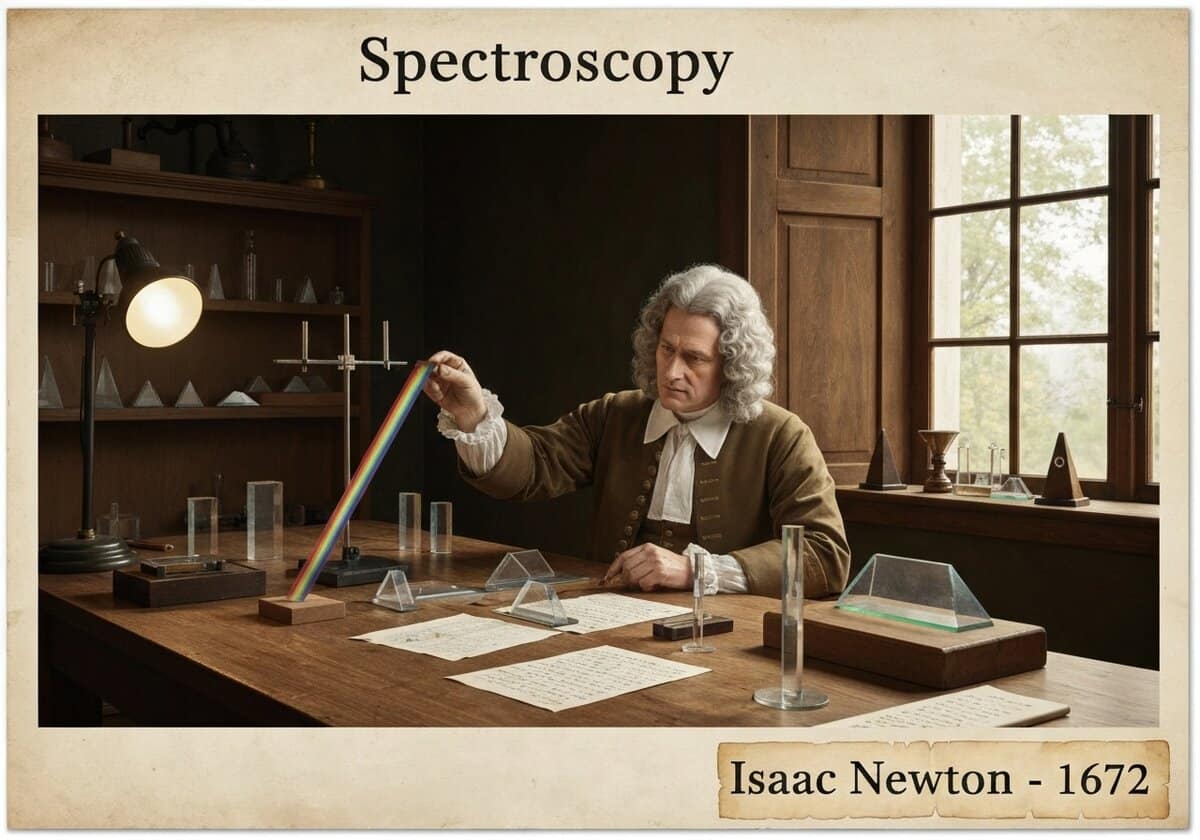
1672
  • Isaac Newton
Isaac Newton realizando experimentos de espectroscopia com prismas e luz em um laboratório histórico.

(Imagem gerada apenas para fins ilustrativos)

Spectroscopy is the study of the interaction between matter and electromagnetic radiation as a function of the radiation’s wavelength or frequency. A spectroscopic instrument produces a spectrum by dispersing the radiation according to its wavelength. This spectrum reveals how the matter absorbs, emits, or scatters the radiation, providing information about the matter’s composition, structure, and physical properties.

The core idea of espectroscopia is that different materials interact with light (or any electromagnetic radiation) in unique ways. When radiation passes through a substance or is emitted by it, specific wavelengths are absorbed or emitted, creating a characteristic pattern or “spectrum”. This pattern is like a fingerprint for the atoms, molecules, or ions in the substance. The positions of the spectral lines (dark for absorption, bright for emission) correspond to the energy differences between quantum states of the material. For example, an electron in an atom can jump to a higher energy level by absorbing a photon of a specific energy, or it can fall to a lower level by emitting a photon. The energy of this photon is directly related to its frequency and wavelength. By analyzing the intensity and position of these lines, scientists can deduce the chemical composition, temperature, density, and motion of the object being studied. This principle applies across the entire electromagnetic spectrum, from radio waves to gamma rays, leading to a vast array of spectroscopic techniques tailored for different types of analysis.

UNESCO Nomenclature: 2209
Óptica

Tipo

Sistema abstrato

Interrupção

Revolucionário

Uso

Uso generalizado

Precursores

  • Experimentos de Isaac Newton com prismas demonstrando a dispersão da luz branca (1672)
  • Descoberta da natureza ondulatória da luz por Christiaan Huygens (1678)
  • Desenvolvimento do conceito de átomos e elementos

Aplicações

  • observação astronômica de corpos celestes
  • análise química
  • diagnósticos médicos
  • ciência dos materiais
  • monitoramento ambiental

Patentes:

NA

Ideias de Inovação Potencial

  • real-time blood glucose monitoring via non-invasive skin spectroscopy
  • handheld food scanners to detect allergens and nutritional content
  • atmospheric pollution drones that map pollutant concentrations in 3d
  • automated classificação systems for plastics recycling based on infrared spectral signatures
  • early-stage cancer detection through analysis of spectral biomarkers in breath
  • in-field mineral prospecting tools for mining operations
  • controle de qualidade sensors for pharmaceutical manufacturing lines
  • vestível sensors to detect dehydration levels in athletes
  • art authentication by analyzing pigment composition without damaging the artwork
  • smart farming sensors to determine soil nutrient levels and crop health
Relacionado a: espectroscopia, radiação eletromagnética, espectro, comprimento de onda, absorção, emissão, análise química, interação matéria-luz, estados quânticos, frequência.

Contexto histórico

Espectroscopia

1650
1650
1672
1687
1687
1738
1750
1600
1650
1650
1678
1687
1687
1738
1750

(Caso a data seja desconhecida ou irrelevante, por exemplo, "mecânica dos fluidos", é fornecida uma estimativa aproximada de seu surgimento notável)

10º ano aniversário

Imagens em tamanho real e downloads estão disponíveis apenas, 100% gratuitos, para membros registrados.