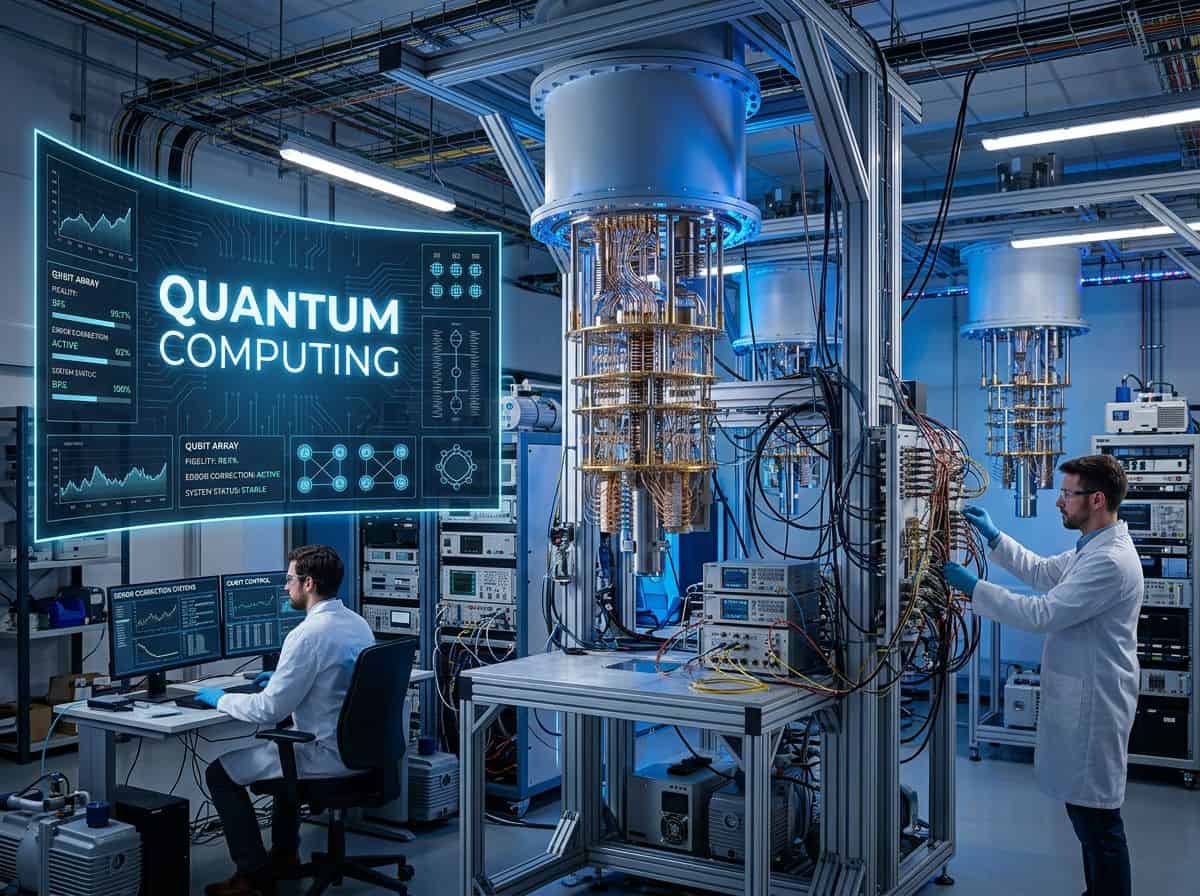

La computación cuántica utiliza la superposición, el entrelazamiento y la interferencia para procesar información de maneras que la lógica clásica no puede reproducir eficientemente. Los cúbits se implementan en diversas plataformas: circuitos superconductores, iones atrapados, átomos neutros, espines en silicio y modos fotónicos. Cada plataforma presenta diferencias en cuanto a tiempo de coherencia, fidelidad de puerta lógica, conectividad y facilidad de fabricación. La detección cuántica se basa en la misma física. Los centros de vacantes de nitrógeno, los vapores atómicos y los interferómetros superconductores alcanzan resoluciones magnéticas, gravitacionales y temporales que los instrumentos convencionales no pueden igualar.
La principal barrera de ingeniería es el error. Los cúbits físicos pierden coherencia en cuestión de microsegundos o segundos, por lo que las máquinas útiles requieren corrección de errores cuánticos, cúbits lógicos y una gran pila de control clásico que opere a temperaturas criogénicas. Los refrigeradores de dilución, la tecnología CMOS criogénica, la densidad de cableado y el software de calibración limitan la escalabilidad tanto como los propios cúbits. Las publicaciones y patentes indexadas a continuación abarcan arquitecturas de cúbits, códigos de corrección de errores, hardware de control y lectura, métodos de compilación, algoritmos híbridos cuántico-clásicos y sensores cuánticos.
Las computadoras cuánticas necesitan hardware frío y silencioso y una corrección de errores inteligente. La refrigeración es fundamental. criogenia y materiales superconductores en superconductores de alta temperaturaLas consecuencias para la seguridad están en cifrado. Los rivales clásicos para problemas difíciles están en computación de alto rendimiento y computación fotónica.
Esta es nuestra selección más reciente de publicaciones y patentes mundiales en inglés sobre computación cuántica, entre numerosas revistas científicas en línea, clasificadas y centradas en procesador cuántico, cúbit, cúbit superconductor, cúbit de ion atrapado, cúbit de átomo neutro, cúbit de espín, cúbit fotónico, corrección de errores cuánticos, cúbit lógico, código de superficie, fidelidad de puerta cuántica, tiempo de coherencia del cúbit, refrigerador de dilución, electrónica de control criogénico, recocido cuántico, algoritmo cuántico variacional, detección cuántica, computación cuántica, centro de vacancia de nitrógeno y magnetómetro cuántico.
acoustic quantum analogue computing including encoding, encrypting, and decrypting information
Patent published on the 2026-11-12 in WO under Ref WO2026235712 by UNIV ARIZONA [US] (Deymier Pierre [us], Runge Keith [us], Ige Akinsanmi [us], Cavalluzzi David [us], Djordjevic Ivan B [us])
Abstract: A framework and methods for performing permutation operations using phi-bits, acoustic analogues of qubits, is disclosed. Possible permutations of a four component state vector describing the state of logical phi-bits in a complex Hilbert space are illustrated. Aspects include a scalable inversion operation which displays the extraordinary power of the exponentially scaling complex Hilbert space to realize quantum analogue computing at scale. In addition, systems and methods for encoding, encryp[...]
Our summary: This content discusses a framework for acoustic quantum analogue computing using phi-bits for encoding, encrypting, and decrypting information. It illustrates permutation operations within a complex Hilbert space, showcasing scalable inversion operations. The methods leverage driven acoustic metamaterials to support cryptographic applications with superpositions akin to quantum bits.
acoustic quantum computing, phi-bits, encryption, Hilbert space
Patent
Method for determining a position information of a mobile magnetic arrangement, device, quantum computer system, computer program, and computer-readab
Patent published on the 2026-11-12 in WO under Ref WO2026233678 by ELEQTRON GMBH [DE] (Siebeneich Hendrik [de], KÖppen Florian [de], Johanning Michael [de], Yaghoubi Pedram [de])
Abstract: A method for determining a position information of a mobile magnetic arrangement is specified for providing an offset magnetic field to a processing region of a quantum computing device, the method comprising: - providing a current magnetic field information characteristic of a current magnetic field in the processing region, wherein the current magnetic field information comprises at least one external magnetic field component, - determining the offset magnetic field dependent on the current ma[...]
Our summary: The method determines the position of a mobile magnetic arrangement in a quantum computing device. It provides an offset magnetic field to dominate external magnetic field components. The process relies on current magnetic field information to ascertain the position relative to the processing region.
magnetic arrangement, quantum computing, position determination, offset magnetic field
Patent
Semiconductor device and manufacturing method thereof
Patent published on the 2026-11-12 in US under Ref US20260362755 by TAIWAN SEMICONDUCTOR MFG [TW] (Radu Iuliana [tw], Chiang Hung-li [tw], Han Hung-chi [tw], Wang Jer-fu [tw], Arutchelvan Goutham [tw], Cheng Chao-ching [tw])
Abstract: A semiconductor device includes a substrate, a first quantum dot transistor structure and a second quantum dot transistor structure. The substrate has a first side and a second side opposite to the first side. The first quantum dot transistor structure is disposed on the first side. The second quantum dot transistor structure disposed on the second side for spin readout of a plurality of quantum dot qubits in the first quantum dot transistor structure.[...]
Our summary: The semiconductor device features a substrate with two sides. It includes a first quantum dot transistor structure on one side and a second on the opposite side. The second structure is used for spin readout of quantum dot qubits in the first structure.
Quantum dot, semiconductor device, spin readout, manufacturing method
Patent
Quantum-derived positional encoding for large language models
Patent published on the 2026-11-12 in US under Ref US20260359627 by MULTIVERSE COMPUTING S L [ES] (Aizpurua Borja [es], Orus Roman [es])
Abstract: [0000] A method and system for training a transformer-based language model, in particular a large language model, or inferring using a transformer-based language model, in particular a large language model, with a hybrid quantum-classical pipeline comprising a classical processor and a quantum processor, wherein. the model comprises a transformer layer, the method comprising: inputting a prompt comprising a sequence of tokens in the classical processor; constructing, with the classical processor[...]
Our summary: The method involves training a transformer-based language model using a hybrid quantum-classical pipeline. A token graph is constructed from input prompts, representing tokens and their relationships. Quantum positional encodings are generated and injected into the model for processing.
Quantum encoding, Transformer model, Hybrid quantum-classical, Token graph
Patent
Casimir-effect-based tunnel transistor using graphene-doped conductors
Patent published on the 2026-11-12 in US under Ref US20260362730 by QUBIT SEMICONDUCTOR LLC [US] (Dannemiller Douglas [us])
Abstract: [0000] The invention introduces a tunnel transistor with a dynamically tunable gate potential, enabling rapid and low-power electronic state transitions without traditional electrostatic gating. It comprises a graphene-doped source and drain electrode, a vacuum tunneling barrier with a central graphene layer for controlled single electron tunneling, and a gate structure that alters the separation of the source and drain nano-electromechanical switching using Casimir force. By varying the distanc[...]
Our summary: The invention presents a tunnel transistor with a tunable gate potential for low-power electronic transitions. It utilizes graphene-doped electrodes and a vacuum tunneling barrier for controlled single electron tunneling. The device enhances spin coherence and enables qubit manipulation through varying the barrier width and Fermi level.
tunnel transistor, graphene doping, single electron tunneling, Casimir effect
Patent
Quantum sensing and metrology with free electrons
Patent published on the 2026-11-11 in EP under Ref EP4838296 by INST CATALANA DE RECERCA I ESTUDIS AVANCATS ICREA [ES] (Garcia De Abajo Javier [es], Velasco Cruz Ignacio [es])
Abstract: [0001] A system for quantum sensing and metrology with free electrons, including one or more subsystems, each subsystem comprising: an electron source configured to provide an incident beam of electrons; at least one optical waveguide and at least one corresponding gate element of the at least one optical waveguide, respectively; the at least one optical waveguide exhibiting respective electromagnetic modes confined within the waveguide; one or more electron beam collimation and focusing element[...]
Our summary: The system enables quantum sensing and metrology using free electrons. It includes an electron source, optical waveguides, and gate elements to control electron trajectories. The interaction generates photons that are detected to measure the electron beam s intensity.
Quantum sensing, free electrons, optical waveguide, metrology
Patent
Algebraic structures of the Lindblad equation
Published on 2026-11-10 by Leonel Bixano, Guillermo Lpez-Alvarez, Victor Alberto Cruz-Barriguete, Vctor Guadalupe Ibarra-Sierra, Jos Luis Cardoso, Juan Carlos Sandoval-Santana and Alejandro Kunold @IOP SCIENCE
Abstract: We investigate the algebraic structure underlying the Lindblad equation for finite-dimensional open quantum systems. Using an orthonormal Hermitian operator basis, we represent the Liouville superoperator in a model-independent basis of Hermitian superoperators realizing the standard left–right multiplication maps. We express their multiplication, commutator, and anticommutator relations explicitly in terms of the Lie and Jordan structure constants of the underlying operator basis. This formul[...]
Our summary: This study explores the algebraic structure of the Lindblad equation for finite-dimensional open quantum systems. It details the representation of the Liouville superoperator and its relations in terms of Lie and Jordan structure constants. The findings highlight computational efficiencies and limitations of algebraic implementations in multiqubit systems.
Lindblad equation, algebraic structure, superoperator algebra, quantum systems
Publication
Unitary realizations of synchronizing automata in quantum systems
Published on 2026-11-04 by J?drzej Stempin, Jan Wjcik, Gabriela Banaszak, Andrzej Grudka, Marcin Karczewski, Pawe? Kurzy?ski and Antoni Wjcik @IOP SCIENCE
Abstract: We introduce a quantum analogue of a classical synchronizing automaton. In the classical case the state of a system evolves according to a set of rules forming an alphabet, and sequences of these rules, called words, govern its evolution. Certain special words, known as synchronizing words, drive the automaton into a predetermined state regardless of its initial configuration. Although such an apparently irreversible process seems incompatible with the unitarity of quantum mechanics, we present [...]
Our summary: We present a quantum version of classical synchronizing automata using auxiliary qubits. A resetting protocol allows the automaton to evolve into a predetermined state independent of its initial configuration. The entanglement generated depends on the rule set and the initial state of the automaton.
quantum automata, synchronizing words, unitary operations, entanglement
Publication