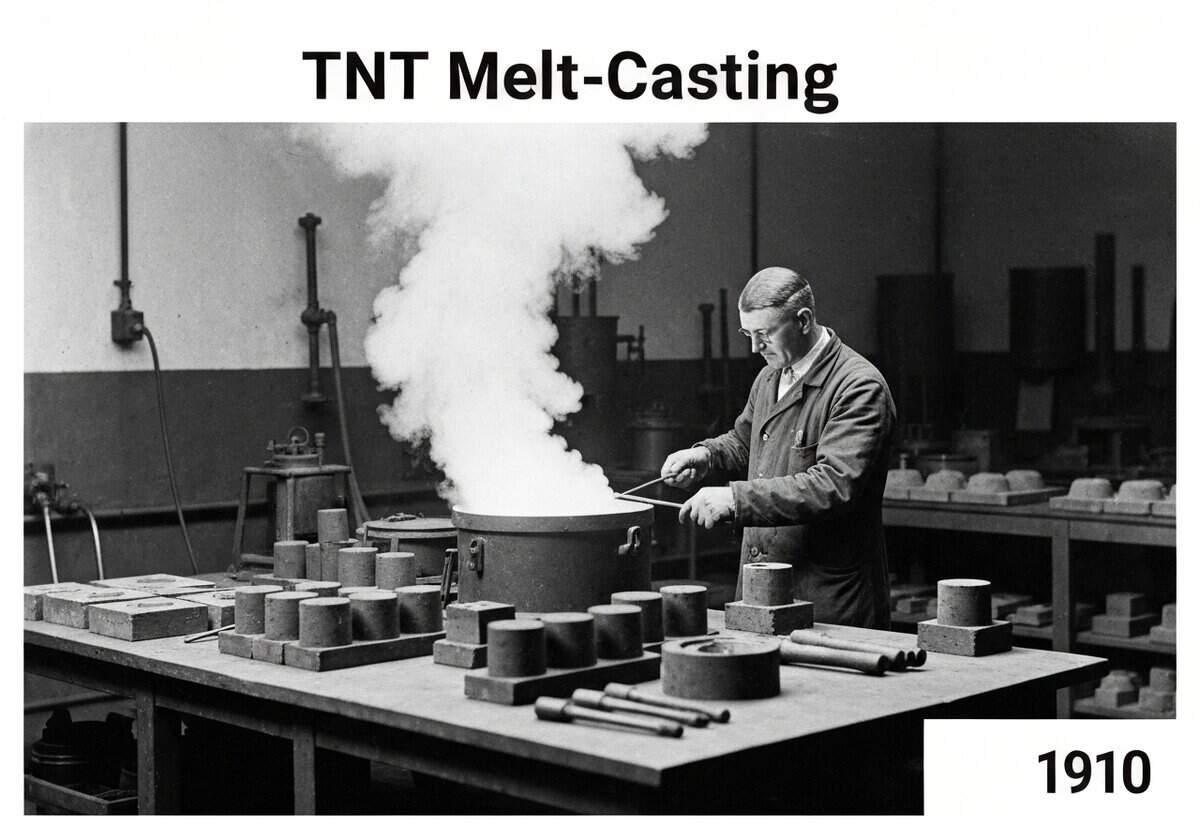
TNT 的一个关键特性是其熔点低,仅为 80.6 °C (177.1 °F),远低于其 240 °C 的自燃温度。如此大的温差使得 TNT 能够安全地用蒸汽或热水熔化,并浇铸到弹药外壳中,这一过程称为熔铸。这使得生产致密、均匀且无裂纹的炸药成为可能。
The ability to melt-cast TNT was a revolutionary development in munitions technology. Before TNT, explosives like picric acid were used, but they were corrosive to metal casings and more sensitive. TNT’s chemical inertness and thermal stability provided a significant advantage. The process involves heating solid TNT flakes in large, steam-jacketed kettles until it becomes a liquid with a viscosity similar to water. This liquid explosive can then be poured directly into shell casings, bombs, or molds of any shape.
As the liquid TNT cools and solidifies, it contracts slightly. This requires careful management of the cooling process to avoid the formation of voids or cracks, which can create dangerous “hot spots” that might lead to premature detonation upon impact. To achieve a dense, uniform charge, the molten TNT is often poured in stages, with subsequent pours filling the contraction voids of the previous layer. This technique ensures the final explosive charge is solid, stable, and has a predictable detonation performance. The melt-castability of TNT also facilitated the creation of composite explosives, such as Composition B, where molten TNT acts as a castable matrix for more powerful but non-meltable crystalline explosives like RDX, combining the safety of TNT with the power of RDX.
Related to: melt-casting, TNT, explosives, munitions, artillery shell, melting point, composition b, shaped charge, demolition block, chemical engineering.