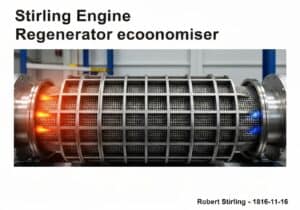
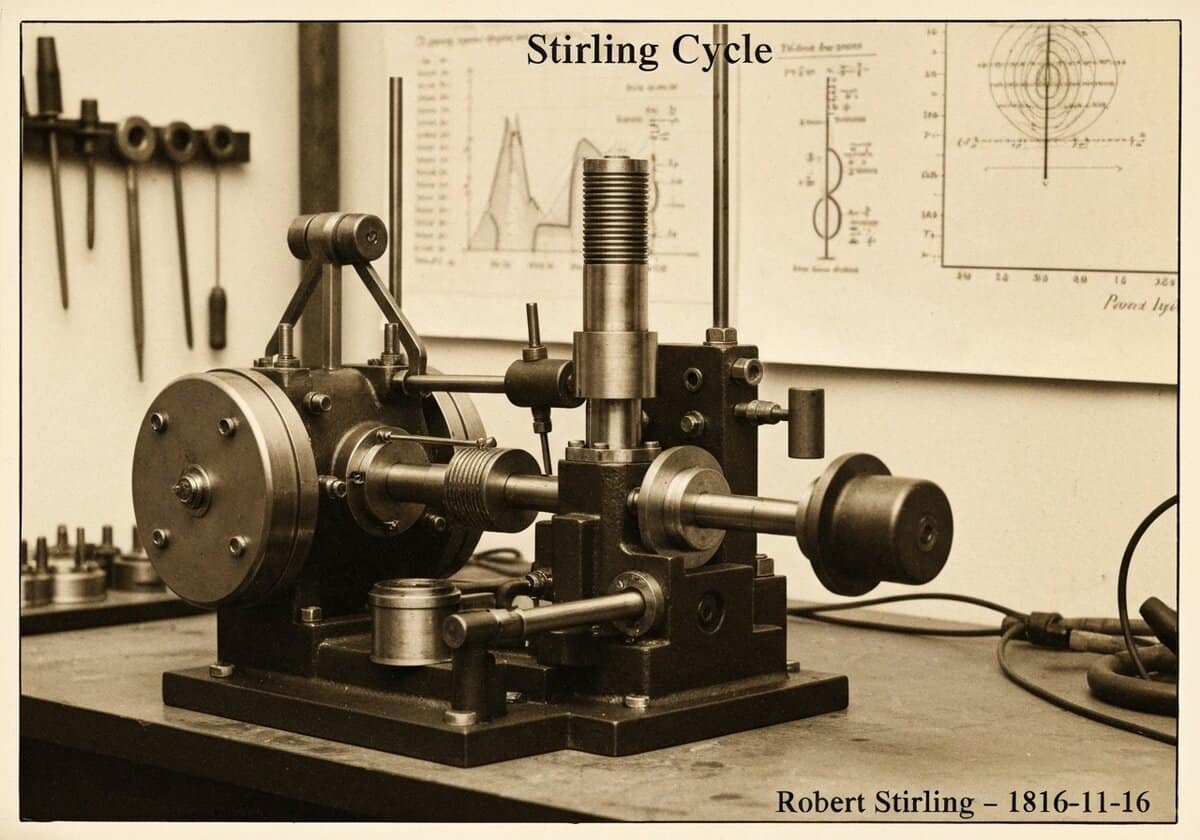
The Stirling cycle’s four processes can be visualized on a Pressure-Volume (P-V) diagram. Process 1-2 is isothermal expansion, where the gas expands at a constant high temperature [latex]T_H[/latex], absorbing heat from the external source and performing work on the surroundings. Process 2-3 is isochoric (constant volume) heat removal, where the gas is passed through the regenerator, cooling to the low temperature [latex]T_C[/latex] and transferring heat to the regenerator matrix. Process 3-4 is isothermal compression, where the gas is compressed at constant temperature [latex]T_C[/latex], rejecting heat to the cold sink while work is done on the gas. Finally, process 4-1 is isochoric heat addition, where the gas passes back through the regenerator, picking up the stored heat and returning to temperature [latex]T_H[/latex].