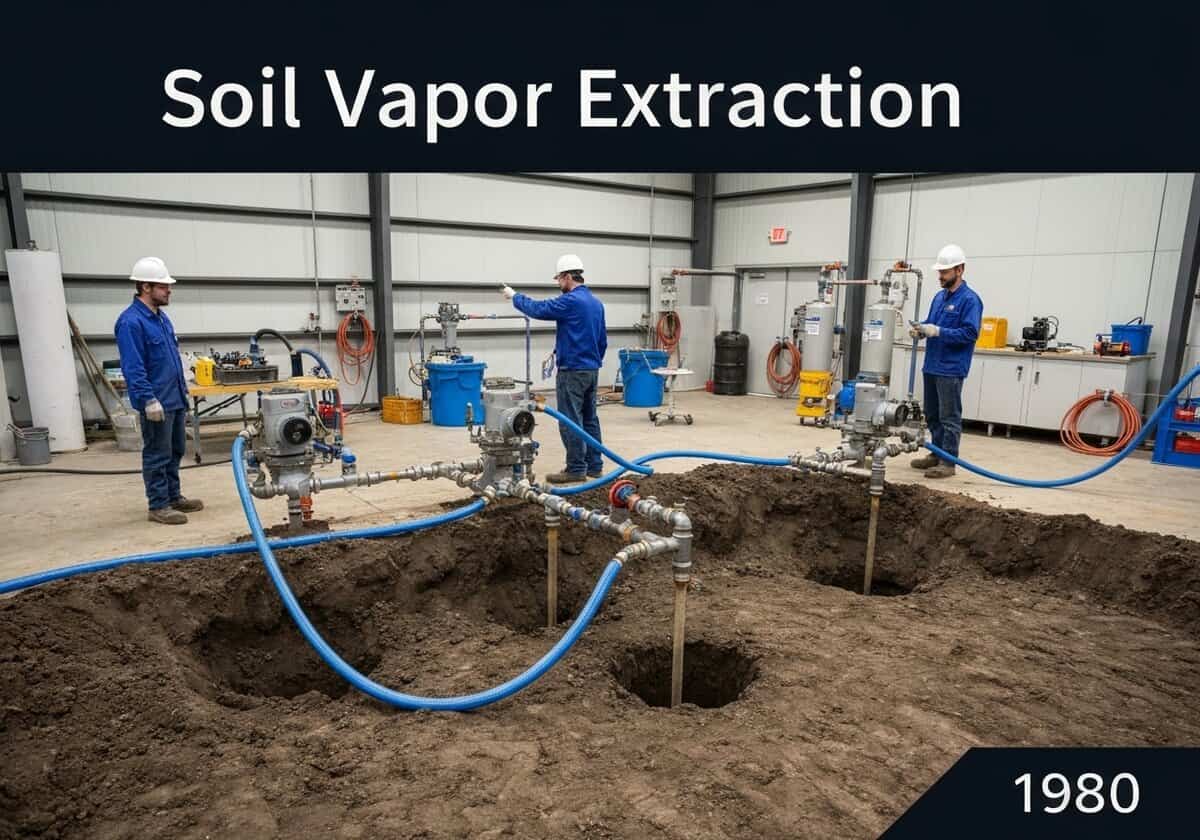
Soil Vapor Extraction operates on the principle of volatilization. By applying a vacuum, SVE lowers the pressure in the soil pore space, causing volatile contaminants adsorbed to soil particles or dissolved in soil moisture to partition into the vapor phase. This contaminated vapor is then drawn towards extraction wells. The effectiveness of SVE is highly dependent on the contaminant’s volatility, described by its Henry’s Law constant and vapor pressure, and the soil’s permeability. It works best in sandy or gravelly soils with high air permeability and is less effective in tight, low-permeability clays.