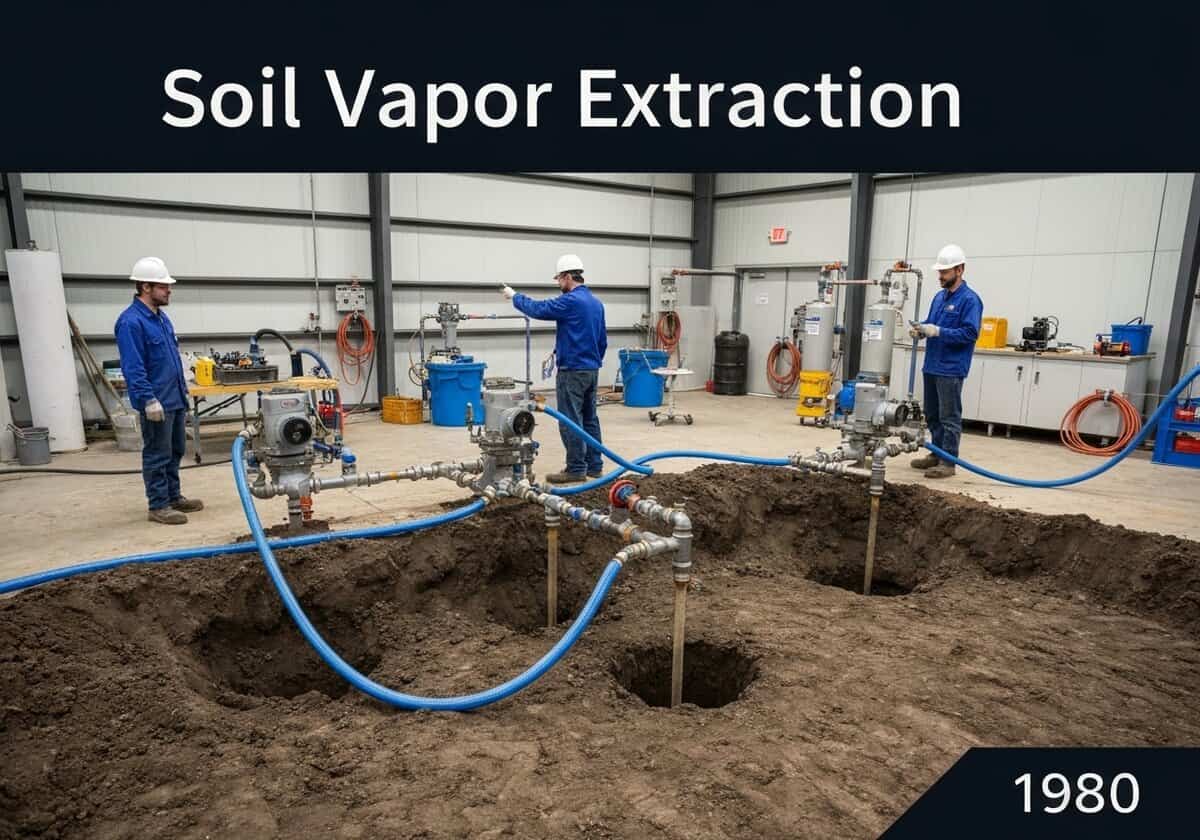
Soil Vapor Extraction operates on the principle of volatilization. By applying a vacuum, SVE lowers the pressure in the soil pore space, causing volatile contaminants adsorbed to soil particles or dissolved in soil moisture to partition into the vapor phase. This contaminated vapor is then drawn towards extraction wells. The effectiveness of SVE is highly dependent on the contaminant’s volatility, described by its Henry’s Law constant and vapor pressure, and the soil’s permeability. It works best in sandy or gravelly soils with high air permeability and is less effective in tight, low-permeability clays.
A typical SVE system consists of extraction wells, vacuum blowers, and an off-gas treatment system. The extracted vapor, laden with contaminants, cannot be directly released into the atmosphere. It must be treated, commonly using methods like granular activated carbon (GAC) adsorption, thermal oxidation, or catalytic oxidation to destroy the VOCs. SVE is often combined with other technologies. For instance, air sparging can be used concurrently to treat saturated zones below the water table. In this combined approach, air is injected into the groundwater, stripping volatile contaminants, which then travel up into the vadose zone where the SVE system captures them. This makes SVE a versatile and relatively low-cost solution for specific types of contamination.