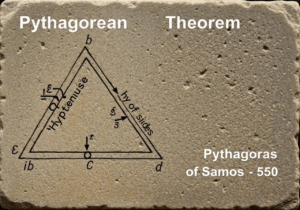
勾股定理由三个正整数 a、b 和 c 组成,满足 a² + b² = c²。一个著名的例子是 (3, 4, 5)。欧几里得的公式是基本的 方法 用于生成这些三元组。给定任意两个正整数 m 和 n,且 [latex]m > n[/latex],公式 [latex]a = m^2 – n^2[/latex],[latex]b = 2mn[/latex],[latex]c = m^2 + n^2[/latex] 生成一个勾股数三元组。
勾股数三元组是指满足勾股定理 [latex]a² + b² = c²[/latex] 的三个正整数 [latex](a, b, c)[/latex]。这些三元组表示边长为整数的直角三角形。最简单也最著名的勾股数三元组是 (3, 4, 5),因为 [latex]3² + 4² = 9 + 16 = 25 = 5²[/latex]。如果 a、b 和 c 除了 1 以外没有其他公约数,则称该三元组为“本原数三元组”。例如,(3, 4, 5) 是本原数三元组,但 (6, 8, 10) 只是 (3, 4, 5) 的倍数,因此不是本原数三元组。
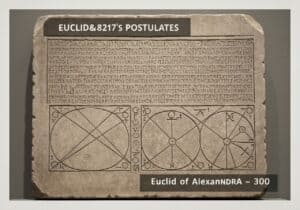
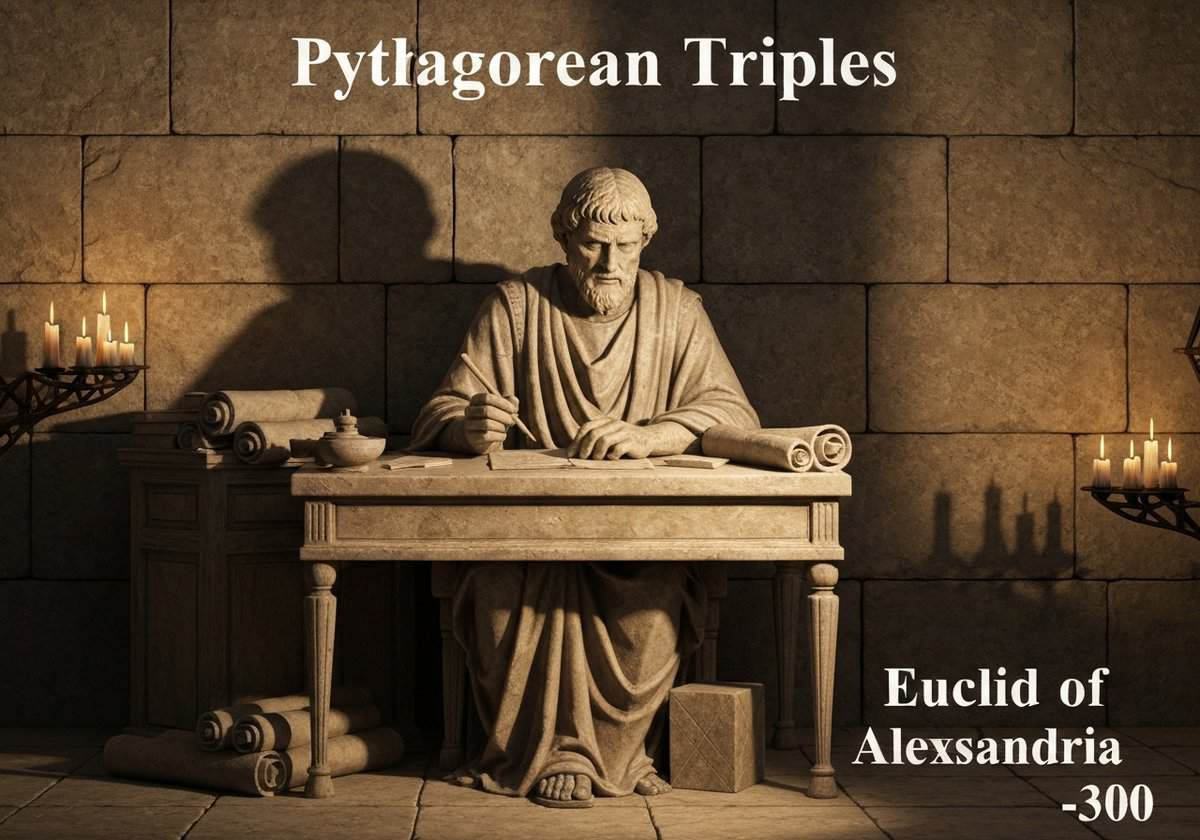
The study of these triples bridges the gap between geometry and number theory. The challenge is not just to find individual triples, but to find a systematic way to generate all of them. This problem was solved by Euclid of Alexandria. In his “Elements” (Book X, Proposition 29), he presented a formula that can generate all primitive Pythagorean triples. The formula requires two positive integers, m and n, which are coprime (share no common factors) and are not both odd, with [latex]m > n[/latex]. The triple is then given by: [latex]a = m^2 – n^2[/latex], [latex]b = 2mn[/latex], [latex]c = m^2 + n^2[/latex]. For example, if we choose [latex]m=2[/latex] and [latex]n=1[/latex], we generate the triple [latex]a = 2^2 – 1^2 = 3[/latex], [latex]b = 2(2)(1) = 4[/latex], and [latex]c = 2^2 + 1^2 = 5[/latex], which is the classic (3, 4, 5) triple. If we choose [latex]m=3[/latex] and [latex]n=2[/latex], we get the primitive triple (5, 12, 13).
这个公式非常强大,因为它将求解二次丢番图方程(具有整数解的方程)的问题转化为一个简单的代换过程。它揭示了整数及其与几何关系中蕴含的深层结构。这种参数化方法的存在产生了深远的影响,影响了其他丢番图方程的研究,包括著名的费马大定理。费马大定理探讨了对于任何大于 2 的整数 n,方程 a^n + b^n = c^n 都不存在整数解的结论。