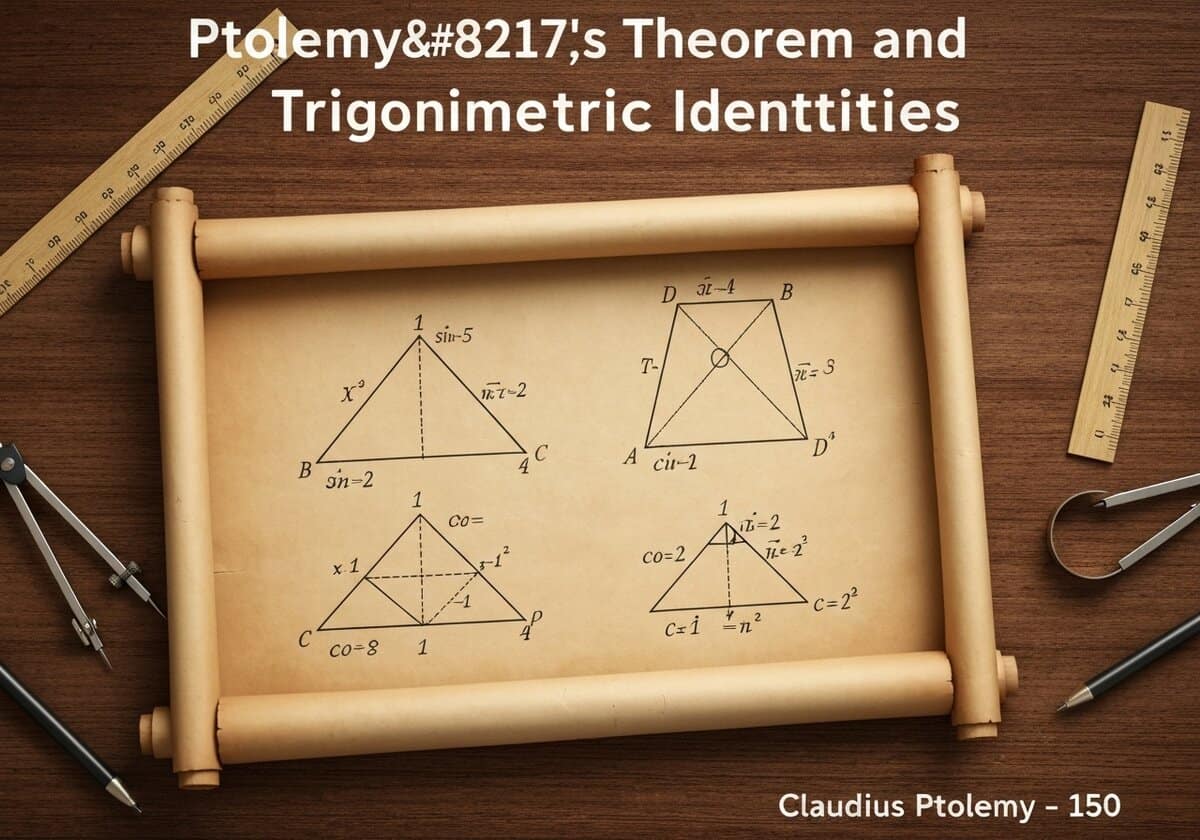
托勒密定理为三角学中的和与差公式提供了一个优雅的几何证明。通过将四边形内接于一个圆,其中四边形的一条边作为直径,四边形的边长可以表示为圆周角的正弦和余弦。直接应用定理[latex]AC cdot BD = AB cdot CD + BC cdot DA[/latex],即可得到诸如[latex]sin(alpha + beta) = sinalphacosbeta + cosalphasinbeta[/latex]之类的恒等式。


(图片仅供参考)
托勒密定理为三角学中的和与差公式提供了一个优雅的几何证明。通过将四边形内接于一个圆,其中四边形的一条边作为直径,四边形的边长可以表示为圆周角的正弦和余弦。直接应用定理[latex]AC cdot BD = AB cdot CD + BC cdot DA[/latex],即可得到诸如[latex]sin(alpha + beta) = sinalphacosbeta + cosalphasinbeta[/latex]之类的恒等式。
托勒密定理的历史重要性与三角学的发展密切相关。托勒密在《天文学大成》中的目标是建立一个宇宙的数学模型,这需要一种计算天体位置的工具。这种工具就是弦表,它列出了在固定半径的圆中,与给定角度对应的弦的长度。弦函数 crd(θ) 与现代正弦函数的关系为 sin(θ) = crd(2θ)/2R,其中 R 是圆的半径。
To derive the sum and difference formulas, one can construct a cyclic quadrilateral ABCD where the diagonal AC is a diameter of the circumcircle, which we can set to have length 1 for simplicity. Let [latex]\angle CAD = \alpha[/latex] and [latex]\angle CAB = \beta[/latex]. Because angles subtended by a diameter are right angles, [latex]\triangle ADC[/latex] and [latex]\triangle ABC[/latex] are right-angled triangles. The side lengths can be expressed trigonometrically: [latex]CD = \sin\alpha[/latex], [latex]AD = \cos\alpha[/latex], [latex]BC = \sin\beta[/latex], and [latex]AB = \cos\beta[/latex]. The angle [latex]\angle DAB = \alpha+\beta[/latex]. Using the law of sines in [latex]\triangle DAB[/latex], the other diagonal [latex]BD = \sin(\alpha+\beta)[/latex]. Plugging these into Ptolemy’s theorem [latex]AC \cdot BD = AB \cdot CD + BC \cdot DA[/latex] gives [latex]1 \cdot \sin(\alpha+\beta) = (\cos\beta)(\sin\alpha) + (\sin\beta)(\cos\alpha)[/latex], which is the angle addition formula for sine. Similar constructions yield the other sum and difference identities, forming the bedrock of trigonometry.
托勒密定理与三角恒等式
(如果日期未知或不相关,例如“流体力学”,则提供其显著出现的近似估计)

只有注册会员才能免费获得 100% 的全尺寸图片和下载。.
> 登录 <