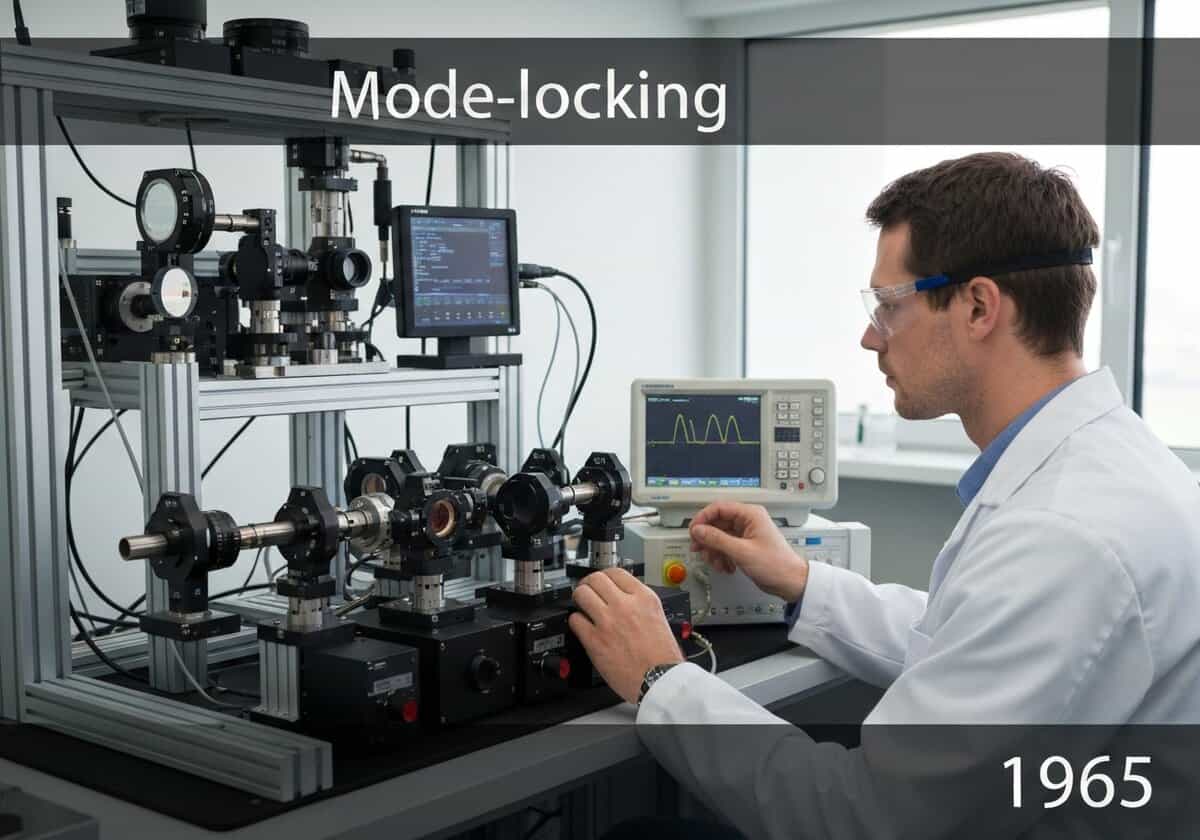
The duration of a mode-locked pulse is inversely proportional to the spectral bandwidth of the gain medium. A wider gain bandwidth supports more longitudinal modes, which can be locked to create a shorter pulse. This is governed by the Fourier uncertainty principle: [latex]\Delta t \Delta u \ge K[/latex], where [latex]\Delta t[/latex] is the pulse duration, [latex]\Delta u[/latex] is the spectral bandwidth, and K is a constant near unity. Techniques for achieving mode-locking can be active (using an external modulator like an acousto-optic modulator) or passive (using a saturable absorber, a material whose absorption decreases at high light intensity). Passive mode-locking, particularly Kerr-lens mode-locking, has produced the shortest pulses to date, reaching the attosecond ([latex]10^{-18}[/latex] s) regime.