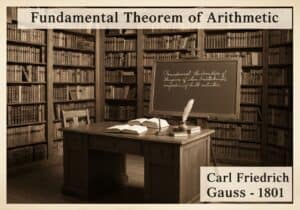
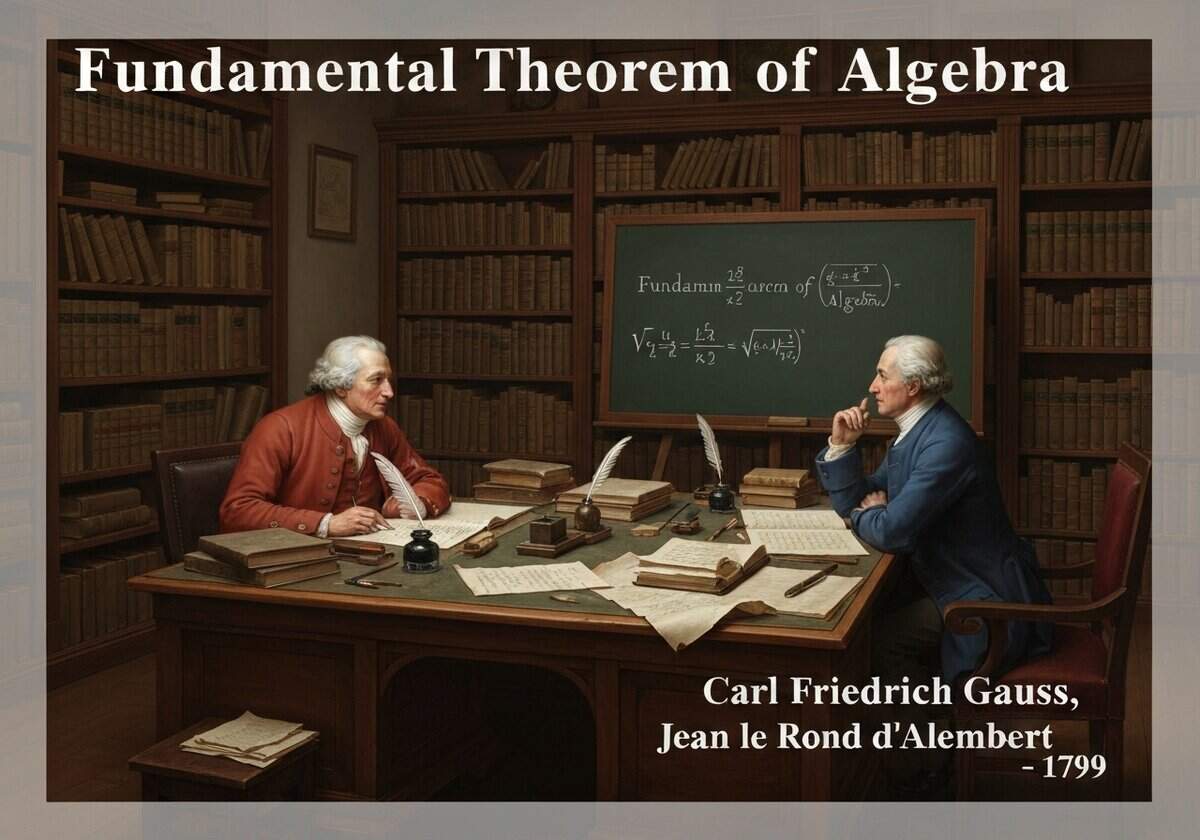
代数基本定理指出,每个非常量单变量复系数多项式至少有一个复数根。这保证了复数域具有代数闭性,即无法用实数求解的多项式方程可用复数求解。 对于多项式 \(p(z) = a_n z^n + \dots + a_1 z + a_0\),存在复数 \(z_0 \in \mathbb{C}\) 使得 \(p(z_0) = 0\)。.

(图片仅供参考)
代数基本定理指出,每个非常量单变量复系数多项式至少有一个复数根。这保证了复数域具有代数闭性,即无法用实数求解的多项式方程可用复数求解。 对于多项式 \(p(z) = a_n z^n + \dots + a_1 z + a_0\),存在复数 \(z_0 \in \mathbb{C}\) 使得 \(p(z_0) = 0\)。.
The theorem is a cornerstone of algebra, asserting the completeness of the complex number system for polynomial equations. While its statement is straightforward, its proof is not purely algebraic and typically requires concepts from analysis or topology. The theorem implies that any polynomial of degree [latex]n[/latex] can be factored into [latex]n[/latex] linear factors over the complex numbers: [latex]p(z) = a_n(z-z_1)(z-z_2)\cdots(z-z_n)[/latex], where [latex]z_1, \dots, z_n[/latex] are the complex roots. This factorization is unique up to the ordering of the roots.
从历史上看,对这类定理的需求源于对多项式方程的研究。16世纪,意大利数学家卡尔达诺和塔尔塔利亚找到了三次和四次方程的解,这些解有时涉及负数的平方根,暗示了复数的必要性。然而,正式的表述和证明尝试出现得较晚。达朗贝尔在1746年做出了重要的尝试,但他的证明存在漏洞。卡尔·弗里德里希·高斯在其1799年的博士论文中给出了第一个较为严谨的证明,尽管按照现代标准来看,他的证明也存在一些拓扑学上的缺陷。之后,他又提出了其他几个不同的证明。
代数基本定理
(如果日期未知或不相关,例如“流体力学”,则提供其显著出现的近似估计)
只有注册会员才能免费获得 100% 的全尺寸图片和下载。.
> 登录 <