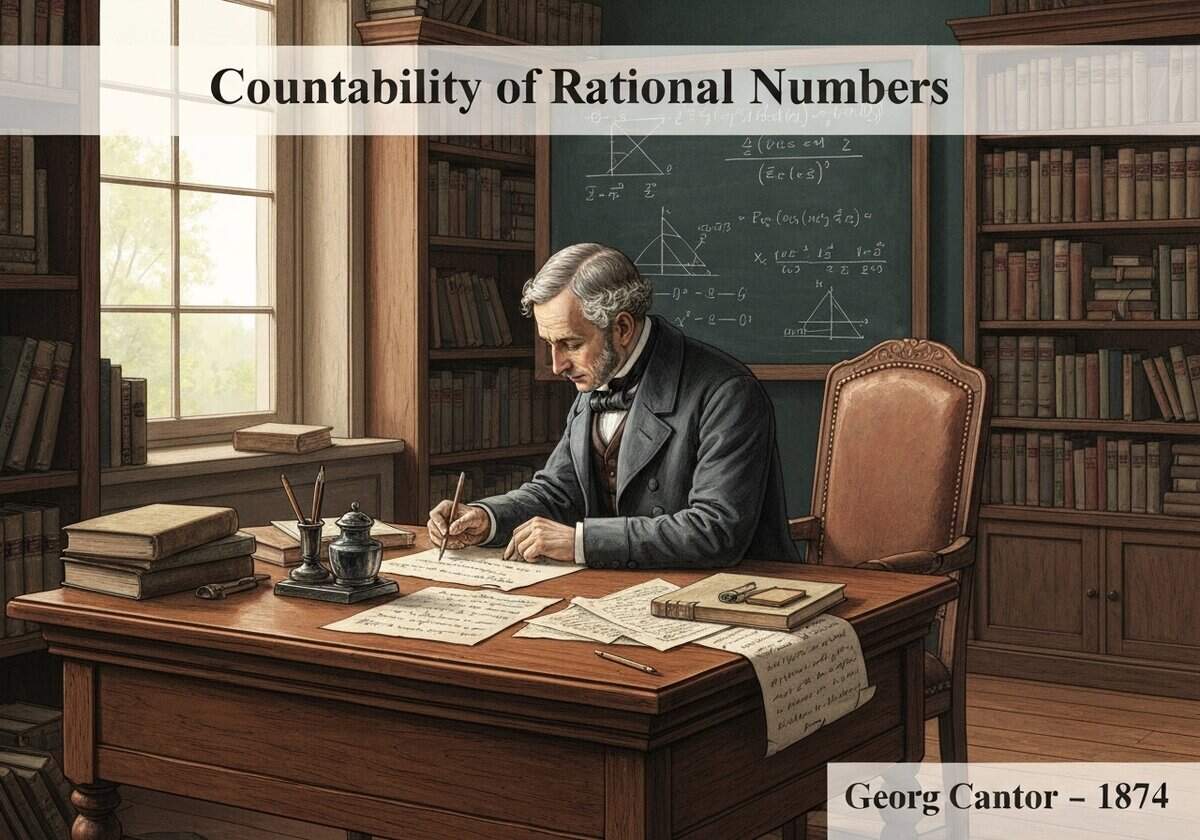
尽管有理数集 [latex]mathbb{Q}[/latex] 稠密(即任意两个不同的有理数之间都存在另一个有理数),但它却是可数无限的。这意味着所有有理数都可以与自然数集 [latex]mathbb{N} = {1, 2, 3, }[/latex] 一一对应。这一令人惊讶的结果表明,[latex]mathbb{Q}[/latex] 与 [latex]mathbb{N}[/latex] 和 [latex]mathbb{Z}[/latex] 具有相同的基数。

(图片仅供参考)
尽管有理数集 [latex]mathbb{Q}[/latex] 稠密(即任意两个不同的有理数之间都存在另一个有理数),但它却是可数无限的。这意味着所有有理数都可以与自然数集 [latex]mathbb{N} = {1, 2, 3, }[/latex] 一一对应。这一令人惊讶的结果表明,[latex]mathbb{Q}[/latex] 与 [latex]mathbb{N}[/latex] 和 [latex]mathbb{Z}[/latex] 具有相同的基数。
Georg Cantor’s proof of the countability of rational numbers was a landmark in the development of set theory and our understanding of infinity. The proof is constructive and elegant. One common method is to arrange all positive rational numbers [latex]p/q[/latex] in a two-dimensional grid where the row index is [latex]p[/latex] and the column index is [latex]q[/latex]. Then, one can traverse this grid diagonally, starting from [latex]1/1[/latex], then [latex]2/1, 1/2[/latex], then [latex]3/1, 2/2, 1/3[/latex], and so on. This path, known as Cantor’s diagonal argument (though the term is more famous for his proof of the uncountability of the reals), systematically lists every positive rational number.
在遍历过程中,任何非最简分数(例如 2/2 或 2/4)都会被跳过,以确保每个有理数只被计数一次。这个过程会生成一个包含所有正有理数的有序列表。为了包含所有有理数,可以将正有理数列表与其对应的负有理数列表交错排列,并在列表开头放置零:0, 1, -1, 1/2, -1/2, 2, -2, 0。这显式地构造了自然数集和有理数集之间的一一对应关系,证明了有理数集是可数的。
这个结果与直觉相悖,因为有理数是稠密的。任意两个有理数之间总能找到另一个(例如,它们的平均值),这表明有理数比整数“更多”,而整数之间存在明显的空隙。康托尔的证明表明,这种直觉是误导性的,无限集的“大小”(即它的基数)更为微妙。他后来证明了实数集是不可数的,从而建立了一个无穷的层级结构。
有理数的可数性
(如果日期未知或不相关,例如“流体力学”,则提供其显著出现的近似估计)

只有注册会员才能免费获得 100% 的全尺寸图片和下载。.
> 登录 <