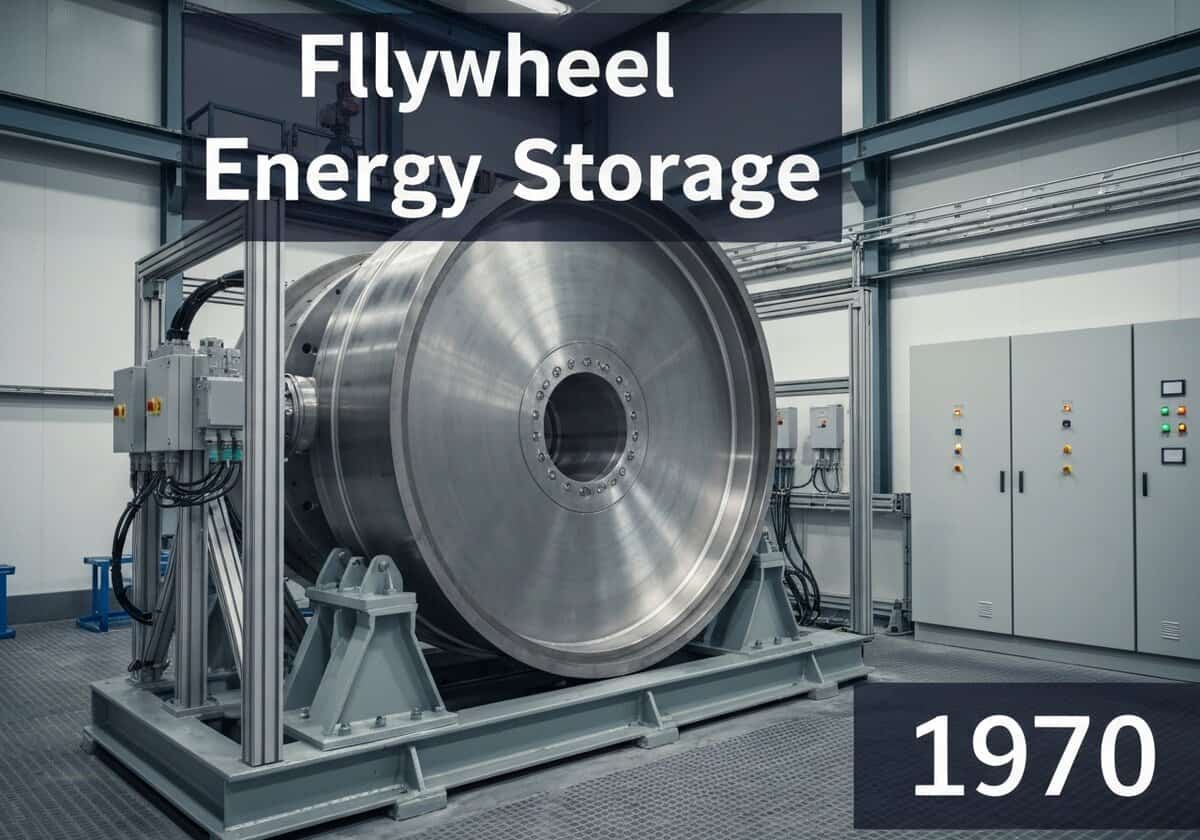
飞轮储能(FES)的工作原理是将转子(飞轮)加速到极高的速度,并将能量以旋转动能的形式储存在系统中。储存的能量与转速的平方成正比。当能量被提取时,飞轮的转速会减慢。储存能量的公式为[latex]E = frac{1}{2} I omega^2[/latex],其中I是转动惯量,ω是角速度。
A modern FES system consists of a massive rotor spinning in a near-vacuum enclosure to minimize air friction. The rotor is connected to a motor/generator. To store energy, the motor uses electricity to spin the flywheel up to speed. To release energy, the spinning flywheel drives the generator, producing electricity and slowing the rotor down. The amount of energy stored is given by [latex]E = frac{1}{2} I omega^2[/latex]. To maximize energy storage, rotors are designed to have a high moment of inertia and be able to withstand the immense centrifugal forces at very high rotational speeds (tens of thousands of RPM). Advanced FES systems use rotors made from high-strength carbon-fiber composites and employ magnetic bearings to eliminate friction from mechanical contact, allowing for extremely high efficiency (often over 90%) and very long lifespans with minimal degradation (hundreds of thousands of cycles). FES is particularly well-suited for applications requiring frequent, rapid charge and discharge cycles, such as grid frequency regulation, as it can respond to power fluctuations in milliseconds.