Product Design, Manufacturing & Innovation Resources
» 发动机爆震

发动机爆震

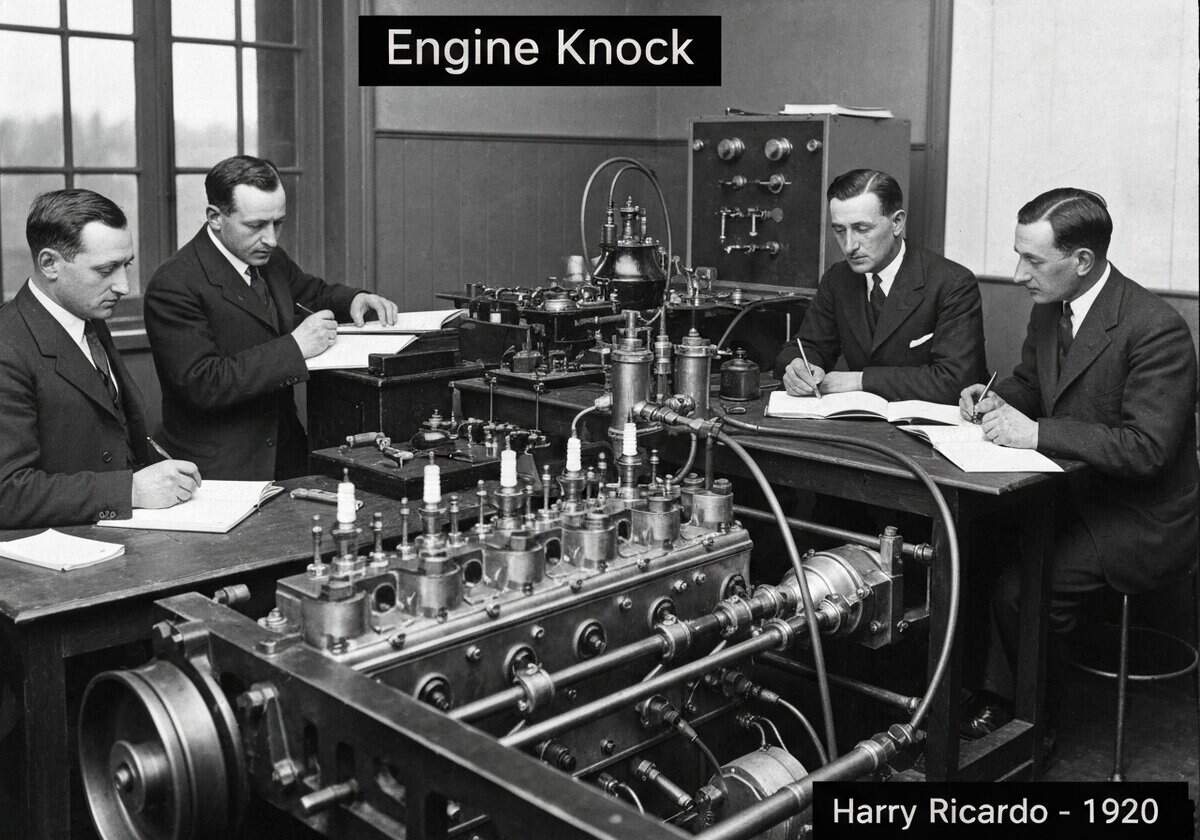
1920
  • Harry Ricardo
20 世纪 20 年代汽车实验室的奥托循环发动机分析,重点是燃烧效率。.

(图片仅供参考)

Engine knock, or detonation, is a major constraint on the thermal efficiency of an Otto cycle engine. While higher compression ratios increase efficiency, they also raise the temperature and 压力 of the air-fuel mixture during compression. This can cause the mixture to auto-ignite prematurely, creating a shockwave that produces a ‘knocking’ sound and can damage the engine.

Engine knock occurs when a portion of the unburned air-fuel mixture (the end gas) ahead of the propagating flame front from the spark plug spontaneously ignites. This auto-ignition is caused by the end gas being compressed and heated beyond its auto-ignition temperature by both the piston’s compression stroke and the advancing flame front. The resulting combustion is extremely rapid and uncontrolled, creating a pressure wave that travels through the cylinder at supersonic speeds. This shockwave collides with the cylinder walls and piston crown, causing the characteristic metallic pinging or knocking sound.

The consequences of severe or prolonged engine knock are significant. The intense pressure spikes can lead to mechanical failure, including cracked pistons, broken piston rings, and damaged cylinder heads. The extreme temperatures can also cause pitting and erosion of metal surfaces. To prevent knock, several strategies are employed. The most fundamental is limiting the engine’s compression ratio to a level suitable for the available fuel. Fuel quality, measured by its octane rating, indicates its resistance to auto-ignition. Higher octane fuels allow for higher compression ratios. Modern engines use sophisticated electronic control systems with knock sensors (essentially microphones tuned to the frequency of knock) that detect the onset of detonation and instruct the engine control unit (ECU) to retard ignition timing, which reduces cylinder pressure and stops the knock.

UNESCO Nomenclature: 3305
- 化学工程

类型

物理现象

中断

递增

用法

广泛使用

前体

  • 高压缩比奥托循环发动机的研发
  • 发动机故障模式的观察
  • 对化学动力学和自燃温度的基本了解
  • 能够测量缸内压力的仪器

应用程序

  • 高辛烷值燃料的开发
  • 使用抗爆剂,例如四乙基铅(以前)和乙醇(现在)
  • 带爆震传感器的发动机控制单元(ECU)
  • 设计燃烧室形状以防止热点
  • 带中冷器的涡轮增压和机械增压

专利:

NA

潜在创新理念

由于机器人流量被拦截(目前每天超过 4 万),此内容仅限社区成员查看。
> 登录 > 或者 > 注册 < (100% 免费)即可访问此内容,以及所有其他受限内容和工具。

Related to: engine knock, detonation, compression ratio, octane rating, auto-ignition, spark-ignition engine, pre-ignition, harry ricardo, anti-knock agent, engine damage.

历史背景

发动机爆震

1910
1920
1920
1920
1922
1924
1927
1910
1910
1920
1920
1920
1922
1925-01-01
1930

(如果日期未知或不相关,例如“流体力学”,则提供其显著出现的近似估计)

相关发明、创新和技术原理

只有注册会员才能免费获得 100% 的全尺寸图片和下载。.

> 登录 <