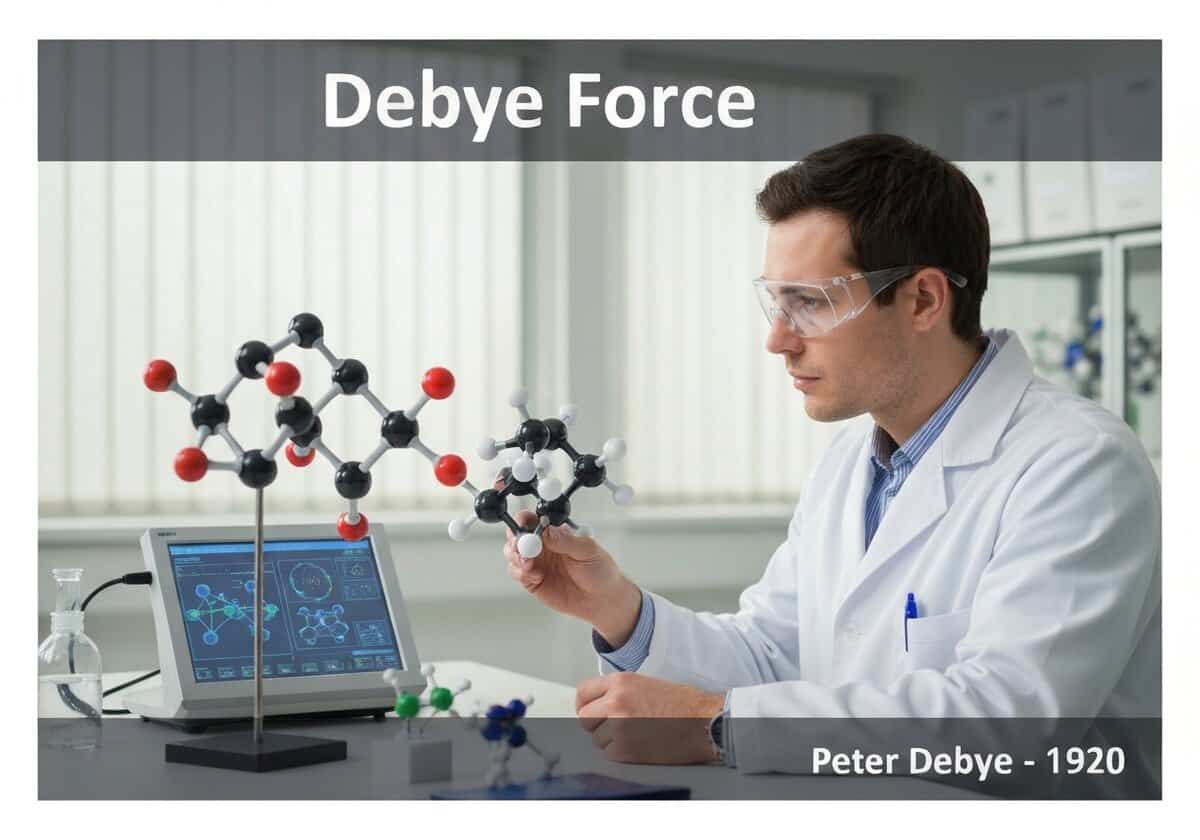
极性分子(具有永久电势)之间的一种吸引力分子间作用力。 偶极子)和一个非极性分子。永久偶极子产生的电场会使非极性分子的电子云发生畸变,从而在其中感应出一个瞬态偶极子。这两个偶极子相互吸引。相互作用势能为 [latex]V propto -frac{alpha mu^2}{r^6}[/latex],其中 [latex]alpha[/latex] 为极化率,[latex]mu[/latex] 为永久偶极矩。 偶极矩.

(图片仅供参考)
极性分子(具有永久电势)之间的一种吸引力分子间作用力。 偶极子)和一个非极性分子。永久偶极子产生的电场会使非极性分子的电子云发生畸变,从而在其中感应出一个瞬态偶极子。这两个偶极子相互吸引。相互作用势能为 [latex]V propto -frac{alpha mu^2}{r^6}[/latex],其中 [latex]alpha[/latex] 为极化率,[latex]mu[/latex] 为永久偶极矩。 偶极矩.

德拜力,也称为感应力,解释了极性分子如何吸引非极性分子。极性分子具有永久电偶极矩,在其周围产生电场。当非极性分子进入该电场时,其电子云发生畸变——电子被推离偶极矩的负极,并被拉向正极。这种电荷分离会在非极性分子中产生一个暂时的“感应”偶极矩。由于感应偶极矩始终相对于产生它的永久偶极矩具有有利的方向,因此这种相互作用始终是吸引力。
Unlike the Keesom force, the Debye force is not dependent on temperature. This is because the induced dipole is created by the permanent dipole and follows its orientation instantaneously, so thermal tumbling of the permanent dipole does not average out the attraction. The strength of the Debye force depends on two factors: the magnitude of the permanent dipole moment ([latex]\mu[/latex]) of the polar molecule and the polarizability ([latex]\alpha[/latex]) of the nonpolar molecule. While generally weaker than dipole-dipole forces, Debye forces are essential for understanding the behavior of mixtures containing both polar and nonpolar components.
德拜力(偶极子诱导偶极子相互作用)
(如果日期未知或不相关,例如“流体力学”,则提供其显著出现的近似估计)
只有注册会员才能免费获得 100% 的全尺寸图片和下载。.
> 登录 <