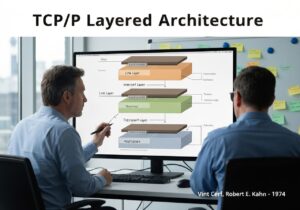
数据封装是指将数据在协议栈中逐层封装,并附上协议信息的过程。当应用层数据传递到传输层时, TCP 或者 UDP 添加头部后,该数据段会被传递到网络层,在那里添加 IP 头部以形成数据包。最后,链路层添加自己的头部,从而创建一个用于传输的帧。
Data encapsulation is a core mechanism that enables the layered architecture of the TCP/IP suite to function. Each layer operates independently, concerned only with its own protocol header. When a sending host prepares data, each layer adds its header containing control information specific to that layer’s function. For example, the TCP header includes port numbers for application identification and sequence numbers for reliability. The IP header includes source and destination IP addresses for routing. The link-layer header (e.g., Ethernet) includes MAC addresses for local delivery. At the receiving host, the process is reversed in a process called de-encapsulation. As the data moves up the stack, each layer strips off its corresponding header, reads the control information, and passes the remaining payload up to the next layer. This modular process ensures that, for instance, the IP layer doesn’t need to know what application generated the data, and the link layer doesn’t need to know the final destination IP address—it only cares about the next hop’s physical address.