Product Design, Manufacturing & Innovation Resources
» 气体的临界温度

气体的临界温度

1869
  • Thomas Andrews
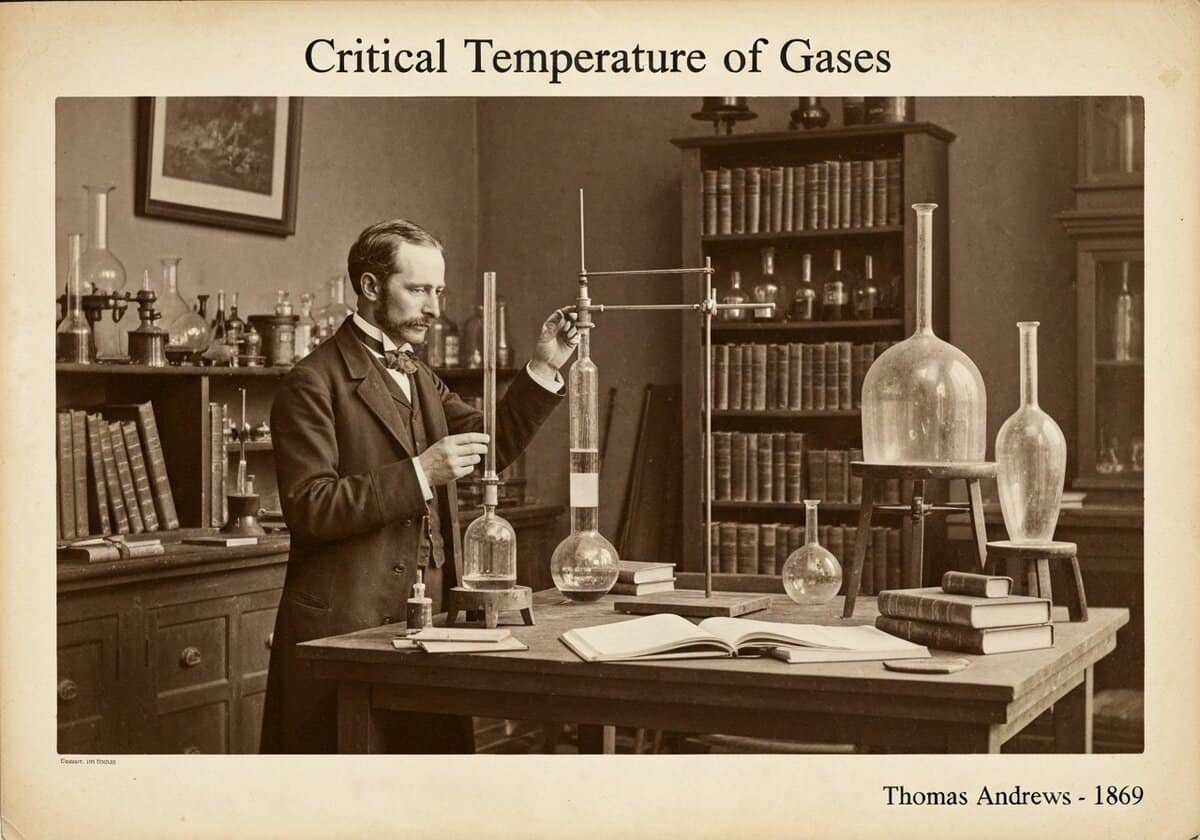
19 世纪的实验室场景,展示热力学中气体的临界温度。.

(图片仅供参考)

The critical temperature is the temperature above which a distinct liquid phase cannot be formed, regardless of the applied 压力. Each gas has a unique critical temperature. To liquefy a gas, it must first be cooled below this temperature. This concept, established by Thomas Andrews, is fundamental to understanding the conditions required for any liquefaction process.

Thomas Andrews’ experiments in the 1860s on carbon dioxide were pivotal. He meticulously measured its pressure-volume-temperature (P-V-T) relationships and discovered that above approximately 30.98 °C (304.1 K), CO2 could not be liquefied no matter how much pressure was applied. He termed this the ‘critical temperature.’ Below this temperature, increasing the pressure on the gas would eventually cause it to condense into a liquid. At the critical temperature itself, the gas transitions into a liquid at a specific ‘critical pressure’ and ‘critical volume,’ a state known as the critical point. At this point, the densities of the liquid and gas phases become equal, and the meniscus separating them disappears. The substance becomes a supercritical fluid, possessing properties of both a gas and a liquid. This discovery was crucial because it explained why earlier attempts by scientists like Faraday to liquefy gases such as oxygen, nitrogen, and hydrogen had failed; they were not cooling the gases below their respective, much lower, critical temperatures, a prerequisite for liquefaction by compression.

UNESCO Nomenclature: 2212
- 热力学

类型

物理原理

中断

基础

用法

广泛使用

前体

  • 波义耳定律(压力与体积之间的关系)
  • Charles’s Law (relationship between volume and temperature)
  • Amagat’s experiments on gas compressibility at high pressures
  • Michael Faraday’s earlier, partially successful attempts at gas liquefaction

应用程序

  • 天然气液化(LNG)
  • 生产用于工业和医疗用途的液氧和液氮
  • 制冷和空调系统
  • 超临界流体萃取(例如咖啡脱咖啡因)
  • 超临界流体色谱法

专利:

NA

潜在创新理念

由于机器人流量被拦截(目前每天超过 4 万),此内容仅限社区成员查看。
> 登录 > 或者 > 注册 < (100% 免费)即可访问此内容,以及所有其他受限内容和工具。

Related to: critical temperature, phase transition, liquefaction, Thomas Andrews, critical point, gas, liquid, pressure, thermodynamics, supercritical fluid.

历史背景

气体的临界温度

1860
1861
1865
1869
1871
1876
1877
1859
1861
1865
1868
1870
1873
1877
1880

(如果日期未知或不相关,例如“流体力学”,则提供其显著出现的近似估计)

相关发明、创新和技术原理

只有注册会员才能免费获得 100% 的全尺寸图片和下载。.

> 登录 <