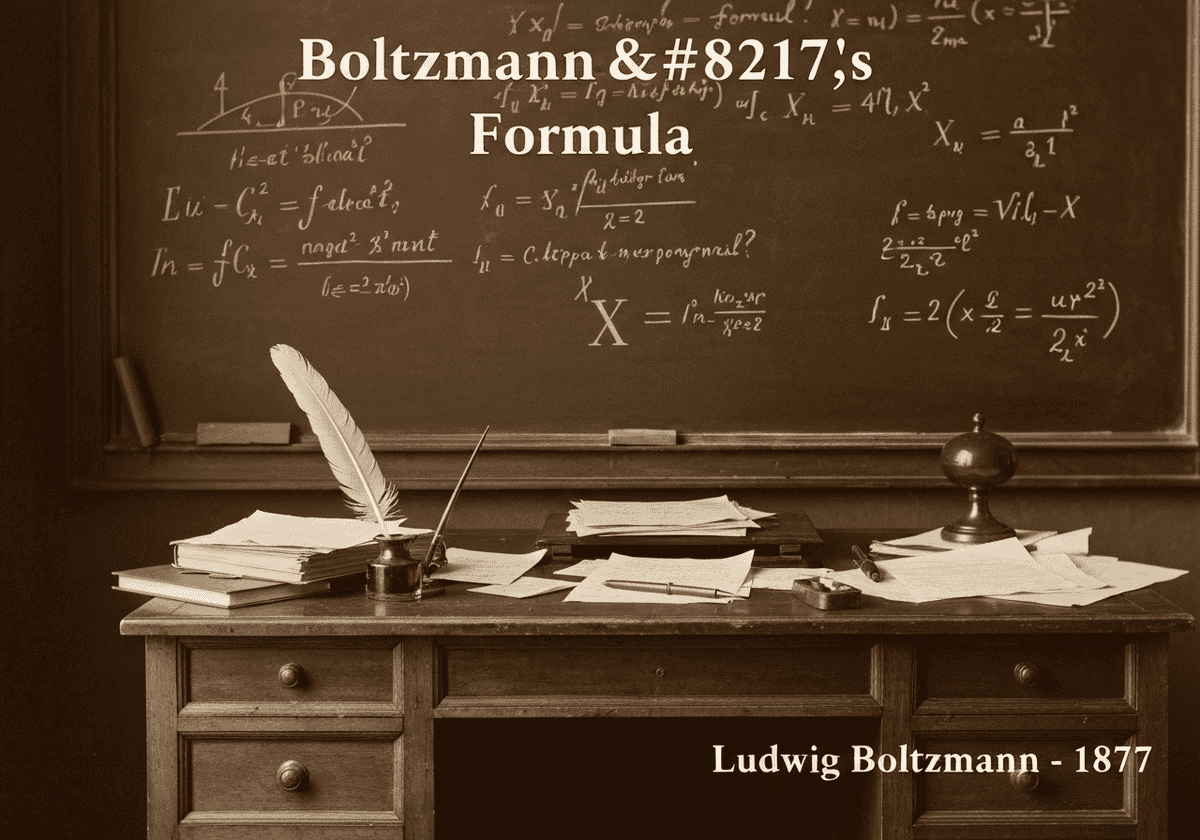
The formula implies that the equilibrium state of an isolated system, which is the state of maximum entropy according to the Second Law of Thermodynamics, is simply the most probable macrostate—the one with the largest number of corresponding microstates (largest W). The logarithmic relationship is crucial because it ensures that entropy is an extensive property. If you combine two independent systems, their total entropy is the sum of their individual entropies ([latex]S_{tot} = S_1 + S_2[/latex]), while the total number of microstates is the product ([latex]W_{tot} = W_1 W_2[/latex]). The logarithm turns this product into a sum: [latex]k_B \ln(W_1 W_2) = k_B \ln W_1 + k_B \ln W_2[/latex]. This formula is famously engraved on Boltzmann’s tombstone in Vienna.