Product Design, Manufacturing & Innovation Resources
家 » 高斯-博内定理

高斯-博内定理

1848
  • Carl Friedrich Gauss
  • Pierre Ossian Bonnet
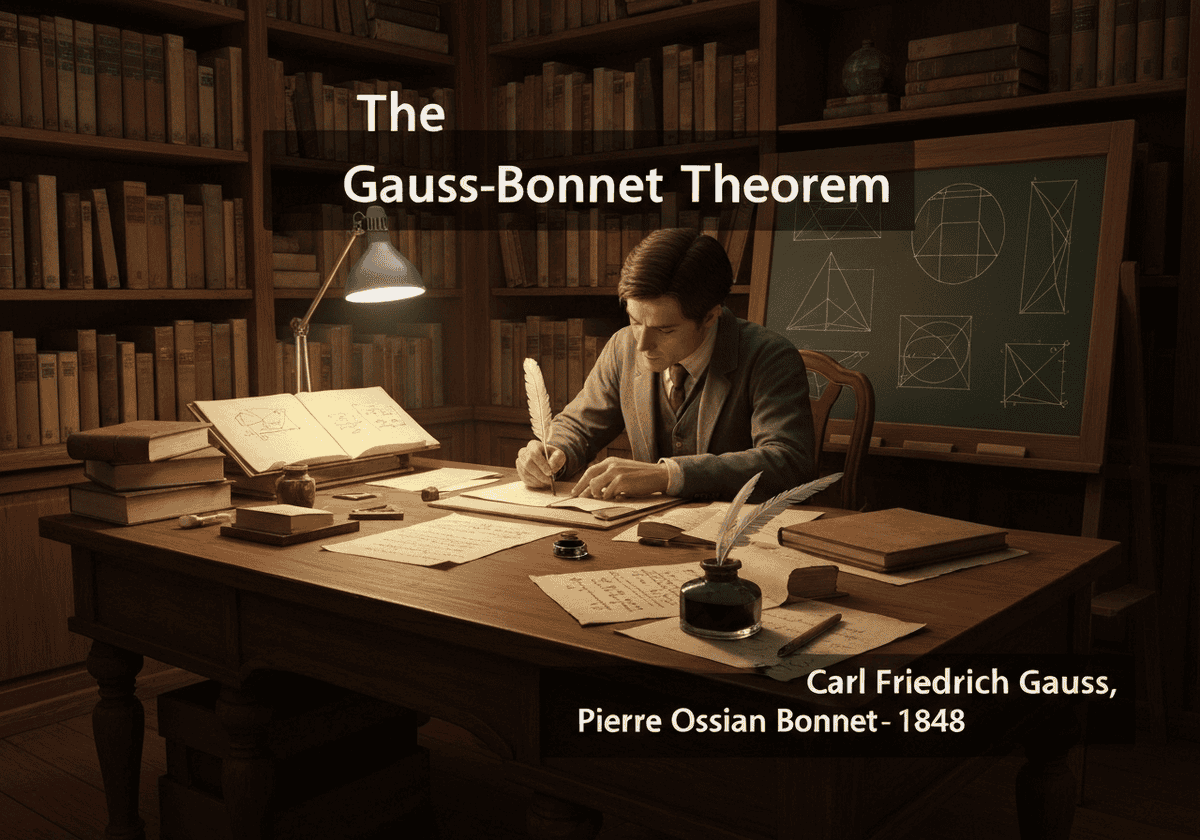
数学家的书房里摆放着羊皮纸和与高斯-博内定理相关的几何图表。

(图片仅供参考)

The Gauss-Bonnet theorem connects the geometry of a compact two-dimensional surface to its topology. It states that the integral of the Gaussian curvature [latex]K[/latex] over the entire surface [latex]M[/latex] is equal to [latex]2\pi[/latex] times the Euler characteristic [latex]\chi(M)[/latex] of the surface. The formula is [latex]\int_M K \, dA = 2\pi \chi(M)[/latex].

The Gauss-Bonnet theorem is a remarkable statement that provides a deep link between the local geometric properties of a surface and its global topological structure. The left side of the equation, [latex]\int_M K \, dA[/latex], involves integrating the Gaussian curvature—a quantity that can vary from point to point—over the entire surface. This is a purely geometric quantity. The right side, [latex]2\pi \chi(M)[/latex], involves the Euler characteristic, [latex]\chi(M) = V – E + F[/latex] (Vertices – Edges + Faces for any triangulation of the surface), which is a topological invariant. This means [latex]\chi(M)[/latex] does not change under continuous deformations of the surface; for example, a sphere always has [latex]\chi=2[/latex] and a torus always has [latex]\chi=0[/latex], regardless of how they are stretched or bent.

The theorem implies that no matter how you deform a surface, the total curvature must remain constant. If you create a dimple in a sphere (introducing negative curvature), you must simultaneously create areas of higher positive curvature elsewhere to keep the total integral equal to [latex]4\pi[/latex] (since [latex]\chi(sphere)=2[/latex]). For a torus, the total curvature must always be zero; any region of positive curvature must be exactly balanced by a region of negative curvature. This theorem was a precursor to more general index theorems, like the Atiyah-Singer index theorem, which relate analytical and topological invariants in higher dimensions.

UNESCO Nomenclature: 1204
– Geometry

类型

抽象系统

中断

Foundational

用法

广泛使用

前体

  • Girard’s theorem on the area of spherical triangles
  • 它指出整个表面 M[/latex] 上的高斯曲率 K[/latex] 的积分等于 2pi[/latex] 乘以表面的欧拉特征 chi(M)[/latex]。公式为 int_MK , dA = 2pi chi(M)[/latex]。)
  • Euler’s polyhedral formula (V – E + F = 2)
  • Development of integral calculus

应用程序

  • topology (linking a geometric property, curvature, to a topological invariant, the euler characteristic)
  • physics (in the context of quantum field theory and string theory)
  • computer graphics (for mesh processing and analysis)
  • robotics (for path planning on complex surfaces)

专利:

NA

潜在创新理念

  • developing self-healing materials that can restore their shape by maintaining a constant total curvature
  • creating algorithms for procedural generation of complex but topologically consistent terrains in 电子游戏
  • designing robust sensor networks for curved surfaces where sensor placement is optimized based on topological features
  • analyzing protein surfaces to identify active sites by correlating geometric curvature with topological properties
  • creating new data visualization techniques that map high-dimensional data onto surfaces with specific topological features
  • designing deployable architectural structures that can change shape while preserving key topological invariants for stability
  • developing error-correction codes for data stored on physical media, where errors are related to local geometric defects
  • modeling fluid dynamics on complex surfaces, ensuring conservation laws are consistent with the surface’s topology
Related to: gauss-bonnet, gaussian curvature, euler characteristic, topology, geometry, integral, surface, invariant.

历史背景

高斯-博内定理

1822
1822
1828
1848
1850
1854
1884
1812
1822
1827
1829
1850
1854
1854
1895

(如果日期未知或不相关,例如“流体力学”,则提供其显著出现的近似估计)

第十年 周年纪念日

只有注册会员才能免费获取完整尺寸的图片和下载内容。

> 登录 <