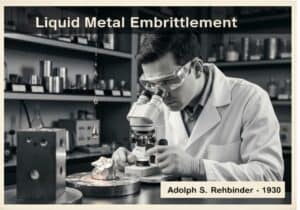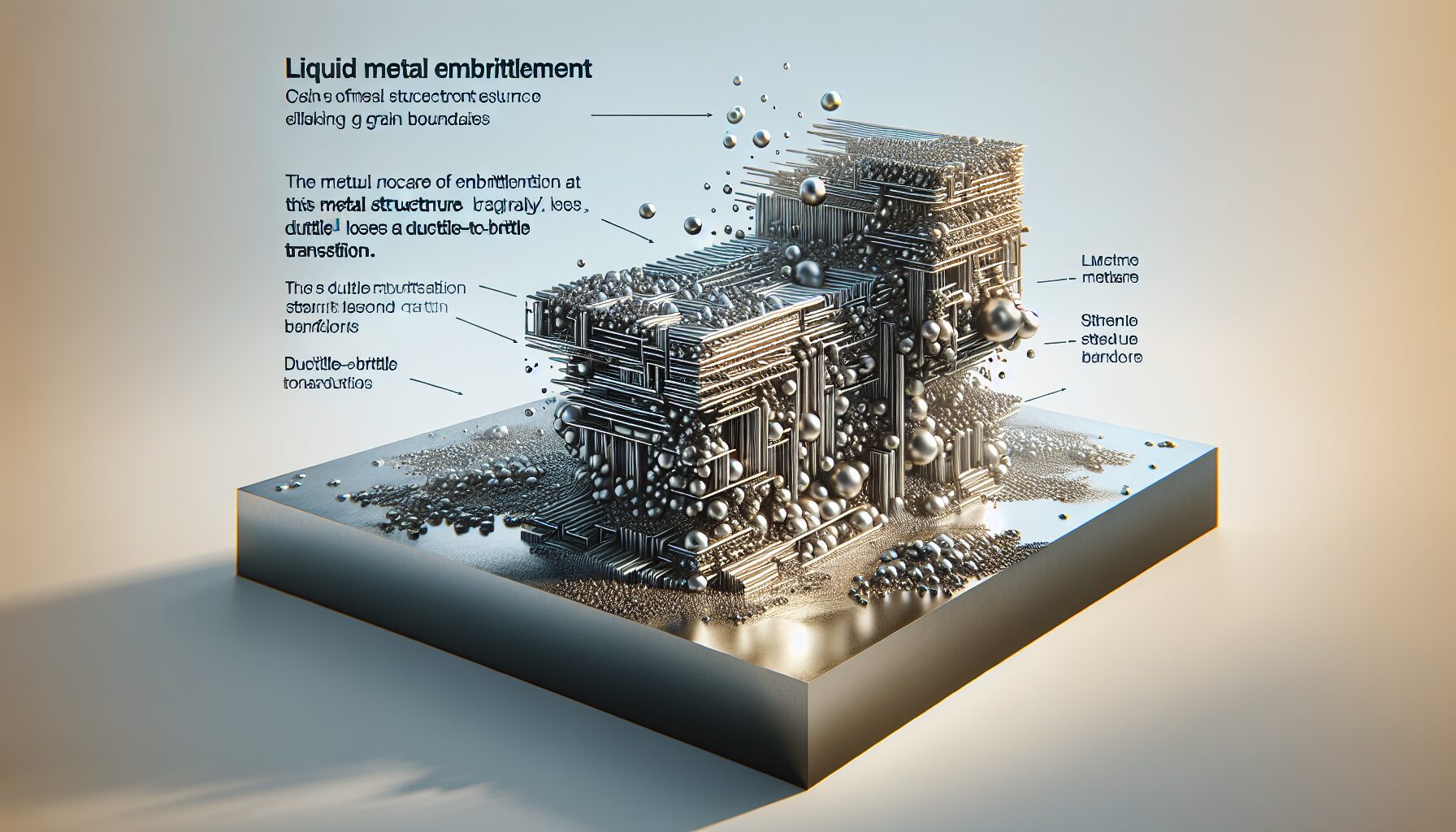
Mais complexo do que apenas a rachadura por corrosão, a fragilização por metal líquido (LME) é um fenômeno em que determinados metais dúcteis se tornam frágeis quando expostos a metais líquidos específicos, levando a uma falha repentina e catastrófica sob stress. Isso ocorre por meio da rápida penetração do metal líquido ao longo dos limites de grão do metal sólido, enfraquecendo assim as ligações interatômicas e facilitando o início e a propagação da trinca. A LME é altamente dependente da combinação dos metais sólidos e líquidos envolvidos, bem como de fatores como temperatura e tensão aplicada. Exemplos industriais comuns incluem a fragilização do aço por zinco líquido ou alumínio durante os processos de galvanização por imersão a quente.
Esta é a nossa mais recente seleção de publicações e patentes mundiais em inglês sobre Fragilização por Metal Líquido (LME), provenientes de diversos periódicos científicos online, classificadas e focadas em fragilização por metal líquido, fragilização de metais, metal líquido, Ga-Al, fragilização induzida por metal líquido, fragilização induzida, perda de ductilidade, transição dúctil-frágil, contornos de grão, fragilização por mercúrio, fragilização por gálio, Al-Ga, gálio líquido e alumínio-gálio.
Annular nuclear fuel rod or channel with convective circulating liquid fuel for fast neutron reactors with in-situ breeding
Patent published on the 2026-06-10 in EP under Ref EP4756839 by PETROV ROMAN [BE] (Petrov Roman [be])
Abstract: [0001] The invention relates to an advanced nuclear fuel channel design for fast-spectrum reactors, featuring an annular O-ring configuration that supports natural circulation of molten fuel. The channel s variable cross-section is optimized to enhance fission in the core zone and neutron capture in the breeding zone. Radial distribution ensures a compact arrangement in the core and wider spacing in the breeding zone for improved neutron management and criticality control. The design integrates [...]
Our summary: The invention presents an annular nuclear fuel channel design optimized for fast-spectrum reactors. It features natural circulation of molten fuel and enhanced fission and neutron capture capabilities. The system is compatible with various coolants and supports extended operation and in-situ breeding.
nuclear fuel, fast neutron reactors, molten fuel circulation, criticality control
Patent
Automated system and method for matching and connecting donors with recipients
Patent published on the 2026-05-28 in US under Ref US20260148264 by THE GLOBAL ORPHAN PROJECT INC [US] (Knittig Joseph [us], Lewis Adrien M [us], Fisk Tyler A [us])
Abstract: A computer-implemented platform facilitates donor-recipient matching with professional-gated intake and church-centric stewardship. A request intake interface receives care requests from approved professionals; a source verification module confirms permitted account origin and domain affiliation, rejecting non-conforming submissions. A responder registry stores responder profiles including church entities. A matching engine computes preferences using proximity, urgency, and responder type and se[...]
Our summary: This platform automates the matching of donors and recipients through a structured intake process. It verifies donor credentials and manages communication between involved parties. Additionally, it governs donations and tracks their impact through an audit ledger and feedback mechanisms.
donor-recipient matching, automated system, payment governance, communication subsystem
Patent
Improved aluminum purification cells
Patent published on the 2026-05-28 in WO under Ref WO2026112228 by ALCOA USA CORP [US] (Liu Xinghua [us], Czekaj Steven A [us], Mosser Benjamin D [us], Mickelson Lawrence [us])
Abstract: New aluminum purification cells are disclosed. An aluminum purification cell may include at least one cathode partially positioned within an electrolyte that is disposed above a molten metal pad. Aluminum ions may be produced within the electrolyte from aluminum of the molten metal pad and metallic aluminum may be produced from the aluminum ions at a surface of the at least one cathode. The metallic aluminum may be collected as purified aluminum metal within a liquid metal collector that at leas[...]
Our summary: Improved aluminum purification cells utilize a cathode partially immersed in an electrolyte above a molten metal pad. Aluminum ions are generated in the electrolyte from the molten aluminum, leading to the production of metallic aluminum at the cathode surface. Purified aluminum is collected in a liquid metal collector that features a recessed region for efficient collection.
aluminum purification, cathode, electrolyte, molten metal
Patent
Method and apparatus for producing hydrochloric acid
Patent published on the 2026-05-28 in WO under Ref WO2026109891 by CAVALIER MARCUS [GB] (Cavalier Marcus [gb])
Abstract: The present invention provides a method of producing hydrochloric acid, comprising reacting high-temperature gaseous chlorine and water vapour in a carbon-free reverse Deacon reaction (RDR) at a temperature of from about 450 to about 750 °Celsius to produce a mixture of gases comprising hydrogen chloride and oxygen. The chlorine is produced by fusing and electrolysing sodium or magnesium chloride in solid phase. The water vapour comes from thermally decomposing a hydroxide of at least one of ca[...]
Our summary: The invention presents a method for producing hydrochloric acid through a carbon-free reverse Deacon reaction using high-temperature gaseous chlorine and water vapor. Chlorine is generated via electrolysis of sodium or magnesium chloride, while water vapor is produced from thermally decomposing hydroxides. The process is energy efficient, allowing for recycling of materials and minimal additional energy requirements.
hydrochloric acid, reverse Deacon reaction, electrolytic cell, energy efficiency
Patent
Method for steel production and corresponding installation network
Patent published on the 2026-05-20 in UA under Ref UA130827 by VERESHCHAK VIKTOR IVANOVYCH [UA] (Vereshchak Viktor Ivanovych [ua], Ivashchenko Valerii Petrovych [ua], Petrenko Vitalii Oleksandrovych [ua], Chaika Oleksii Leonidovych [ua], Loboda Petro Ivanovych [ua], Hryshchenko Serhii Heorhiiovych [ua], Vereshchak Denys Viktorovych [ua])
Abstract: Invention relates to ferrous metallurgy, specifically to production of steel from iron ore using iron oxide reduction method via network of installations. Method is proposed for producing steel from iron ore raw materials by reducing iron oxide, in which furnace with shaft chamber for preliminary reduction (A), horizontal chamber for final reduction (B), and liquid metal accumulation chamber (C) are used, all connected by transition channels. Pellets made from raw materials that do not contain c[...]
Our summary: The invention describes a method for steel production using iron oxide reduction with a network of installations. It employs a furnace system with multiple chambers and utilizes low-temperature plasma for heating and reduction. The method aims to lower costs and reduce CO2 emissions while improving environmental conditions.
ferrous metallurgy, steel production, iron oxide reduction, plasma torches
Patent
Method of manufacturing circuit board
Patent published on the 2026-04-23 in US under Ref US20260113852 by ALPS ALPINE CO LTD [JP] (Kishida Katsuhiko [jp])
Abstract: A method of manufacturing a circuit board is disclosed. The method includes: a first step of forming a plurality of pixel circuits on a film with the pixels connected to each other by a wiring pattern; a second step of processing the film to thin the film at least at a position between pixels, and singulating the film into individual pixel units such that the film is cut together with the wiring pattern at the position between the pixels; a third step of transferring a plurality of singulated pi[...]
Our summary: A method for manufacturing a circuit board involves forming pixel circuits on a film. The film is processed to create individual pixel units and transferred onto a flexible substrate. Finally, a stretchable interconnect is formed using liquid metal between the wiring patterns.
circuit board manufacturing, pixel circuits, flexible substrate, liquid metal interconnect
Patent
The Effect of Post-Heat Treatments on Microstructure and Mechanical Properties of a L-PBF CoCrNi–AlTi Medium-Entropy Alloy
Published on 2026-02-03 by Xiaojing Xiong, Xiaodong Nong, Libin Yu, Xianzhao Meng, Chunjia Mo, Yunjie Bi, Hui Ding @MDPI
Abstract: A CoCrNi-AlTi medium-entropy alloy was fabricated via laser powder bed fusion (L-PBF), and its microstructural evolution and mechanical response during aging at 500–900 °C for 1 h were systematically investigated. The as-built alloy exhibits a hierarchical microstructure consisting of elongated columnar grains and dislocation-rich cellular substructures, which is associated with an excellent strength–ductility combination (YS: 848 MPa, UTS: 1136 MPa, EF: 3[...]
Our summary: The study investigates the effects of post-heat treatments on the microstructure and mechanical properties of a CoCrNi-AlTi medium-entropy alloy fabricated via laser powder bed fusion. Aging at temperatures between 500-900 °C enhances hardness and tensile strength, with peak performance noted at 800 °C. The research highlights the role of L-PBF-induced defect structures in influencing precipitation behavior and the strength-ductility trade-off during heat treatment.
L-PBF, CoCrNi-AlTi, microstructure, mechanical properties
Publication
Influence of HFCVD Parameters on Diamond Coatings and Process Investigation of Sapphire Wafer Lapping
Published on 2026-02-03 by Wei Feng, Shuai Zhou, Xiaokang Sun @MDPI
Abstract: Aiming at the key problems of the material removal rate and surface integrity of existing tools in the lapping of sapphire hard and brittle crystals, an efficient lapping tool has been developed to explore a new process for HFVCD (hot filament chemical vapor deposition) diamond tools to efficiently lap sapphire wafers. With the premise of ensuring the surface roughness of the wafer is Ra ≤ 0.5 μm, the material removal rate is increased to more than 1 μm/h. To exp[...]
Our summary: The study investigates the influence of HFCVD parameters on diamond coatings for lapping sapphire wafers. An efficient lapping tool was developed to enhance material removal rates while maintaining surface integrity. Experimental results showed that specific coating morphologies significantly affected the lapping performance and surface quality of the sapphire wafers.
HFCVD, diamond coatings, sapphire wafers, material removal rate
Publication