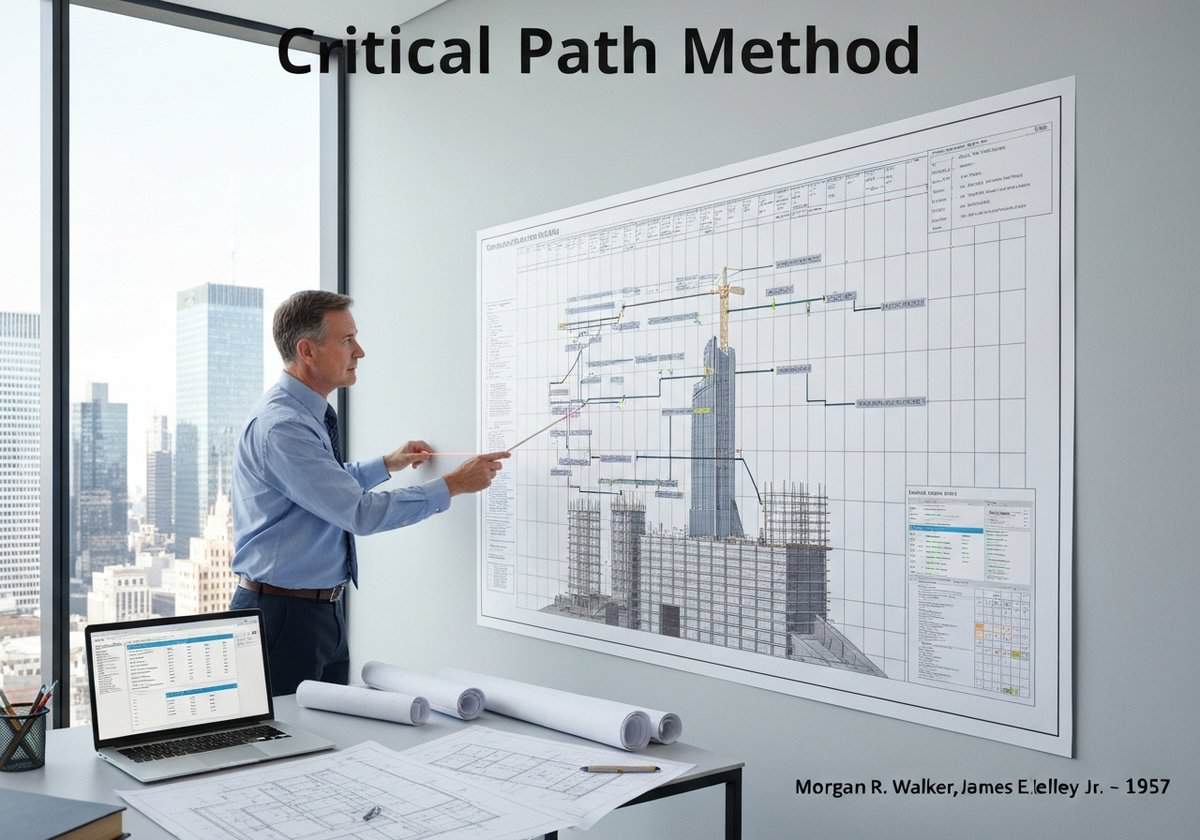
Método do Caminho Crítico (projetos)
1957
- Morgan R. Walker
- James E. Kelley Jr.
The Critical Path Método (sometimes referred as CPM, confusing in many domains) is a methodology for scheduling project activities. It identifies the longest stretch of dependent tasks (the ‘critical path’) and measures the time required to complete them from start to finish. Any delay in a task on the critical path directly impacts the project’s completion date -targeted parameter here is date, not cost, nor quality, nor resources, although none of these are independent-. It helps consequently in resource allocation and schedule optimization.
Developed in the late 1950s by Morgan R. Walker of DuPont and James E. Kelley Jr. of Remington Rand, the Critical Path Method (CPM) was created to manage complex industrial projects, initially for the maintenance of chemical plants. Its novelty lies in its use of network analysis to model a project’s workflow. The process begins by identifying all project activities, determining their sequence and dependencies, and estimating the duration of each. This information is used to construct a project network diagram, which visually represents tasks as nodes and dependencies as connecting arrows.
The core of CPM is the calculation of the ‘critical path’. This is achieved through a forward pass and a backward pass through the network. The forward pass calculates the earliest start and finish times for each activity, while the backward pass determines the latest start and finish times. The ‘float’ or ‘slack’ for each activity—the amount of time it can be delayed without affecting the project’s final deadline—is then calculated by subtracting the earliest finish time from the latest finish time. Activities with zero float are on the critical path. Any delay to these critical tasks will delay the entire project. CPM is a deterministic model, meaning it uses single, fixed time estimates for each task. This contrasts with its contemporary, PERT (Program Evaluation and Review Technique), which uses a probabilistic three-point estimate (optimistic, pessimistic, most likely) to account for uncertainty. CPM provides managers with a powerful tool to focus their attention on the most crucial tasks, optimize resource allocation, and perform ‘what-if’ analysis to assess the impact of potential delays.
UNESCO Nomenclature: 5312
Ciências da gestão
Precursores
- Gantt charts
- Network flow analysis
- Graph theory
- Operations research development during WWII
Aplicações
- large-scale construction projects (skyscrapers, bridges)
- aerospace and defense projects
- software development and it infrastructure rollouts
- manufacturing plant shutdowns and maintenance
- research and development projects
- oil and gas exploration and production
Ideias de Inovação Potencial
Devido ao tráfego de bots de coleta de dados, atualmente superior a 40 mil por dia, este conteúdo é reservado aos membros da comunidade.
> Login < ou > Registrar < (100% gratuito) para acessar isso, assim como todo o restante do conteúdo e das ferramentas restritas.
Related to: critical path method, CPM, project management, scheduling, network diagram, critical path, float, slack, task dependency, operations research.