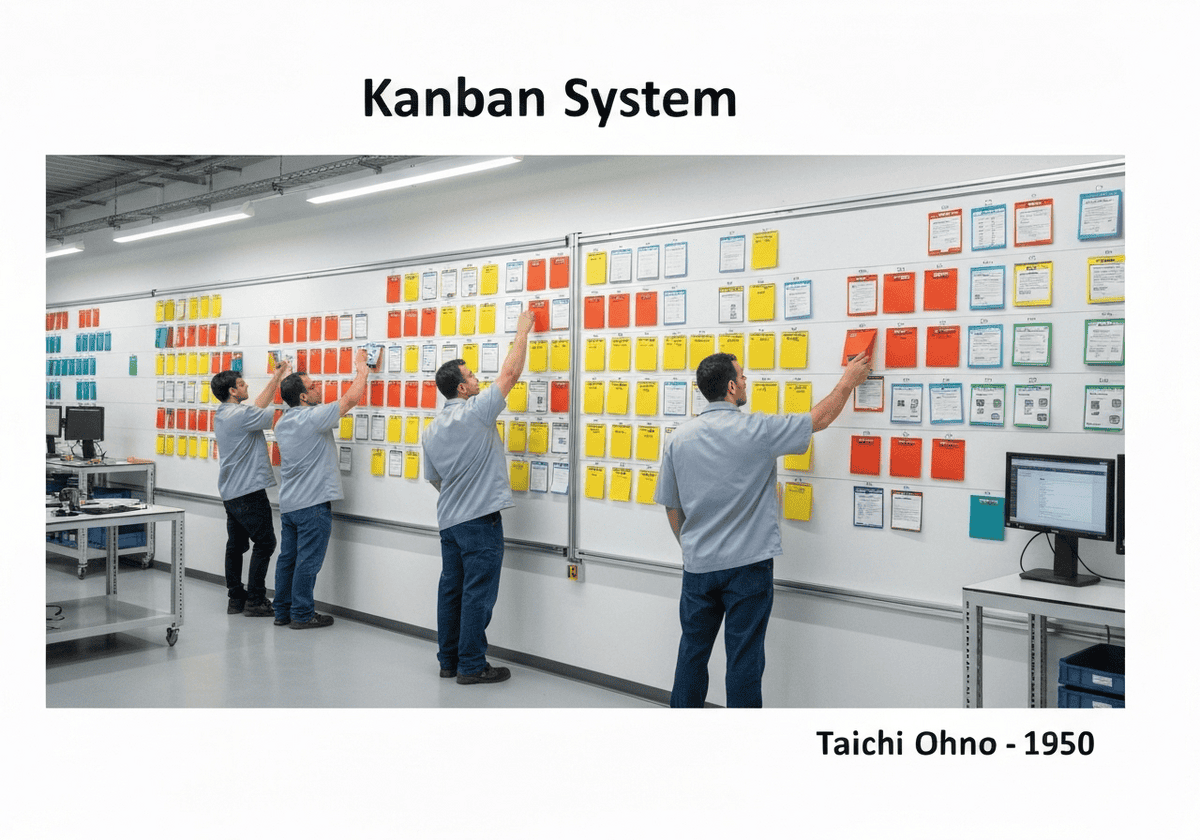
Kanban일본어로 '비주얼 카드' 또는 '간판'을 의미하는 이 시스템은 일정 관리에 필수적인 시스템입니다. 도요타 생산 시스템시각적 신호(일반적으로 카드)를 사용하여 작업을 시작하고 워크플로를 관리합니다. 이는 자재 이동의 필요성을 알리는 '풀(pull)' 시스템입니다. 조작 생산 시설 내 또는 외부 공급업체로부터 제품을 공급받습니다.

(설명을 위한 생성된 이미지입니다)
Kanban일본어로 '비주얼 카드' 또는 '간판'을 의미하는 이 시스템은 일정 관리에 필수적인 시스템입니다. 도요타 생산 시스템시각적 신호(일반적으로 카드)를 사용하여 작업을 시작하고 워크플로를 관리합니다. 이는 자재 이동의 필요성을 알리는 '풀(pull)' 시스템입니다. 조작 생산 시설 내 또는 외부 공급업체로부터 제품을 공급받습니다.
The Kanban system was developed by Taiichi Ohno at Toyota to achieve Just-in-Time (JIT) manufacturing. The core idea is to limit the amount of work-in-progress (WIP) to avoid overproduction, a primary form of waste. In its simplest form, a Kanban card is attached to a container of parts. When a worker at a downstream station begins using parts from that container, they take the Kanban card and place it in a designated collection box. This card then serves as a signal to the upstream process to produce another container of the same parts.
There are two main types of Kanbans: a Production Kanban, which authorizes the production of a new batch of parts, and a Withdrawal (or Conveyance) Kanban, which authorizes the movement of parts from one workstation to another. The number of Kanban cards in circulation for a particular part directly controls the maximum amount of inventory for that part in the system. By carefully managing the number of cards, managers can control the flow and reduce WIP. The system’s visual nature makes it easy for everyone to understand the status of work and identify bottlenecks. This simplicity and visual control are key to its effectiveness in creating a smooth, efficient production flow.
현재 하루 4만 건이 넘는 봇 트래픽을 차단하기 위해 이 콘텐츠는 커뮤니티 회원만 이용할 수 있습니다.
> 로그인 < 또는 >등록 < 이 콘텐츠를 비롯한 모든 제한된 콘텐츠와 도구는 (100% 무료로) 이용할 수 있습니다.
칸반 시스템
(날짜를 알 수 없거나 관련이 없는 경우, 예를 들어 "유체역학"의 경우, 주목할 만한 등장 시기를 대략적으로 추정하여 제공합니다.)
고화질 이미지 및 다운로드는 등록된 회원에게만 100% 무료로 제공됩니다.
> 로그인 <