Product Design, Manufacturing & Innovation Resources
집 » 휘발성 유기 화합물(VOC)

휘발성 유기 화합물(VOC)

1990
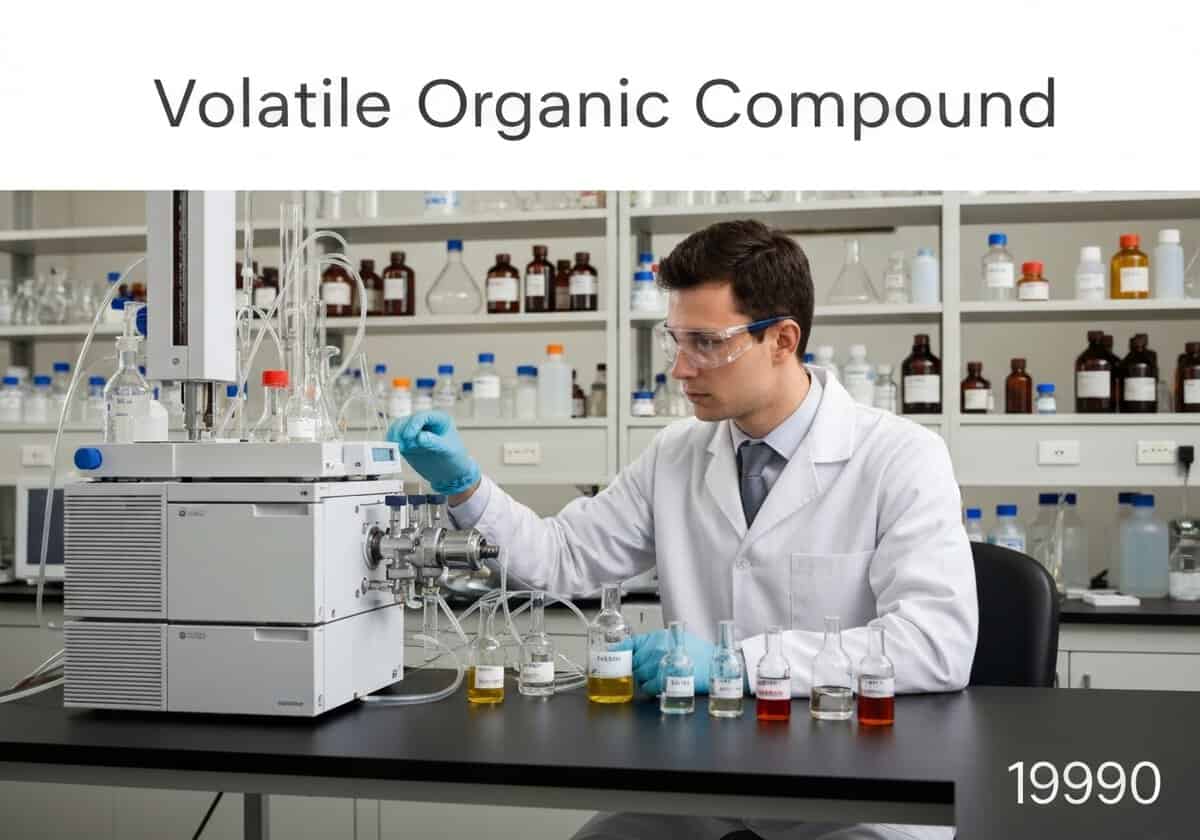
Laboratory analysis of volatile organic compounds using gas chromatography in organic chemistry.

(설명을 위한 생성된 이미지입니다)

A Volatile Organic Compound (VOC) is an organic chemical that has a high vapor 압력 at room temperature, leading to significant evaporation. This property is due to a low boiling point. The European Union defines a VOC as any organic compound having an initial boiling point less than or equal to 250°C measured at a standard pressure of 101.3 kPa.
The definition of a Volatile Organic Compound is not universally standardized and often depends on the regulatory context. The most common definitions are based on physical properties. The World Health Organization (WHO) defines VOCs as organic compounds with boiling points ranging from 50 to 260°C. This definition is widely adopted, including by the EU’s Paint Directive (2004/42/EC), which aims to limit VOC emissions from decorative paints and varnishes. This physical definition is practical for regulation as boiling point is a readily measurable property.

In contrast, the United States Environmental Protection Agency (EPA) uses a reactivity-based definition. It defines VOCs as any compound of carbon, excluding certain listed non-reactive compounds (like methane, carbon monoxide, and acetone), that participates in atmospheric photochemical reactions. This approach focuses on the environmental impact, specifically the role of VOCs in forming ground-level ozone. The consequence is that some compounds with low boiling points, like acetone, are considered VOCs under the EU definition but are exempt in the US due to their low photochemical reactivity. These differing definitions highlight the dual nature of VOCs as both a physical class of chemicals and a category of environmental pollutants.

It shall not be confused with the VoC (“Voice of Customer”) technique used extensively in marketing and product design.

UNESCO Nomenclature: 2509
유기화학

유형

화학적 성질

분열

상당한

용법

널리 사용됨

전구체

  • development of distillation techniques to measure boiling points
  • antoine’s work on the relationship between 증기압 and temperature
  • understanding of organic chemical structures
  • early studies on industrial hygiene and solvent exposure

응용 프로그램

  • formulation of low-voc paints and solvents
  • regulation of industrial emissions
  • indoor air quality monitoring
  • manufacturing of consumer products like deodorants and cleaning supplies
  • environmental impact assessments

특허:

NA

잠재적 혁신 아이디어

  • smart building materials that absorb and neutralize vocs
  • personal 의복 sensors for real-time voc exposure tracking
  • genetically engineered houseplants with enhanced voc metabolization
  • voc-scavenging drones for industrial leak detection
  • ai-powered systems for predicting voc emissions from manufacturing processes
  • self-reporting paint that changes color when voc levels exceed safety thresholds
  • biodegradable solvents with zero voc content
  • advanced membrane technology for capturing vocs from air streams
  • consumer-grade gc-ms devices for home air quality analysis
  • voc-based breathalyzers for early disease detection
Related to: VOC, volatile organic compound, boiling point, vapor pressure, eu directive, WHO, definition, organic chemistry, environmental regulation, physical property.

역사적 맥락

휘발성 유기 화합물(VOC)

1980
1980
1982
1990
1990
1990
1993
1980
1980
1982
1990
1990
1990
1990
2000

(날짜를 알 수 없거나 관련이 없는 경우, 예를 들어 "유체역학"의 경우, 주목할 만한 등장 시기를 대략적으로 추정하여 제공합니다.)

10년차 기념일

고화질 이미지 및 다운로드는 등록된 회원에게만 100% 무료로 제공됩니다.

> 로그인 <