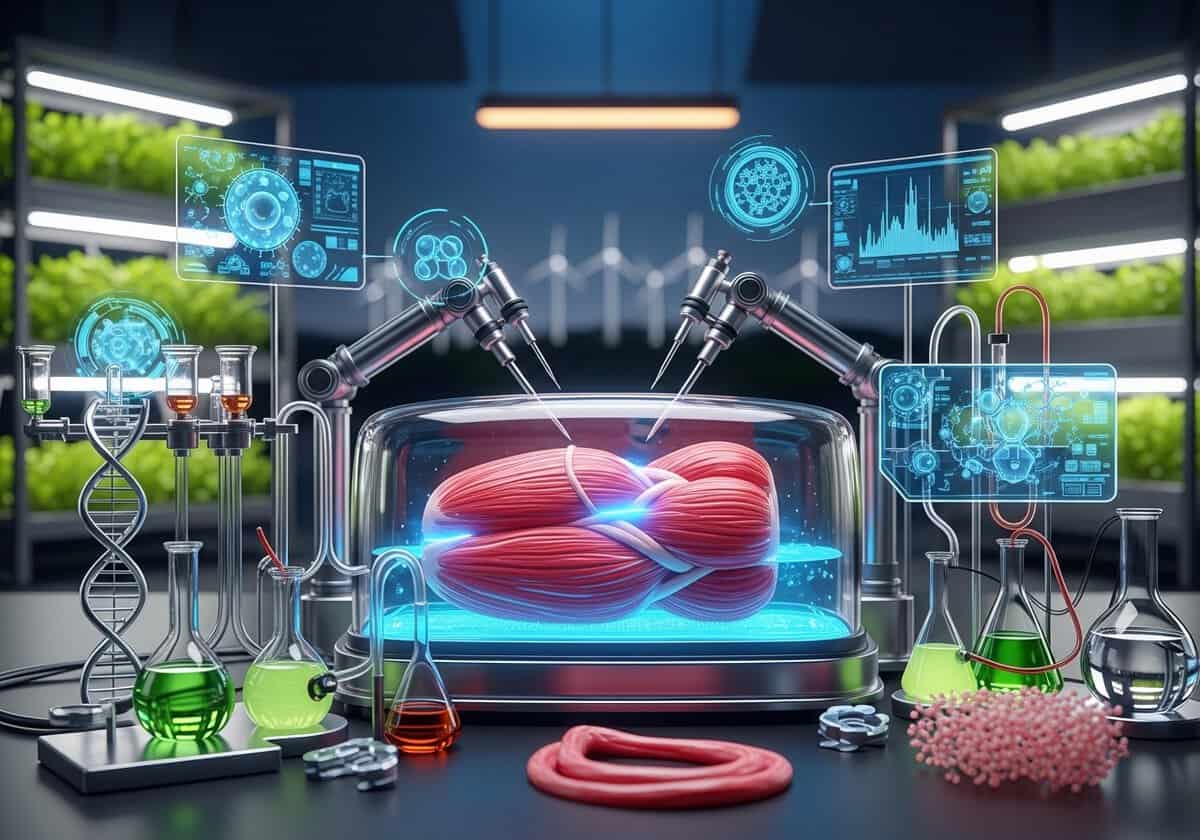

Lab-grown meat involves the cultivation of animal muscle cells in controlled environments to produce edible tissue without conventional livestock farming. This domain integrates cellular biology, tissue engineering, and bioprocessing techniques to optimize cell proliferation, differentiation, and scaffold development for replicating the texture and flavor of traditional meat. Innovations focus on serum-free culture media, scalable bioreactor designs, and edible scaffold materials to enhance production efficiency and product quality. The following collection presents recent scientific publications and patented テクノロジー detailing advancements in cell line development, bioprocess optimization, sensory attributes, regulatory considerations, and sustainability assessments critical to the commercialization of cultured meat products.
これは、ラボで培養された肉に関する英語の世界中の出版物と特許の最新のセレクションです。多くの科学オンラインジャーナルの中から、ラボで培養された肉、培養肉、細胞ベースの肉、体外肉、組織工学肉、培養肉バイオリアクター、筋肉細胞培養、幹細胞肉生産、肉の細胞増殖、培養肉用足場、無血清培地、筋芽細胞培養、肉の細胞分化、ラボで培養された肉、肉組織足場、細胞農業、成長肉、培養肉の食感、培養肉の風味、細胞増殖技術、肉のバイオプロセス、培養肉のスケールアップ、食用足場、細胞収穫方法に分類され、焦点を絞っています。
出版物: この件に関する最近のニュースはありません。上記リンク先の出版物データベースで、詳細な手動検索をお試しください。
Method for preparing porcine induced pluripotent stem cell
Patent published on the 2026-06-11 in US under Ref US20260159814 by SIMPLE PLANET CO LTD [KR] (Han Dongoh [kr], Park Hee Ho [kr], Yoo Ki Hyun [kr], Seo Bong Jong [kr], Jeong Ildoo [kr], Lim Jee Yoon [kr], Kim Kwan Hyun [kr])
Abstract: [0000] The present invention relates to a method for preparing porcine induced pluripotent stem cells (piPSCs), wherein hOCT3, hOCT4, hSK, hUL, mP53DD, and EBNA1 genes are introduced into porcine embryonic fibroblasts by electroporation, thereby producing piPSCs without problems caused by the integration of foreign genes. The porcine induced pluripotent stem cells prepared by the preparation method of the present invention have pluripotency and spontaneous differentiation capability, and in part[...]
Our summary: The invention describes a method for preparing porcine induced pluripotent stem cells (piPSCs) using electroporation to introduce specific genes. This method avoids issues related to foreign gene integration. The resulting piPSCs exhibit pluripotency and strong differentiation potential, particularly towards myotube cells, making them suitable for the cultured meat industry.
induced pluripotent stem cells, porcine, electroporation, differentiation
Patent
Method for producing cultured meat, and cultured meat
Patent published on the 2026-05-21 in WO under Ref WO2026105820 by ITOHAM YONEKYU HOLDINGS INC [JP] (Matsusaki Michiya [jp], Yamada Asuka [jp], Nakadozono Oya Chika [jp], Sugiura Takuya [jp], Takasuga Akiko [jp])
Abstract: The present disclosure relates to a method for producing cultured meat, the method comprising: a washing step for bringing bovine tissue into contact with a washing liquid containing peracetic acid; a recovery step for recovering stem cells from the washed bovine tissue; a preparation step for preparing bio-ink containing the recovered stem cells and fragmented extracellular matrix components; a printing step for printing the bio-ink to form a structure containing the stem cells; and a culturing[...]
Our summary: The method involves washing bovine tissue with peracetic acid, recovering stem cells, and preparing a bio-ink. The bio-ink is printed to create a structure containing stem cells. Finally, the stem cells undergo differentiation induction culturing to form a tissue body.
cultured meat, stem cells, bio-ink, tissue engineering
Patent
Electroconductive bioinks, method of obtaining and use thereof, method of obtaining a food product and said food product
Patent published on the 2026-04-09 in WO under Ref WO2026075575 by INST SUPERIOR TECNICO [PT] (Castelo Alves Ferreira Frederico [pt], CondeÇo Marques Diana Maria [pt], Sanjuan Alberte Paola [pt])
Abstract: The current invention relates to electroconductive bioinks, as well as their method of obtaining and their use in food production. The described electroconductive bioinks feature a high capability for cell support, as well as excellent printability and high organoleptic and nutritional properties. The present invention also relates to a method of obtaining a food product through bioprinting by 3D extrusion of the electroconductive bioinks and of the resulting food product. The invention represen[...]
Our summary: The invention focuses on electroconductive bioinks and their method of production. These bioinks support cells and have excellent printability and nutritional properties. The method involves 3D extrusion bioprinting to create food products, offering an alternative to traditional food production methods.
electroconductive bioinks, bioprinting, food production, cellular agriculture
Patent