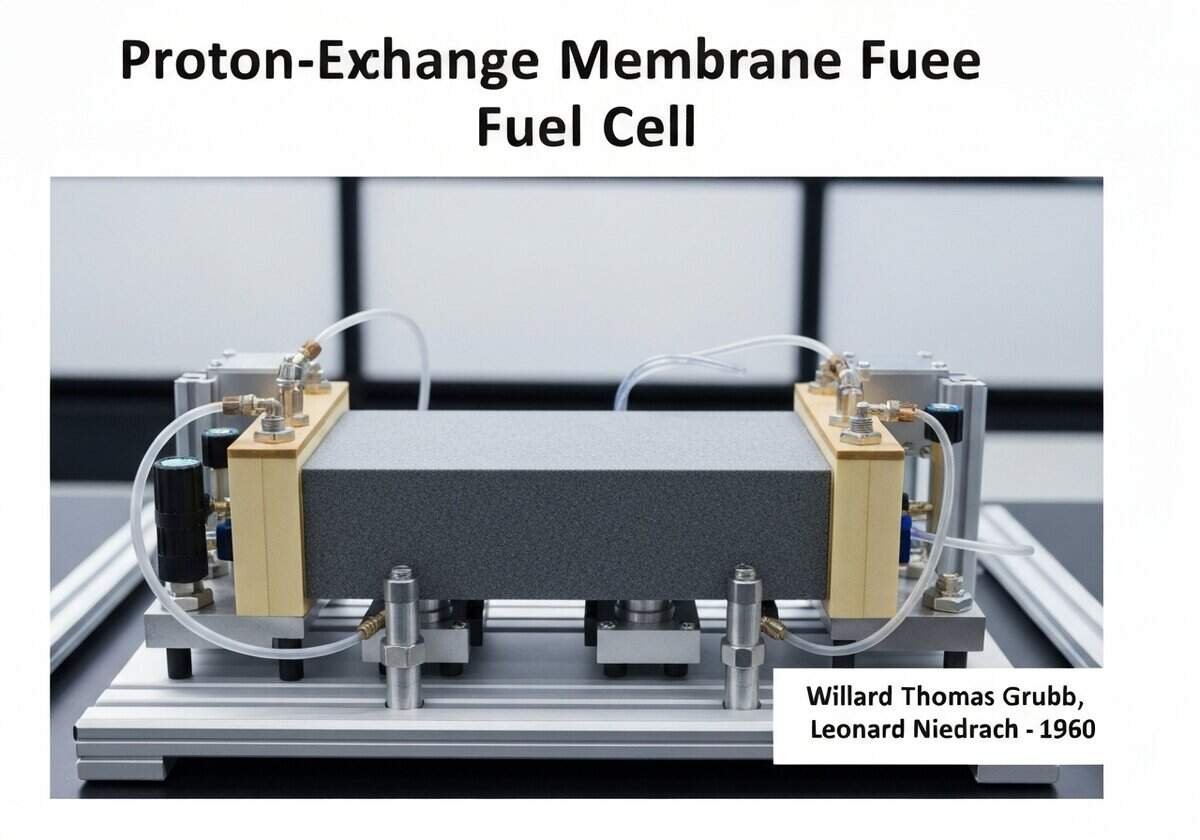
プロトン交換膜 燃料電池 PEMFC(プロトン交換膜燃料電池)は、ナフィオンなどの固体高分子膜を電解質として使用します。この膜は、陽極から陰極へプロトン([latex]H^+[/latex])を選択的に伝導します。PEMFCは低温(通常50~100℃)で動作するため、迅速な起動とコンパクトな設計が可能です。白金系触媒の被毒を防ぐため、燃料として高純度水素が必要です。
(画像はイメージです)
プロトン交換膜 燃料電池 PEMFC(プロトン交換膜燃料電池)は、ナフィオンなどの固体高分子膜を電解質として使用します。この膜は、陽極から陰極へプロトン([latex]H^+[/latex])を選択的に伝導します。PEMFCは低温(通常50~100℃)で動作するため、迅速な起動とコンパクトな設計が可能です。白金系触媒の被毒を防ぐため、燃料として高純度水素が必要です。
The heart of the PEMFC is the membrane electrode assembly (MEA), which consists of the proton-exchange membrane sandwiched between two catalyst-coated electrodes. At the anode, hydrogen gas is split into protons and electrons: [latex]H_2 \rightarrow 2H^+ + 2e^-[/latex]. The solid polymer membrane, which is an electrical insulator, allows only the protons to pass through to the cathode. The electrons are forced to travel through an external circuit, generating the electrical current. At the cathode, oxygen from the air, the protons from the membrane, and the electrons from the external circuit combine to form water: [latex]O_2 + 4H^+ + 4e^- \rightarrow 2H_2O[/latex].
A critical aspect of PEMFC operation is water management. The membrane must remain hydrated to maintain its proton conductivity, but excess water at the cathode (product water) can block the flow of oxygen to the catalyst sites, a phenomenon known as ‘flooding’. The low operating temperature makes PEMFCs susceptible to catalyst poisoning, particularly from carbon monoxide (CO) present in reformed hydrogen, which binds strongly to the platinum catalyst sites. This necessitates the use of very pure hydrogen fuel, increasing operational costs.
ボットによるトラフィック(現在1日あたり4万件以上)を排除するため、このコンテンツはコミュニティメンバー限定となっています。
> ログイン < または > 登録 < (100%無料)でこれにアクセスできます。他のすべての制限付きコンテンツとツールも同様です。
プロトン交換膜燃料電池(PEMFC)
(日付が不明または関連性がない場合、例えば「流体力学」などでは、その注目すべき出現時期の概算値が提示されます。)
フルサイズの画像とダウンロードは、登録会員のみが100%無料で利用できます。
> ログイン <