Product Design, Manufacturing & Innovation Resources
» 熱交換器の汚れ

熱交換器の汚れ

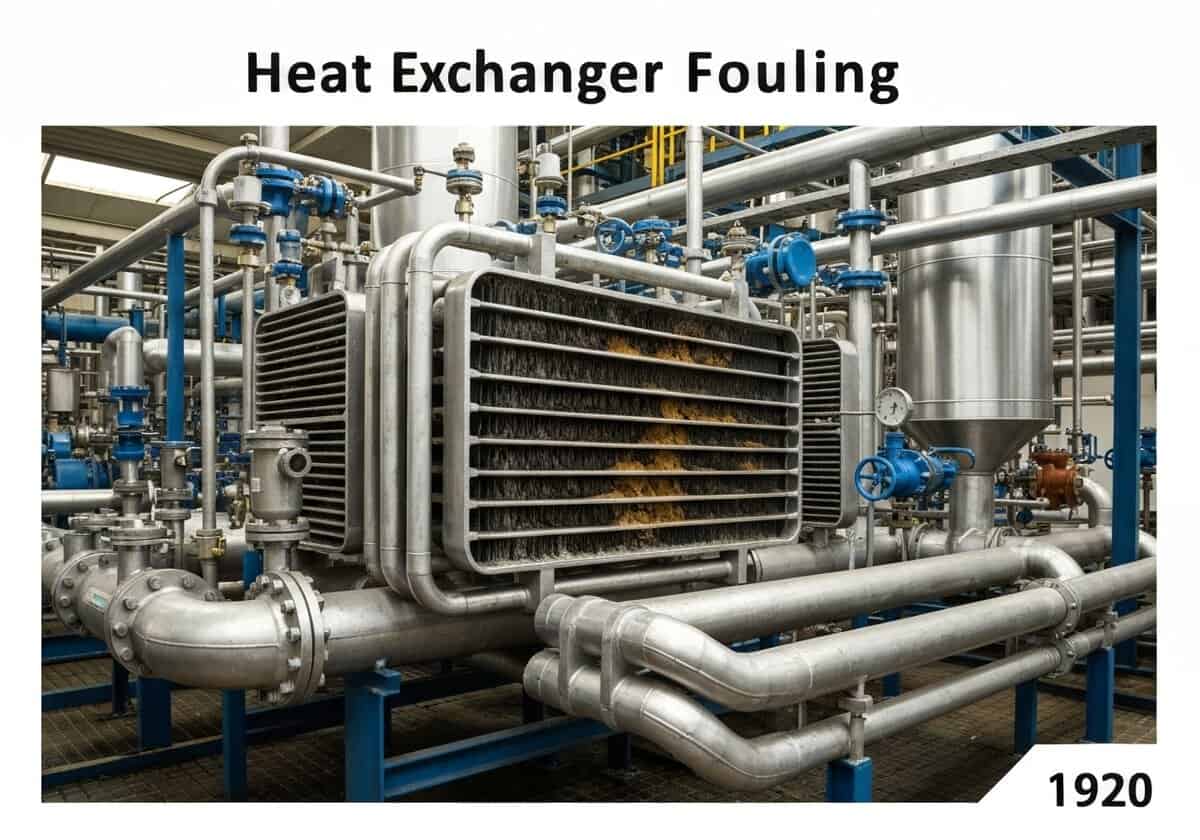
1920
Heat exchanger with fouling deposits affecting thermal performance in thermodynamics.

(画像はイメージです)

ファウリングとは、伝熱面に不要な物質が蓄積することで、熱抵抗が増加し、熱交換器の性能が低下する現象です。このファウリング抵抗([latex]R_f[/latex])は、総括伝熱係数(U)を低下させます。この影響は、総括伝熱方程式[latex]frac{1}{U} = frac{1}{h_i} + frac{1}{h_o} + R_f + R_w[/latex]で定量化されます。

Fouling is a critical, time-dependent problem in nearly all heat exchanger applications. It increases thermal resistance, impedes fluid flow (increasing pressure drop and pumping costs), and can initiate corrosion. There are several types of fouling. Precipitation fouling occurs when dissolved solids in a fluid precipitate onto surfaces, common in cooling water systems (scaling). Particulate fouling is the accumulation of suspended particles like dust or rust. Corrosion fouling results from the heat transfer surface itself reacting to form an insulating layer of corrosion products. Chemical reaction fouling involves reactions within the process fluid that form deposits, such as in polymerization processes. Finally, biofouling is the growth of microorganisms, algae, or slime on surfaces, prevalent in raw water systems. To account for this inevitable degradation, engineers include a ‘fouling factor’ or ‘fouling resistance’ ([latex]R_f[/latex]) during the design phase. This essentially means the heat exchanger is oversized to ensure it still meets the required heat duty after a certain period of operation with the expected level of fouling. The overall heat transfer coefficient for a clean exchanger ([latex]U_{clean}[/latex]) is related to the dirty or service coefficient ([latex]U_{dirty}[/latex]) by [latex]\frac{1}{U_{dirty}} = \frac{1}{U_{clean}} + R_f[/latex]. Managing and mitigating fouling through chemical treatment, filtration, and periodic cleaning is a major aspect of industrial maintenance.

UNESCO Nomenclature: 3328
熱力学

タイプ

物理的プロセス

混乱

増分

使用法

広く普及している

前駆物質

  • ボイラーやケトルにおけるスケールの蓄積の観察
  • 熱抵抗とフーリエの法則の理解
  • 工業化学と水処理の発展
  • 材料科学と腐食研究の進歩

アプリケーション

  • 工業プラントの予知保全スケジュール
  • プロセス機器の化学洗浄手順の設計
  • 防汚コーティングおよび材料の開発
  • 冷却塔およびボイラー向けの水処理プログラム
  • 将来の汚れを考慮して、新しい熱交換器を大きめに設計する

特許:

NA

潜在的なイノベーションのアイデア

ボットによるトラフィック(現在1日あたり4万件以上)を排除するため、このコンテンツはコミュニティメンバー限定となっています。
> ログイン < または > 登録 < (100%無料)でこれにアクセスできます。他のすべての制限付きコンテンツとツールも同様です。

関連事項:汚れ、スケール、熱交換器、熱抵抗、メンテナンス、熱伝達、総括熱伝達係数、生物付着、圧力損失、洗浄。

歴史的背景

熱交換器の汚れ

1910
1920
1920
1920
1922
1925-01-01
1930
1910
1920
1920
1920
1922
1924
1927
1930

(日付が不明または関連性がない場合、例えば「流体力学」などでは、その注目すべき出現時期の概算値が提示されます。)

関連する発明、革新、および技術原理

フルサイズの画像とダウンロードは、登録会員のみが100%無料で利用できます。