プラスチック設計理論は一切不要。射出成形で実現可能な、最も一般的なプラスチック設計の特徴を、豊富な図解例で紹介します。射出成形を前提とした設計が現実のものとなり、最も安価な大量生産技術となる場所を解説します。
このコレクションは、時間をかけて拡大していく予定です。
アイデア、コメント、写真などを提案してください。
プラスチッククリップのデザイン
プラスチック射出成形が優れており、他の技術では代替が非常に難しい点:大きな柔軟性、カバーに追加される設置面積が小さいこと。シンプルな2つの部品の金型設計だけで実現できます。エンドストップ用のリブ、ユーザー向けのマーキング、その他多数。


プラスチック補強設計
通常は金属部品を追加することで、
- 最終組み立て時に部品を追加するだけで済む(例:組み立て時に六角形のくぼみに単純なナットを配置する)。
- オーバーモールディングによって成形される、通常は金属部品(少なくとも1つの寸法、つまり金型内で形状を維持するために必要な寸法については、厳しい公差が必要)
- 金属をプラスチックの上に密着させて組み立てる、またはバネ効果を利用する

Plastic Latch Design
Made in two parts.
Nice cinematic to be operated by hand but would not detach with pull force once closed. Typically clearances on-axis & material flexibility are necessary for such applications.
An additional no-cost plastic-included function is the ability to block it with a screw, or in other cases with a lock.
Note the protrusion variant on the transparent cover to have one version that can not be dismounted on either side (in this case to retain the plastic cover from the lamp, when hanging on the ceiling)


Fragile Wall to be punched by user
Permits some flexibility in sizes of counterpart or common parts to be used in different variants or designs … at the cost of not visually perfect edges. Note the reinforcement rib around the surface to be punched and the channels to feed the inner surface.
This wall is not particularly easy to remove: the wall thickness could have been thinner than that and easier to punch, but the recess would likely have been more visible on the other side.

Plastic Ribs Design
The typical plastics classic feature is hardly obtainable by any other technology than injection (or Mazac, aluminum…). Its thickness should ideally be a third of the main wall thickness to avoid recess on the other side.
ヒント: mind that thinner ribs will limit or suppress the recess on the other side but may be problematic if you need a fire-resistant design (plastic materials are frequently guaranteed fire-resistant only if a minimum thickness is respected)


Plastic Living Hinges Design
One of the smartest design features possible with plastic, but also the one requiring the best cooperation with the mold + process team, as the exact design depends more than any other on the material choice and mold design options.
As long as the product is not too big, it permits avoiding additional parts & molds, so as assembly operations.
Initially used for low-cost packaging (food, sauce, liquids …) to connect the lid to the main box, it can also be used for product housing as long as the hinge is somehow hidden or on a back surface (example in the gallery below)
Points of interest for product design
- injection point/gate location is critical, as some material will have to flow perpendicular across the thin hinge section. In case of several gates, mind not to join the flows at the hinge
- If several hinges are required, the injection point/gate will typically be placed in the center of the two, to avoid the flow to cross both hinges one after the other (which would decrease pressure & injection speed)
- hinge thickness typically from 0.2 to 0.4mm, with connecting radius & chamfers
- in some cases, manipulating the hinge just after injection is required (can be part of the ejection system)
- for long-lasting products, the design should incorporate some angle limiters pins, or stoppers to control the start & end positions
- the material of choice is PP
- some new prototyping materials permit to obtain living hinges as in production processes
typically made out of plastic injection, it can also be made in other materials (leather, wood …) so as obtained with post-processing (milling, stamping…)
… although some of these techniques will impact the durability of the hinge


Plastic Parting Lines Design
Parting lines are not exactly a feature but a consequence of mold designs being in two -or more- parts and other recess or kiss-off surfaces.
Being wise in that area is where one makes mold cost savings. On the other hand, parting lines are usually where you first see the quality of the mold (enough thickness & rigidity, quality of the steel) and the wearing and maintenance over time.


Plastic Locating Pins Design
In any kind of shape, form & size, either to locate bottom+top plastic parts together or to fix some components


Plastic Overmolding – Bi-materials
Either mix different properties (ex: soft+hard) or have different colors or replace metal (lighter or cheaper objective).
Because of the additional mold required, or an advanced mold with several cavities or sides, plus the placing robot placing the first part into the mold (usually), this technique is mostly for high runner parts.


Plastic Cable Guides & Cable Fixtures Design
Mostly used in home appliances, with or without screws depending on the required pull force to withstand.


To Dive Deeper into Plastics
- Injection molding techniques: advanced methods for optimizing the injection molding process to improve efficiency and reduce defects.
- Material selection criteria: guidelines for selecting appropriate plastic materials based on mechanical properties, thermal resistance, and environmental impact
- Finite Element Analysis (FEA): simulation techniques to predict how plastic components will behave under various stresses and conditions
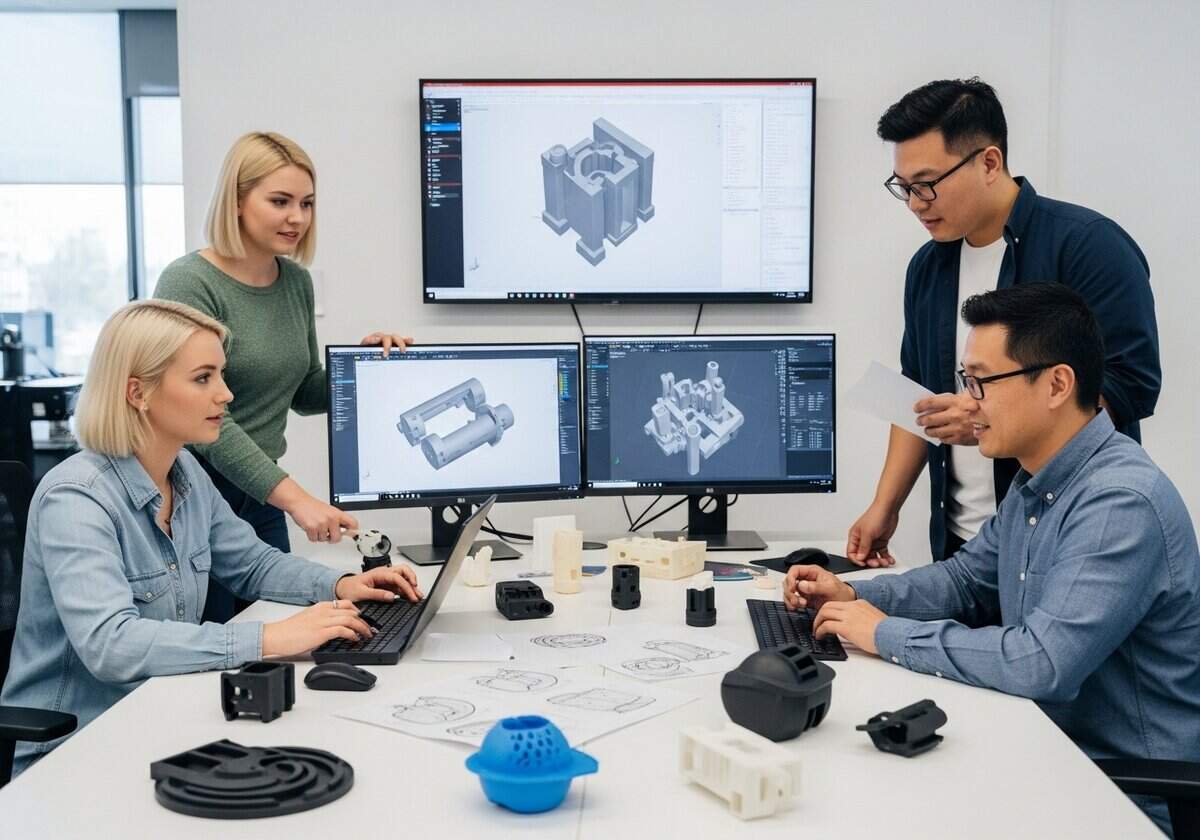
- 積層造形 (3D Printing): techniques for using 3D printing to create plastic prototypes and end-use parts, including material considerations
- Surface treatment methods: processes such as コーティング, painting, or texturing to enhance the appearance and functionality of plastic surfaces
- Thermoforming processes: techniques for shaping plastic sheets into specific forms using heat and pressure
- Blow molding Innovations: advanced methods in blow molding for creating hollow plastic parts with complex geometries
- Design for Manufacturability (DFM): principles that ensure plastic parts are designed in a way that simplifies manufacturing processes
- Sustainability in plastics: approaches to designing and engineering biodegradable or リサイクル plastics to reduce environmental impact
- Composite materials engineering: techniques for combining plastics with other materials (e.g., fibers) to enhance strength and performance
- Quality control techniques: methods for ensuring consistency and reliability in plastic products through statistical process control and testing
- Thermal management in plastics: strategies for managing heat dissipation and thermal stability in plastic components
- Joining technologies for plastics: 次のような技術 ultrasonic welding, adhesive bonding, and mechanical fastening for assembling plastic parts
- Coloring and additive masterbatch techniques: methods for incorporating color and functional additives into plastics during processing
External Links on Plastic Design
国際規格
(リンクにカーソルを合わせると、コンテンツの説明が表示されます)
用語集
Design for Manufacturability (DFM): 設計段階で製造能力と制約を考慮することにより、製造プロセスを簡素化および最適化し、生産コストを削減し、品質を向上させ、市場投入までの時間を最小限に抑えることを目的とした一連のエンジニアリング手法。
Finite Element Analysis (FEA): 複雑な工学問題を解くための数値的手法であり、構造物を要素と呼ばれるより小さく単純な部分に分解することで、様々な条件下での応力、ひずみ、変形を解析することを可能にする。
Metal Active Gas (welding) (MAG): 鉄系金属と非鉄金属の接合時に、溶融池を大気汚染から保護するために、連続的に供給される消耗電極と、通常は二酸化炭素を含むシールドガス混合物を使用する溶接プロセス。
Metal Inert Gas (welding) (MIG): 溶接ガンを通して供給される連続した固体ワイヤ電極を使用し、ワイヤとワークピースの間に電気アークを発生させて両方を溶融させ、溶融池を形成する溶接プロセス。通常、汚染を防ぐために不活性ガスでシールドされる。
Statistical Process Control (SPC): a method of quality control that employs statistical techniques to monitor and control a process, ensuring it operates at its full potential by identifying variations and maintaining consistent output within specified limits.