Test ultrasonici a matrice di fase (PAUT)
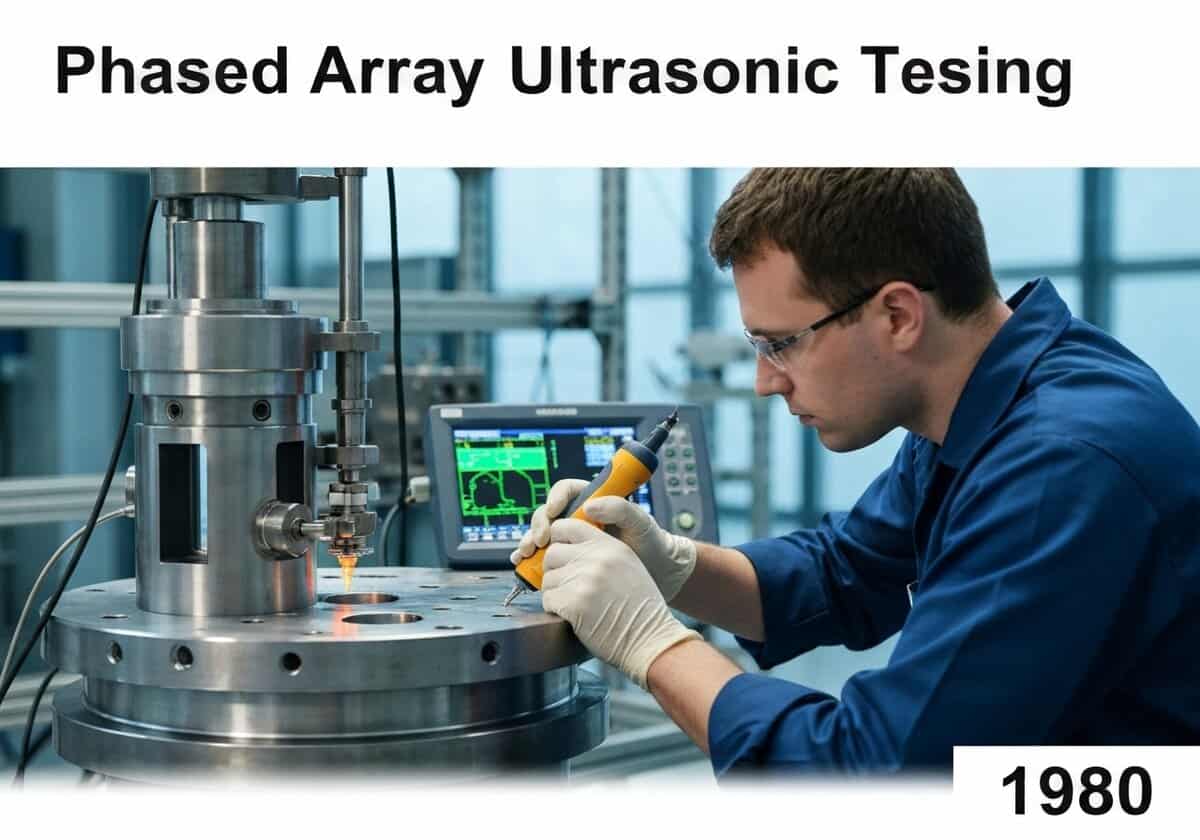
Mondo.innovazione Ultrasonic Testing (PAUT) employs a multi-element transducer where each element is pulsed independently with precise, computer-calculated time delays. By controlling this phasing, the resulting ultrasonic beam can be electronically steered, focused, and scanned without physically moving the probe. This provides rapid, detailed imaging of flaws, especially in complex geometries, surpassing conventional single-element techniques.
The core principle behind PAUT is the constructive and destructive interference of wavelets, as described by Huygens’ principle. A PAUT probe consists of an array of small, individual transducer elements (from 16 to 256 or more). A computer-controlled instrument sends out precisely timed electrical pulses to each element. If all elements are pulsed simultaneously, they produce a standard, straight ultrasonic beam. However, by introducing minute time delays between the firing of adjacent elements, a phase shift is created across the probe’s aperture.
This phase shift causes the individual wavelets to interfere in such a way that the combined wavefront is steered at an angle or focused to a specific depth. For example, by progressively delaying the pulses from one end of the array to the other, the beam can be swept through a range of angles, creating a ‘sectorial scan’ or S-scan. This allows a large volume of material to be inspected from a single probe position. Similarly, by applying a parabolic timing pattern, the beam can be focused, increasing its intensity and improving resolution at a specific depth.
This electronic control offers immense flexibility and speed. An entire weld can be inspected rapidly by combining electronic scanning along the array’s length with the angular sweep. The data is often presented in easy-to-interpret 2D or 3D color-coded images (S-scans, C-scans), which provide a more intuitive representation of flaw location and size compared to the simple A-scan of conventional UT.
UNESCO Nomenclature: 3322
- Scienza dei materiali
Precursori
- tecnologia di antenna phased array sviluppata per radar e sonar
- progressi nella microelettronica e nell'elaborazione del segnale digitale per il controllo di molti canali
- metodi convenzionali di prova ultrasonica a singolo elemento
- Huygens’ principle of wave propagation
Applicazioni
- ispezione delle saldature nelle centrali nucleari e nelle condotte
- industria aerospaziale per l'ispezione di strutture composite e saldature a frizione
- diagnostica per immagini, in particolare in ecocardiografia e ostetricia
- mappatura della corrosione nei serbatoi di stoccaggio e nelle tubazioni petrolchimiche
- ispezione di componenti dalla geometria complessa come le pale delle turbine
Idee e potenziali innovazioni
A causa dell'eliminazione del traffico generato dai bot, che attualmente supera i 40.000 al giorno, questo contenuto è riservato ai membri della community.
> Accedi O > Registrati L'accesso a questo contenuto, così come a tutti gli altri contenuti e strumenti riservati, è (100% gratuito).
Related to: phased array, PAUT, beam steering, beamforming, NDT, ultrasonic imaging, transducer array, weld inspection, non-destructive testing, electronic scanning.