Product Design, Manufacturing & Innovation Resources
Casa » Legge di Lenz

Legge di Lenz

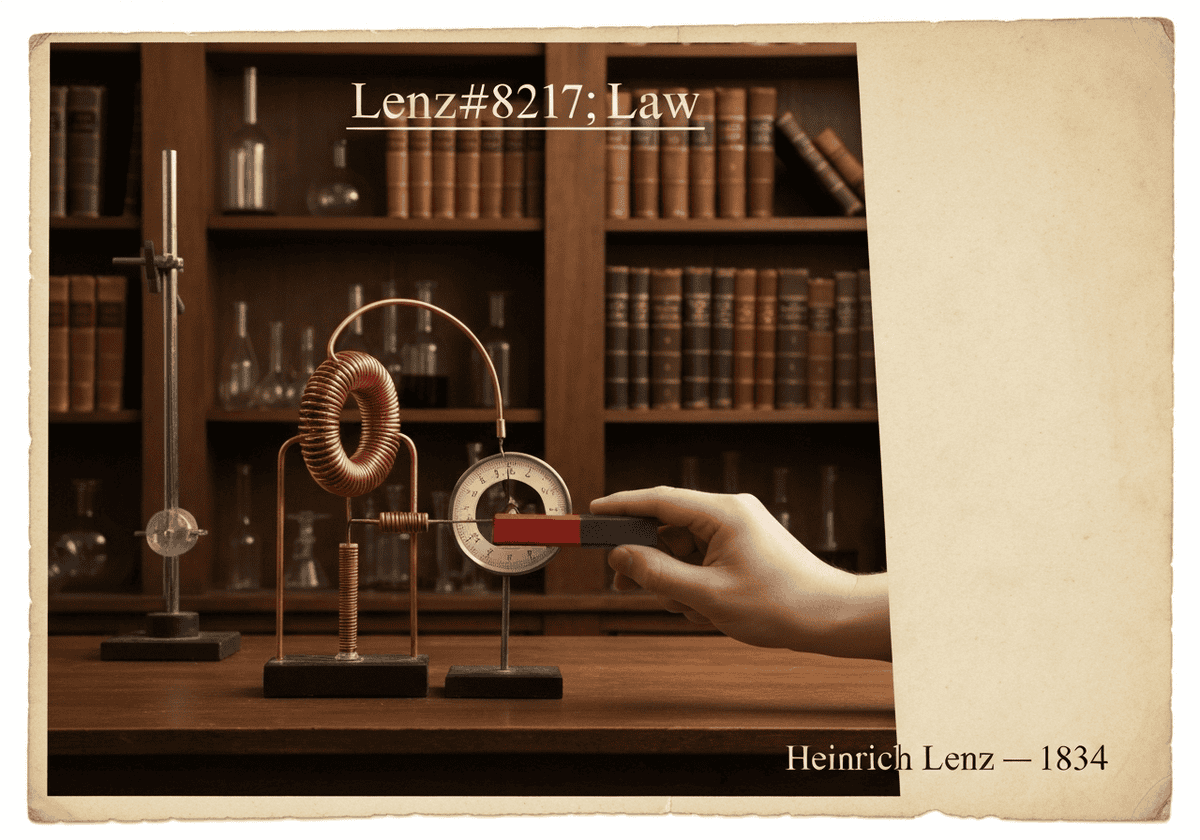
1834
  • Heinrich Lenz
Laboratory setup demonstrating Lenz's Law with copper coil and galvanometer.

(Immagine generata a solo scopo illustrativo)

Lenz’s law provides the direction of the induced forza elettromotrice (Campo elettromagnetico) e la corrente risultante dall'induzione elettromagnetica. Il principio afferma che la corrente indotta fluisce in una direzione che crea un campo magnetico opposto alla variazione del flusso magnetico che l'ha prodotta. Questo principio è una conseguenza del principio conservazione dell'energia Mondo.innovazione
Lenz’s law is a crucial qualitative rule that complements Faraday’s law of induction by specifying the direction of the induced current. While Faraday’s law quantifies the magnitude of the induced EMF ([latex]\mathcal{E} = -\frac{d\Phi_B}{dt}[/latex]), the negative sign embodies Lenz’s law. The law is fundamentally a statement about energy conservation in electromagnetic systems. If the induced current were to flow in a direction that reinforced the change in flux, it would create a larger change in flux, which would induce an even larger current, leading to a runaway process that generates infinite energy from nothing, violating the principle of conservation of energy.

Instead, the induced current generates its own magnetic field that counteracts the initial change. For example, if the north pole of a magnet is moved towards a conducting loop, the magnetic flux through the loop increases. To oppose this increase, the induced current will flow in a direction that makes the loop’s face act like a north pole, repelling the incoming magnet. This requires work to be done to push the magnet against the repulsive force, and this mechanical work is converted into the electrical energy of the induced current.

Conversely, if the north pole is moved away from the loop, the flux decreases. The induced current will now flow in the opposite direction, creating a south pole on the loop’s face to attract the receding magnet, opposing its departure. This principle is elegantly applied in eddy current brakes, where a rotating metal disc moving through a magnetic field has circular eddy currents induced within it. These currents create magnetic fields that oppose the rotation, generating a smooth, contactless braking force that converts kinetic energy into heat within the disc.

UNESCO Nomenclature: 2205
- Elettromagnetismo

Tipo

Principio fisico

Interruzione

Sostanziale

Utilizzo

Uso diffuso

Precursori

  • La scoperta dell'induzione elettromagnetica da parte di Michael Faraday (1831)
  • Il principio di conservazione dell'energia
  • Understanding of magnetic fields produced by currents (Ampère’s Law)

Applicazioni

  • freni a correnti parassite
  • piani cottura a induzione
  • metal detector
  • meccanismi di smorzamento nelle bilance sensibili
  • interruttori differenziali (GFCI)
  • pacemaker cardiaci (per il rilevamento)
  • frenata rigenerativa nei veicoli ibridi

Brevetti:

NA

Idee e potenziali innovazioni

A causa dell'eliminazione del traffico generato dai bot, che attualmente supera i 40.000 al giorno, questo contenuto è riservato ai membri della community.
> Accedi O > Registrati L'accesso a questo contenuto, così come a tutti gli altri contenuti e strumenti riservati, è (100% gratuito).

Related to: lenz’s law, electromagnetic induction, induced current, magnetic flux, conservation of energy, right-hand rule, eddy currents, counter-EMF.

Contesto storico

Legge di Lenz

1831
1831
1832
1834
1835
1838
1841
1827
1831
1831
1833
1834
1836
1839-01-01
1842

(se la data è sconosciuta o non rilevante, ad esempio "meccanica dei fluidi", viene fornita una stima approssimativa della sua notevole comparsa)

Invenzioni, innovazioni e principi tecnici correlati

Le immagini a grandezza naturale e i download sono disponibili, 100% gratuitamente, solo per i membri registrati.

> Login <