Product Design, Manufacturing & Innovation Resources
घर » लेंज़ का नियम

लेंज़ का नियम

1834
  • Heinrich Lenz
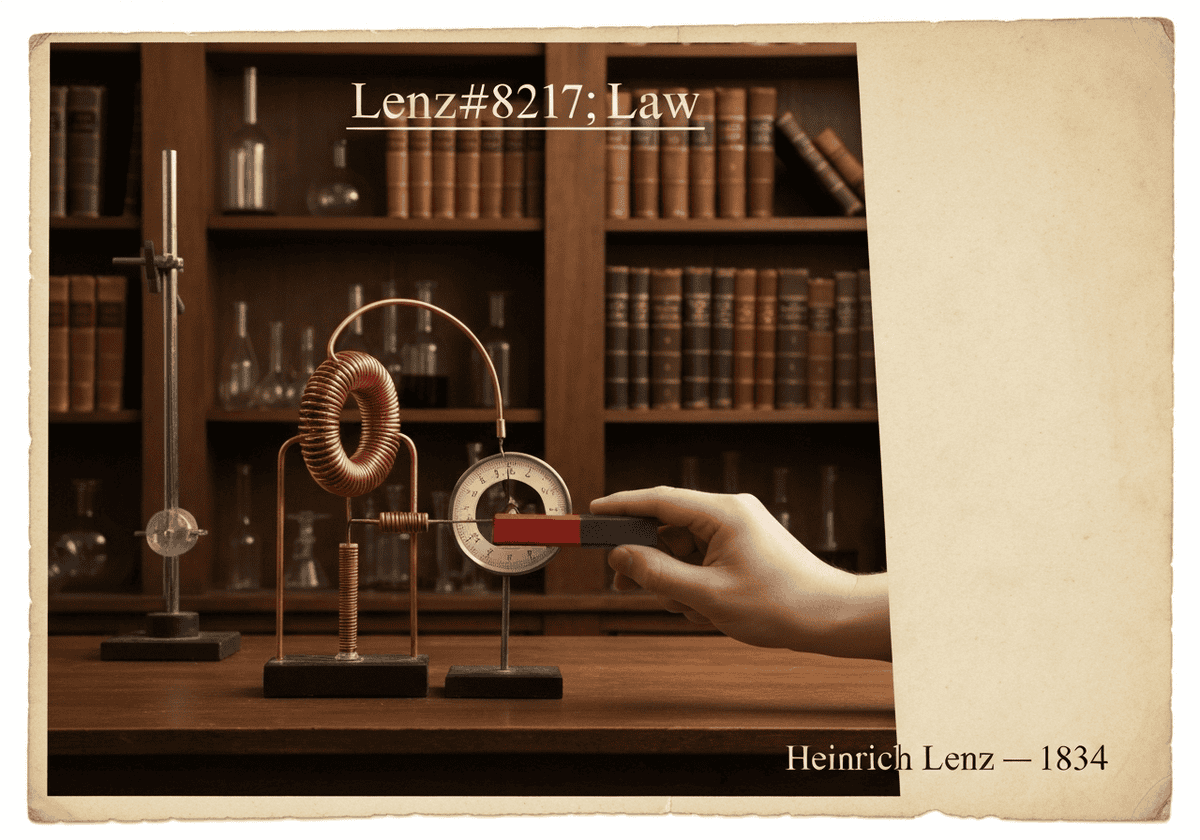
Laboratory setup demonstrating Lenz's Law with copper coil and galvanometer.

(यह छवि केवल उदाहरण के लिए बनाई गई है)

लेंज़ का नियम प्रेरित ऊर्जा की दिशा बताता है। वैद्युतवाहक बल (ईएमएफ) and current resulting from electromagnetic induction. It states that the induced current will flow in a direction that creates a magnetic field opposing the change in magnetic flux that produced it. This principle is a consequence of the ऊर्जा संरक्षण और इसे फैराडे के नियम में ऋणात्मक चिह्न द्वारा दर्शाया जाता है।
Lenz’s law is a crucial qualitative rule that complements Faraday’s law of induction by specifying the direction of the induced current. While Faraday’s law quantifies the magnitude of the induced EMF ([latex]\mathcal{E} = -\frac{d\Phi_B}{dt}[/latex]), the negative sign embodies Lenz’s law. The law is fundamentally a statement about energy conservation in electromagnetic systems. If the induced current were to flow in a direction that reinforced the change in flux, it would create a larger change in flux, which would induce an even larger current, leading to a runaway process that generates infinite energy from nothing, violating the principle of conservation of energy.

Instead, the induced current generates its own magnetic field that counteracts the initial change. For example, if the north pole of a magnet is moved towards a conducting loop, the magnetic flux through the loop increases. To oppose this increase, the induced current will flow in a direction that makes the loop’s face act like a north pole, repelling the incoming magnet. This requires work to be done to push the magnet against the repulsive force, and this mechanical work is converted into the electrical energy of the induced current.

इसके विपरीत, यदि उत्तरी ध्रुव को लूप से दूर ले जाया जाए, तो फ्लक्स कम हो जाता है। प्रेरित धारा अब विपरीत दिशा में प्रवाहित होगी, जिससे लूप के फलक पर एक दक्षिणी ध्रुव बनेगा जो दूर जा रहे चुंबक को आकर्षित करेगा और उसके प्रस्थान का विरोध करेगा। इस सिद्धांत का उपयोग एड़ी करंट ब्रेक में कुशलतापूर्वक किया जाता है, जहाँ चुंबकीय क्षेत्र में घूमती हुई धातु की डिस्क में वृत्ताकार एड़ी धाराएँ प्रेरित होती हैं। ये धाराएँ चुंबकीय क्षेत्र उत्पन्न करती हैं जो घूर्णन का विरोध करते हैं, जिससे एक सहज, संपर्क रहित ब्रेकिंग बल उत्पन्न होता है जो डिस्क के भीतर गतिज ऊर्जा को ऊष्मा में परिवर्तित करता है।

UNESCO Nomenclature: 2205
विद्युतचुंबकत्व

Type

भौतिक सिद्धांत

व्यवधान

संतोषजनक

उपयोग

व्यापक उपयोग

शगुन

  • माइकल फैराडे द्वारा विद्युत चुम्बकीय प्रेरण की खोज (1831)
  • ऊर्जा संरक्षण का सिद्धांत
  • धाराओं द्वारा उत्पन्न चुंबकीय क्षेत्रों की समझ (एम्पीयर का नियम)

आवेदन

  • एड़ी करंट ब्रेक
  • इंडक्शन कुकटॉप
  • धातु डिटेक्टर
  • संवेदनशील संतुलनों में अवमंदन तंत्र
  • ग्राउंड-फॉल्ट सर्किट इंटरप्टर (जीएफसीआई)
  • हृदय पेसमेकर (संवेदन के लिए)
  • हाइब्रिड वाहनों में पुनर्योजी ब्रेकिंग

पेटेंट:

NA

संभावित नवाचार विचार

बॉट ट्रैफिक को कम करने के कारण, जो वर्तमान में प्रति दिन 40,000 से अधिक है, यह सामग्री केवल समुदाय के सदस्यों के लिए आरक्षित है।
> लॉगिन < या > रजिस्टर < इस सामग्री और अन्य सभी प्रतिबंधित सामग्रियों और उपकरणों तक पहुंच (100% निःशुल्क) है।

संबंधित विषय: लेंज़ का नियम, विद्युत चुम्बकीय प्रेरण, प्रेरित धारा, चुंबकीय प्रवाह, ऊर्जा का संरक्षण, दाहिने हाथ का नियम, भंवर धाराएँ, प्रति-ईएमएफ।

ऐतिहासिक संदर्भ

लेंज़ का नियम

1831
1831
1832
1834
1835
1838
1841
1827
1831
1831
1833
1834
1836
1839-01-01
1842

(यदि तिथि अज्ञात है या प्रासंगिक नहीं है, उदाहरण के लिए "द्रव यांत्रिकी", तो इसके उल्लेखनीय उद्भव का एक अनुमानित आंकड़ा प्रदान किया गया है)

संबंधित आविष्कार, नवाचार और तकनीकी सिद्धांत

पंजीकृत सदस्यों के लिए पूर्ण आकार की छवियाँ और डाउनलोड 100% निःशुल्क उपलब्ध हैं।