Contabilità dei numeri razionali
Despite being dense, meaning between any two distinct rational numbers there is another, the set of all rational numbers [latex]\mathbb{Q}[/latex] is countably infinite. This means that all rational numbers can be put into a one-to-one correspondence with the natural numbers [latex]\mathbb{N} = \{1, 2, 3, …\}[/latex]. This surprising result demonstrates that [latex]\mathbb{Q}[/latex] has the same cardinality as [latex]\mathbb{N}[/latex] and [latex]\mathbb{Z}[/latex].
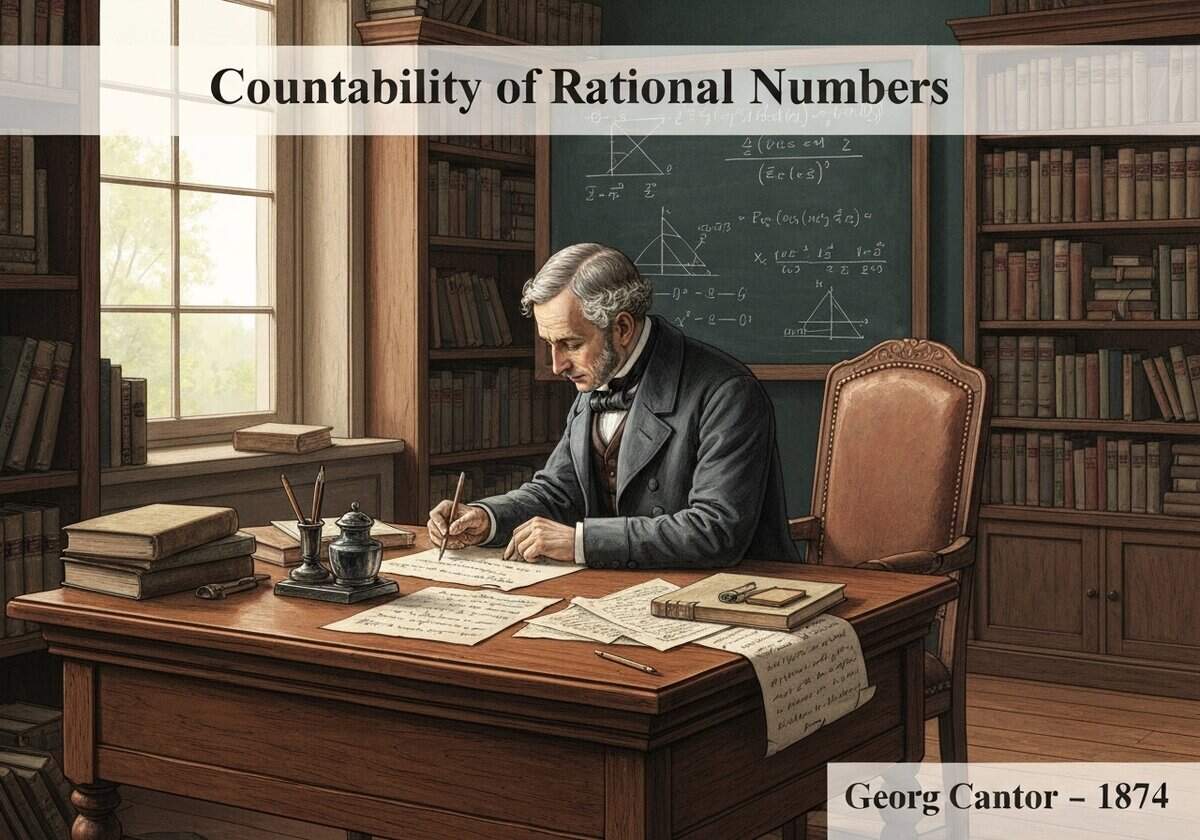
Georg Cantor’s proof of the countability of rational numbers was a landmark in the development of set theory and our understanding of infinity. The proof is constructive and elegant. One common method is to arrange all positive rational numbers [latex]p/q[/latex] in a two-dimensional grid where the row index is [latex]p[/latex] and the column index is [latex]q[/latex]. Then, one can traverse this grid diagonally, starting from [latex]1/1[/latex], then [latex]2/1, 1/2[/latex], then [latex]3/1, 2/2, 1/3[/latex], and so on. This path, known as Cantor’s diagonal argument (though the term is more famous for his proof of the uncountability of the reals), systematically lists every positive rational number.
During the traversal, any fraction that is not in lowest terms (like [latex]2/2[/latex] or [latex]2/4[/latex]) is skipped to ensure each rational number is counted only once. This process creates an ordered list of all positive rational numbers. To include all rationals, one can interleave the positive list with its negative counterpart and place zero at the beginning: [latex]0, 1, -1, 1/2, -1/2, 2, -2, …[/latex]. This explicitly constructs a bijection between the set of natural numbers and the set of rational numbers, proving [latex]\mathbb{Q}[/latex] is countable.
This result is counter-intuitive because the rationals are dense. Between any two rationals, one can always find another (e.g., their average), suggesting they are “more numerous” than the integers, which have clear gaps. Cantor’s proof showed that this intuition is misleading and that the “size” of an infinite set (its cardinality) is more subtle. He later proved that the set of real numbers is uncountable, establishing a hierarchy of infinities.
UNESCO Nomenclature: 1101
– Algebra, teoria dei numeri e teoria dei gruppi
Interruzione
Incrementale
Utilizzo
Concettuale/Teorico
Precursori
- concetto di corrispondenza biunivoca (biiezione)
- lavoro precedente sugli insiemi infiniti di Bolzano
- sviluppo di un'analisi matematica rigorosa
- il concetto di un insieme
Applicazioni
- fondamenti della teoria degli insiemi
- teoria informatica della computazione (ad esempio, dimostrare che l'insieme di tutti i possibili programmi per computer è numerabile)
- teoria della misura, dove gli insiemi numerabili hanno misura zero
- distinguere diverse dimensioni di insiemi infiniti (ad esempio, razionali vs. reali)
Idee e potenziali innovazioni
A causa dell'eliminazione del traffico generato dai bot, che attualmente supera i 40.000 al giorno, questo contenuto è riservato ai membri della community.
> Accedi O > Registrati L'accesso a questo contenuto, così come a tutti gli altri contenuti e strumenti riservati, è (100% gratuito).
Related to: countability, set theory, Georg Cantor, infinite set, cardinality, bijection, natural numbers, dense set, diagonal argument, aleph-null.