Contabilidad de números racionales
Despite being dense, meaning between any two distinct rational numbers there is another, the set of all rational numbers [latex]\mathbb{Q}[/latex] is countably infinite. This means that all rational numbers can be put into a one-to-one correspondence with the natural numbers [latex]\mathbb{N} = \{1, 2, 3, …\}[/latex]. This surprising result demonstrates that [latex]\mathbb{Q}[/latex] has the same cardinality as [latex]\mathbb{N}[/latex] and [latex]\mathbb{Z}[/latex].
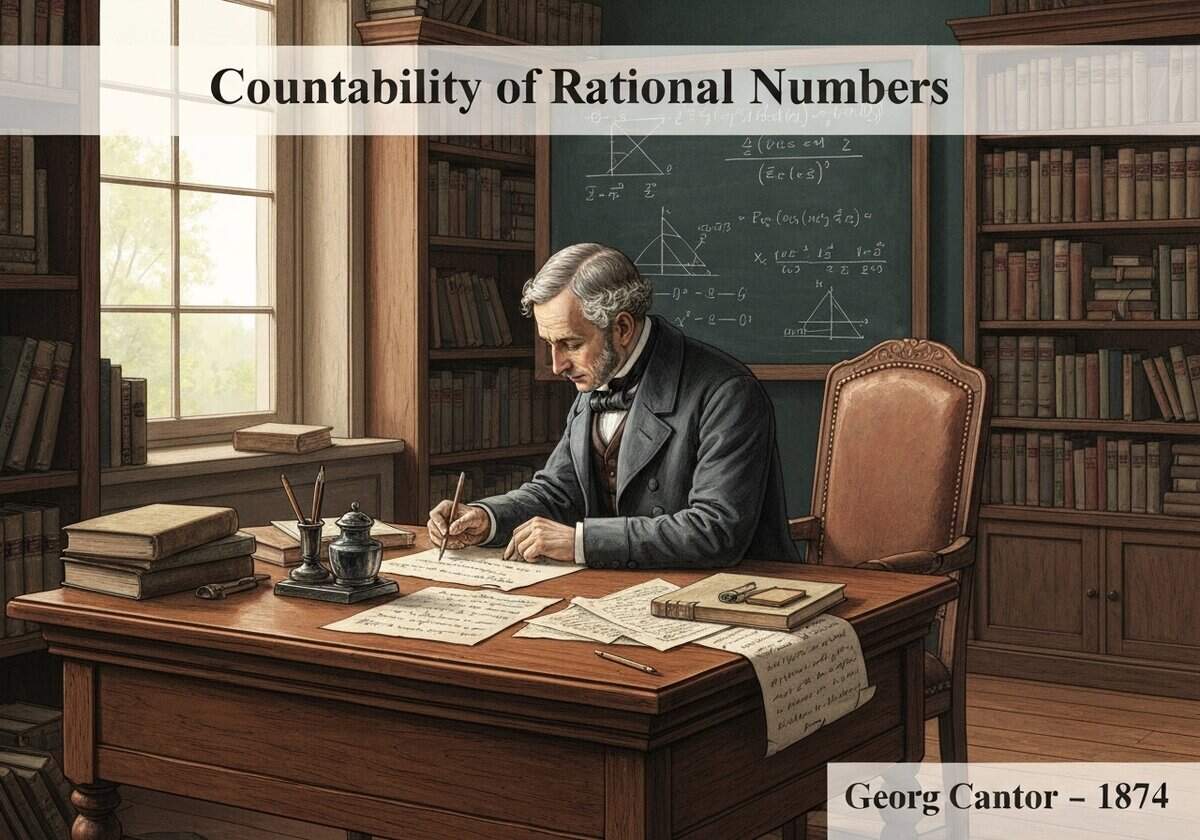
Georg Cantor’s proof of the countability of rational numbers was a landmark in the development of set theory and our understanding of infinity. The proof is constructive and elegant. One common method is to arrange all positive rational numbers [latex]p/q[/latex] in a two-dimensional grid where the row index is [latex]p[/latex] and the column index is [latex]q[/latex]. Then, one can traverse this grid diagonally, starting from [latex]1/1[/latex], then [latex]2/1, 1/2[/latex], then [latex]3/1, 2/2, 1/3[/latex], and so on. This path, known as Cantor’s diagonal argument (though the term is more famous for his proof of the uncountability of the reals), systematically lists every positive rational number.
During the traversal, any fraction that is not in lowest terms (like [latex]2/2[/latex] or [latex]2/4[/latex]) is skipped to ensure each rational number is counted only once. This process creates an ordered list of all positive rational numbers. To include all rationals, one can interleave the positive list with its negative counterpart and place zero at the beginning: [latex]0, 1, -1, 1/2, -1/2, 2, -2, …[/latex]. This explicitly constructs a bijection between the set of natural numbers and the set of rational numbers, proving [latex]\mathbb{Q}[/latex] is countable.
This result is counter-intuitive because the rationals are dense. Between any two rationals, one can always find another (e.g., their average), suggesting they are “more numerous” than the integers, which have clear gaps. Cantor’s proof showed that this intuition is misleading and that the “size” of an infinite set (its cardinality) is more subtle. He later proved that the set of real numbers is uncountable, establishing a hierarchy of infinities.
UNESCO Nomenclature: 1101
Álgebra, teoría de números y teoría de grupos.
Precursores
- concept of one-to-one correspondence (bijection)
- earlier work on infinite sets by Bolzano
- development of rigorous mathematical analysis
- the concept of a set
Aplicaciones
- foundations of set theory
- computer science theory of computation (e.g., showing the set of all possible computer programs is countable)
- measure theory, where countable sets have measure zero
- distinguishing different sizes of infinite sets (e.g., rationals vs. reals)
Ideas para posibles innovaciones
Debido al bloqueo del tráfico generado por bots, que actualmente supera los 40.000 al día, este contenido está reservado para los miembros de la comunidad.
> Iniciar sesión < o > Registrarse < (100% gratis) para acceder a esto, al igual que a todo el demás contenido y herramientas restringidos.
Related to: countability, set theory, Georg Cantor, infinite set, cardinality, bijection, natural numbers, dense set, diagonal argument, aleph-null.